Following Up After Sending a Resume Through Professional Connections
You've sent your resume through a professional connection, now you're in limbo. Did it get lost in their inbox? Should you message them again? How long do you wait before you seem desperate?

You've sent your resume through a professional connection, now you're in limbo. Did it get lost in their inbox? Should you message them again? How long do you wait before you seem desperate? The silence is the worst part. Following up after sending a resume through professional connections is not just polite, it's strategic. The right follow-up keeps your application visible, shows genuine interest, and often makes the difference between getting forgotten and landing the interview.
Photo by RDNE Stock project from Pexels
TL;DR
- Follow up 5-7 days after sending your resume through a professional connection, then again 2-3 weeks later if you hear nothing.
- Keep follow-up messages brief, specific, and friendly, reference the original conversation and the role.
- Balance confidence with respect; show interest without urgency or neediness.
- Use templates but personalize them; generic follow-ups get skipped.
- Stay open to feedback; if your contact offers suggestions, act on them visibly.
When you send a resume through a personal connection, you've already cleared the biggest hurdle: you're not cold. That introduction matters. But inertia kills momentum. Most people don't follow up at all, they assume silence means "no", or they follow up too aggressively and kill the goodwill they started with. The reality is somewhere in the middle. Strategic, respectful follow-up reminds your contact you're serious, keeps you top-of-mind, and often surfaces useful feedback that helps you improve your chances at this company or the next one.
When Should You Follow Up?
Timing matters. Too soon and you seem impatient. Too late and you've faded from memory.
The first follow-up should come 5-7 days after sending your resume. This window is short enough that your contact still remembers the conversation and the role, but long enough that they've had time to look at your materials. It's specific and respectful, you're not demanding an answer, just checking in to confirm they received it.
If you don't hear back after that first follow-up, wait another 10-14 days, then send a second one. This is your last meaningful touch before accepting that the answer might be no. After two genuine follow-ups with no response, the silence is telling you something. It's time to move on to other prospects.
The gap between follow-ups matters too. You're not hunting the person down, you're staying present. Think of it as occasionally raising your hand in a crowded room, not waving frantically.
Crafting the Follow-Up Message

The best follow-up message is short, specific, and reminds the reader why they wanted to help you in the first place.
Start by referencing the original context. Don't write "Hi, I wanted to follow up on the resume I sent." Instead: "Hi Sarah, thanks again for connecting me with the Product Manager role at TechCorp, I wanted to check in on the materials I sent over last week."
That one line does three things: names the person, reminds them of the specific role, and references the relationship you already have.
Then add a reason to respond. Don't just say "Did you look at my resume?" Instead, give them something easy to engage with:
- "I noticed TechCorp recently launched their new analytics dashboard, that's exactly the kind of end-to-end product work I want to focus on."
- "I came across an article about your team's approach to user testing and wanted to share how I've applied similar methods in my past role."
- "I realized I didn't mention my experience with [specific tool/skill] in our conversation, but it's directly relevant to what you described."
Keep it under 100 words. Hiring managers and busy professionals receive dozens of messages daily. Brevity is respect.
End with a clear, low-pressure ask: "Would you have time for a quick 15-minute call to discuss what the role involves?" or "If you have any questions about my background, I'm happy to clarify." Make it easy to say yes without them feeling obligated.
Here's the skeleton:
- Greeting + specific role reference
- One concrete reason you're interested in this role or company
- A soft ask (call, feedback, or next step)
- Sign-off
"The follow-up email that got me the job (and the one that didn't) 📧
BAD follow-up (my actual email from 2019): "Thank you for your time yesterday."
>, How to Follow Up After Submitting a Resume
Tone: Confident but Respectful
The biggest mistake in follow-up emails is overthinking the tone. You swing between two extremes: either you sound desperate and needy, or you sound arrogant and entitled.
Aim for the middle. You're a professional checking in on something you both discussed. There's no shame in that. Your contact offered to pass your resume along, they want to help. Your job is to make that help easy.
Avoid phrases that kill your credibility:
- "I'm sure you're very busy..." (you don't need to apologize for their time)
- "I hope this isn't bothering you..." (it isn't, you're being professional)
- "Just checking in..." (vague and passive)
- "I really need this job..." (their problem to solve, not yours)
- "Let me know if you find time..." (puts the burden on them)
- "I wanted to follow up on..."
- "I'm excited about this role because..."
- "I'd love to discuss..."
- "I'm happy to provide any additional information you need."
- "Looking forward to hearing from you."
Keeping the Conversation Open
Sometimes your first follow-up triggers a response, but not the one you want. Your contact might say: "The hiring team is still reviewing," or "I'll keep an eye out for similar roles," or even "This particular role went in a different direction." Now what?
Don't disappear. This is where most people give up. They hear "not right now" and treat it like a "no forever."
If you get a delay, accept it gracefully: "Thanks for keeping me updated. I appreciate the heads-up, feel free to reach out if priorities shift." Then move on to other applications. No need to follow up again on this specific role.
If you hear they went a different direction, ask for feedback: "I'd appreciate any insight into what direction they went. It would help me understand where I could strengthen my candidacy for future roles here." This serves two purposes. First, you get intel that helps you improve. Second, you stay on good terms with your contact. People move roles, roles open up, and your contact might refer you somewhere else.
If they say they're keeping your resume on file, take them at their word but stay visible. Connect with them on LinkedIn if you haven't already. Engage with their posts occasionally. When something relevant to your skills hits the news, send them a brief message with a link: "Saw this article on [topic] and thought of our conversation about [specific skill]." That's not pushy, that's staying genuinely connected.
The goal is to turn a single introduction into an ongoing relationship. Most hiring happens through networks, and networks require maintenance.
Follow-Up Email Templates
Use these as starting points, not scripts. Real personalization makes the difference.
Template 1: First Follow-Up (5-7 days)
Subject line: "Following up on [Role Title] at [Company]"
Hi [Name],
Thanks so much for passing my resume along to [Hiring Manager] for the [Role Title] position at [Company]. I sent the materials over last week and wanted to check in on the status.
I'm particularly drawn to this role because [one specific reason, product direction, team composition, technical challenge, etc.]. It aligns perfectly with [specific aspect of your background].
Would [Hiring Manager] be open to a brief conversation? I'd love to discuss how my experience with [specific skill/project] could contribute to the team.
Thanks for your help on this.
Best,
[Your name]
Template 2: Second Follow-Up (after 2-3 weeks of silence)
Subject line: "Quick follow-up on the [Role Title] role"
Hi [Name],
I realized I didn't hear back on the follow-up I sent a couple weeks ago, no worries, I know how busy things get.
I wanted to circle back and let you know I'm still very interested in the [Role Title] role. If the timing isn't right with this particular opening, I'd be grateful for any feedback on my application or suggestions for other opportunities at [Company] that might be a good fit.
I'm happy to chat at your convenience.
Thanks again,
[Your name]
Template 3: If You Get a Delay
Subject line: "RE: [Role Title] status"
Hi [Name],
Thanks for the update. I appreciate you keeping me in the loop, and I understand the timeline can shift. Feel free to reach out whenever the next steps are clearer. I remain excited about the role and [Company].
Best,
[Your name]
Template 4: If You Get Rejected (and Want to Stay Connected)
Subject line: "RE: [Role Title] decision"
Hi [Name],
Thanks for letting me know. I'm disappointed, but I appreciate the feedback and the opportunity to be considered.
Would you be open to sharing what direction the team went? I'd love to understand how I could better position myself for future opportunities at [Company] or in similar roles elsewhere.
Looking forward to staying in touch.
Best,
[Your name]
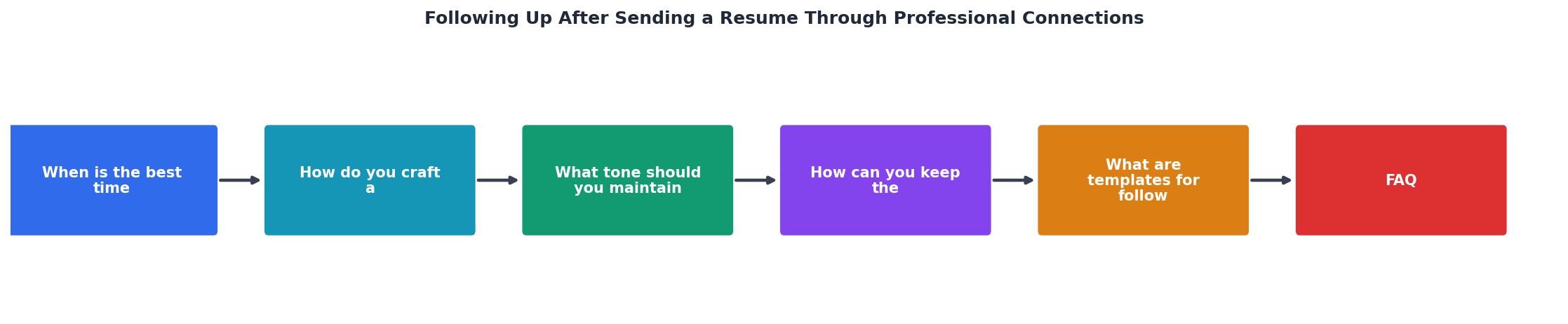
The Follow-Up Process at a Glance
Interactive Follow-Up Strategy Tracker
To help you visualize your follow-up timeline and outcomes, here's a quick reference tool showing the typical follow-up path and decision points:
Follow-Up Timeline Strategy
Pass resume to contact; confirm they received it.
Send personalized message; reference specific role and company detail.
Did they reply? If yes, engage actively. If no, prepare second follow-up.
Final attempt; ask for feedback or timeline. Be graceful about potential rejection.
If silence continues, assume "no" and focus energy on other prospects. Stay connected on LinkedIn.
Follow-Up Email Checklist
Your progress is saved automatically in your browser.
FAQ
Frequently Asked Questions
Next Steps
You've sent your resume through the right person. Now your job is to follow up in a way that keeps you visible without being annoying, that shows confidence without arrogance, and that reminds your contact why they wanted to help you in the first place. The best follow-ups are specific, brief, and give people a reason to respond.
Before you send a resume through a professional connection again, consider making it as polished as possible. Use Resume Hedgehog to tailor your resume to the specific job description, ensuring it's ATS-friendly and packed with the keywords and skills the hiring team will actually screen for. The stronger your resume, the less you have to worry about your follow-up carrying the weight. Your materials do the talking, the follow-up just keeps the conversation alive.
Additional Resources
- How to Follow Up After Submitting a Resume - Respect timelines: Wait a few days before following up, and always keep your note polite, brief, and professional to avoid sounding impatient or pushy.
- How To Write a Follow-Up Email After a Job Application - A strong follow-up email should be concise and professional, include a clear subject line, highlight relevant qualifications, and include a ...
- Networking & The Art of Following Up - Experts suggest sending a follow-up within 24 hours, as many hiring decisions are made shortly after the interview process. For networking connections, send ...
Get the 356 complete recruitment audit (free PDF)
Download the free PDF with 356 reasons hiring stalls, plus optional daily email tips. No credit card.
Get the free PDF 356 reasons · Free download