Highlighting Key Aspects in First Job Marketing Resumes
You finished your marketing degree, ran a campus Instagram account, maybe even completed an internship at a local agency. Now you stare at a blank resume template and wonder which of those experiences actually matters to a hiring manager. The gap between what you have done and what recruiters want to see is smaller than you think. This guide walks through the exact sections, skills, and formatting choices that turn a thin entry-level resume into one that earns interviews.


You finished your marketing degree, ran a campus Instagram account, maybe even completed an internship at a local agency. Now you stare at a blank resume template and wonder which of those experiences actually matters to a hiring manager. The gap between what you have done and what recruiters want to see is smaller than you think. This guide walks through the exact sections, skills, and formatting choices that turn a thin entry-level resume into one that earns interviews.
Photo by Sora Shimazaki from Pexels
TL;DR:- Lead with a skills section that mirrors the job posting's language, especially digital marketing and analytics keywords.
- Treat internships, class projects, and freelance gigs as legitimate professional experience with measurable results.
- Tailor every resume to the specific marketing role using tools like Resume Hedgehog so the ATS sees a match before a human ever reads it.
What belongs on a marketing resume
A first-job marketing resume needs five clear sections: a professional summary, a skills section, an experience block (internships, freelance, campus roles), an education section, and a certifications or tools list. Skip the objective statement. Recruiters spend roughly six seconds on an initial scan, and a two-line summary that names the target role plus one or two measurable wins beats a vague objective every time.
Your skills section does the heaviest ATS lifting. Marketing job postings commonly mention terms like SEO, Google Analytics, content strategy, CRM platforms, and email marketing. If you have used any of these, list them explicitly. An ATS cannot infer that "managed the club newsletter" means email marketing unless you say so.
Education goes near the top while you have fewer than two years of experience. Include your degree, relevant coursework (Consumer Behavior, Marketing Analytics, Digital Advertising), and your GPA if it is above 3.3. After a year or two in the field, education slides to the bottom.
Emphasize digital marketing skills

Digital skills separate entry-level candidates who can contribute on day one from those who need weeks of onboarding. Here is what to highlight and how:
- SEO and SEM - Mention specific tools: Google Search Console, Ahrefs, SEMrush. If you optimized blog posts for a class project and saw ranking improvements, state the numbers.
- Social media management - Name the platforms (Instagram, TikTok, LinkedIn) and any scheduling tools (Hootsuite, Buffer, Later). Include follower growth percentages or engagement rate changes.
- Email marketing - Platforms like Mailchimp, HubSpot, or Constant Contact. Even a campus newsletter counts when you frame it with open rates and subscriber counts.
- Analytics - Google Analytics 4 certification is free and takes a weekend. It instantly signals data literacy.
- Content creation - Canva, Adobe Creative Suite, WordPress, or video editing tools. Specify what you built: infographics, landing pages, short-form video.
Showcase internships and projects

Internships are your strongest asset. Treat each one like a full job entry: company name, title, dates, and three to four bullet points starting with action verbs. The formula is Action + Task + Result.
"Achieved a 30% increase in email open rates and a 25% rise in click-through rates by implementing A/B testing and refining email content strategies.">, Guide to Writing a Winning Marketing Resume
That single bullet point tells a recruiter three things: you know A/B testing, you understand email metrics, and you deliver measurable improvement. Apply the same structure to your own experience.
No internship? Class projects, freelance clients, and personal projects fill the gap:
- Capstone campaign for a real local business counts as consulting experience.
- Personal blog with documented traffic growth shows content marketing skills.
- Volunteer social media management for a nonprofit demonstrates real-world platform knowledge.
Tailor sections to specific roles

A resume for a Social Media Coordinator role looks different from one targeting a Marketing Analyst position. The core facts stay the same, but emphasis shifts.
| Social Media Coordinator | Marketing Analyst |
|---|---|
| Platform management skills first | Analytics and data tools first |
| Engagement metrics highlighted | Conversion and ROI metrics highlighted |
| Content creation tools prominent | SQL, Excel, Tableau prominent |
| Creative portfolio link included | Case study or report sample linked |
This is where tailoring each application pays off. Reading a job description, pulling out the top five to eight required skills, and reordering your resume to lead with those skills takes about 20 minutes manually. Resume Hedgehog automates that process: upload your base resume, paste the job description, and get back a version that matches the posting's language and priorities.
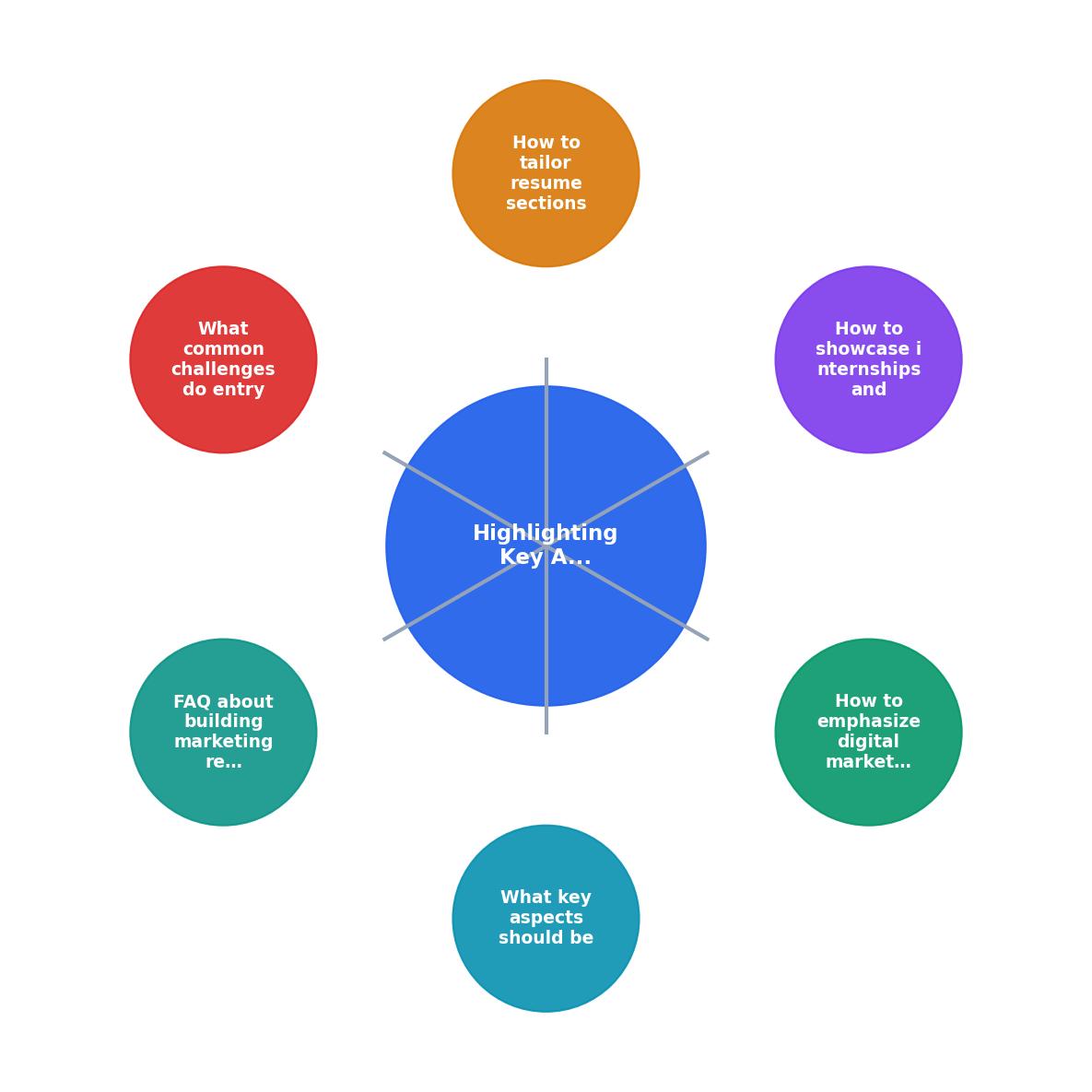
The process follows four steps: Identify keywords from the posting, Reorder skills to match priority, Rewrite bullets with matching terminology, and Verify ATS compatibility before submitting.
Common entry-level challenges
Every new grad faces the same set of obstacles. Knowing them in advance lets you plan around them.
- "Requires 2-3 years experience" - Apply anyway. Entry-level postings with low experience requirements often accept strong internship backgrounds. Frame your internship months as cumulative experience.
- Generic resume syndrome - Sending the same PDF to 50 companies produces silence. Tailored resumes convert at a significantly higher rate.
- Keyword blindness - You used the skill but called it something different. Read job postings carefully and adopt their vocabulary.
- Overloaded design - Creative marketing resumes with columns, icons, and color blocks often break ATS parsing. Stick to a single-column layout with standard headings until you confirm the company uses human-first screening.
The following interactive card summarizes the key resume sections and their priority for a typical entry-level marketing application:
Entry-Level Marketing Resume Sections
Resume template for entry-level marketing
Entry-Level Marketing Resume Checklist
Your progress is saved automatically in your browser.
FAQ
Frequently Asked Questions
What section of your marketing resume are you finding hardest to write? Share your challenge below and let's work through it together.
Additional Resources
- The Ultimate Guide to Writing a Winning Marketing Resume - Your understanding of the role; Your most pertinent achievements; Relevant keywords; Customized information that speaks to the specific ...
- 14 Key Marketing Skills for Your Resume (Plus Examples) - Knowing how to highlight relevant skills on your resume can help you get a job in the marketing field.In this article, we list 14 key marketing ...
- 15 Essential Skills to Include On Your Resume for a Marketing ... - For marketing jobs, an essential skill to highlight on your resume is technical proficiency, specifically expertise in a marketing tool. It's ...
Get the 356 complete recruitment audit (free PDF)
Download the free PDF with 356 reasons hiring stalls, plus optional daily email tips. No credit card.
Get the free PDF 356 reasons · Free download