Improving Resumes After Career Transition Feedback
You asked a recruiter, a mentor, or an AI tool to review your career-change resume and got a wall of suggestions back. Some contradict each other. Some feel impossible to act on when your entire work history is in a different field. The good news is that feedback is the single fastest way to close the gap between where your resume is and where it needs to be, and there is a clear method for turning those notes into a stronger document.


You asked a recruiter, a mentor, or an AI tool to review your career-change resume and got a wall of suggestions back. Some contradict each other. Some feel impossible to act on when your entire work history is in a different field. The good news is that feedback is the single fastest way to close the gap between where your resume is and where it needs to be, and there is a clear method for turning those notes into a stronger document.
Photo by Mikhail Nilov from Pexels
TL;DR:- Prioritize feedback that highlights transferable skills and aligns your language with the target industry.
- Follow a structured revision cycle: categorize notes, draft changes, get a second review, then finalize.
- Address contradictory or confusing feedback by mapping each suggestion to a specific job requirement.
Why feedback matters more for career changers
Most job seekers treat resume feedback as a nice-to-have. For career changers, it is a necessity. Your resume was written for one audience and now needs to speak to a completely different one. Without outside input, you will keep using the vocabulary, metrics, and framing of your old field.
"By some estimates, 70 percent of large businesses, and 99 percent of Fortune 500 companies, use applicant tracking systems to perform an initial review of applications.">, Career Change Resume & Cover Letter Writing Guide
That statistic alone explains why feedback focused on keyword alignment is critical. An ATS does not care about your impressive track record in education if you are applying for an instructional design role at a tech company. It cares whether your resume contains the terms the hiring manager typed into the system. Feedback from someone who knows the target field reveals exactly which terms you are missing.
Three types of feedback matter most during a career transition:
- Terminology gaps - words and phrases the new industry expects that you have not used.
- Transferable skill framing - suggestions to rewrite accomplishments so they map to the new role's requirements.
- Structural changes - moving sections around so the most relevant content appears first.
How to prioritize feedback

Not all feedback carries equal weight. A common mistake is treating every suggestion as equally urgent, then burning out halfway through the revision. Here is a practical framework for sorting notes.
Tier 1: Job-description alignment. Any feedback that directly connects your resume to a requirement listed in the target job posting goes to the top. If a reviewer says "add project management metrics" and the job description asks for "demonstrated project management experience," that is Tier 1.
Tier 2: Transferable skill translation. Suggestions that help reframe old-field accomplishments into new-field language. A teacher who managed a $50,000 departmental budget has financial oversight experience. A reviewer who spots that connection and tells you to surface it is giving you Tier 2 feedback.
Tier 3: General resume best practices. Things like "quantify more achievements" or "shorten your summary." Useful, but not career-change-specific.
Tier 4: Cosmetic and stylistic. Font, color, template choice. Handle last.
When you sort feedback into these tiers, the revision process stops feeling overwhelming. You tackle Tier 1 first, then move down. If you run out of time or energy, at least the highest-impact changes are done.
Steps to revise your resume
This is where the actual work happens. Follow these steps in order. Skipping ahead creates rework.
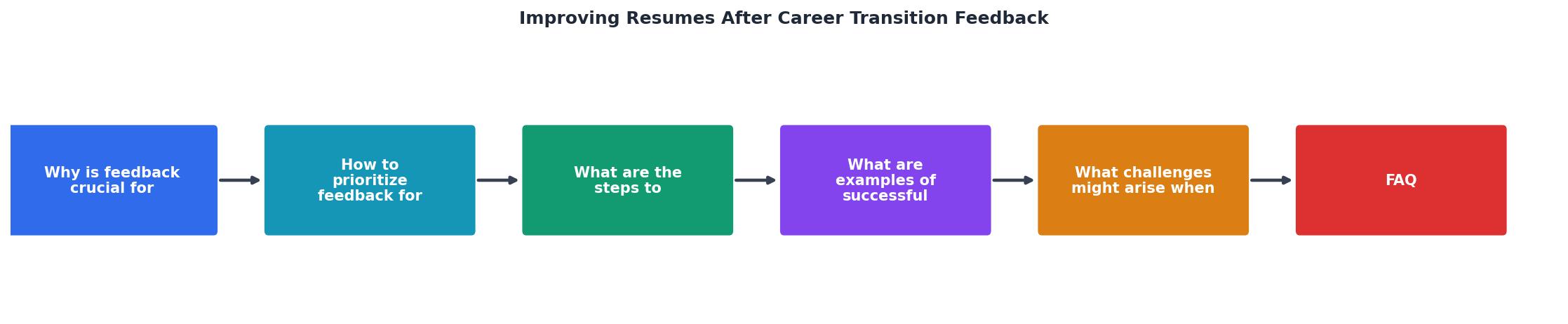
Step 1: Collect and categorize
Gather every piece of feedback into one document. Use the four-tier system above. If you received feedback from multiple sources, note where they agree and where they conflict. Agreement across sources is a strong signal. Conflict means you need to investigate further.
Step 2: Map to job requirements
Take your Tier 1 items and write the specific job requirement next to each one. This creates a direct link between the feedback and the outcome you want. For example:
- Feedback: "Rewrite your teaching bullet points to emphasize curriculum development."
- Job requirement: "3+ years of instructional design or curriculum development experience."
- Action: Rewrite three bullet points under your teaching role to use "curriculum development," "learning objectives," and "content design."
Step 3: Draft revisions
Work through Tier 1 and Tier 2 items. For each bullet point you rewrite, keep the original version in a separate document. You want to be able to compare before and after. Focus on three things in every rewrite:
- Action verb from the target industry (designed, implemented, analyzed, optimized)
- Metric or outcome that proves impact (reduced onboarding time by 30%, managed 12 concurrent projects)
- Keyword from the job description used naturally in the sentence
Step 4: Get a second review
Do not finalize after one round. Show the revised version to someone in the target field, or run it through a tool like Resume Hedgehog that compares your resume against a specific job posting. Fresh eyes catch things you have gone blind to.
Step 5: Finalize and format
Only now do you address Tier 3 and Tier 4 feedback. Tighten language, fix formatting, ensure consistency. Save as PDF unless the application specifically requests a different format.
Here is an interactive overview of the revision process and typical time investment at each step:
Collect & Categorize
Gather all feedback, sort into four tiers by impact.
~20 minMap to Job Requirements
Link each Tier 1 item to a specific line in the job posting.
~15 minDraft Revisions
Rewrite bullet points with target-field verbs, metrics, and keywords.
~45 minSecond Review
Get fresh eyes from someone in the target field or an AI matching tool.
~20 minFinalize & Format
Address cosmetic feedback, tighten language, export as PDF.
~15 minBefore-and-after examples

Abstract advice only goes so far. Here are concrete rewrites that show how feedback transforms a career-change resume.
Example 1: Teacher to instructional designer
| Before (Teacher Language) | After (Instructional Design Language) |
|---|---|
| Taught 9th-grade biology to 120 students | Designed and delivered biology curriculum for 120 learners using backward design methodology |
| Created lesson plans and graded assignments | Developed learning objectives, assessments, and multimedia instructional materials |
| Managed classroom behavior | Facilitated learner engagement strategies resulting in 15% improvement in test scores |
The "before" column reads like a teaching resume. The "after" column uses terms an instructional design hiring manager searches for: curriculum, backward design, learning objectives, multimedia instructional materials, learner engagement. Same experience, different framing.
Example 2: Military to project management
- Before: "Led a platoon of 30 soldiers during deployment operations."
- After: "Managed a cross-functional team of 30 personnel across multiple concurrent operations, coordinating logistics, scheduling, and resource allocation under strict deadlines."
Example 3: Retail manager to operations analyst
- Before: "Oversaw daily store operations and managed a team of 15 associates."
- After: "Directed daily operations for a $2.4M revenue location, analyzing sales data to optimize staffing schedules and reduce labor costs by 12%."
Career changers who apply targeted, feedback-driven revisions to their resumes consistently report significantly higher callback rates. The difference between a generic resume and one revised with field-specific feedback is not incremental. It is multiplicative.
Common challenges with feedback
Feedback is not always clean and easy to apply. Here are the issues career changers run into most often, and how to handle them.
Contradictory advice. One reviewer says to keep your old job title prominent. Another says to downplay it. The tiebreaker is always the job description. If the target role values leadership experience and your old title signals leadership, keep it visible. If it signals the wrong industry, consider a functional or hybrid resume format that leads with skills instead.
Feedback that feels like "start over." Sometimes a reviewer essentially tells you the entire resume needs rewriting. That is demoralizing but often accurate for career changers. The fix is to break the rewrite into the five steps above. You are not starting from scratch. You are translating.
Too much feedback, no clear priority. This happens when you ask five people for input. Use the tier system. If you still feel stuck, focus exclusively on the top three items from Tier 1. Three targeted changes beat twenty scattered ones.
Feedback from the wrong audience. Your aunt who works in HR at a hospital may not give relevant feedback for a software engineering role. Always weight feedback from people who work in or hire for your target field more heavily than general career advice.
Resume Revision After Feedback Checklist
Your progress is saved automatically in your browser.
FAQ
Frequently Asked Questions
Additional Resources
- Career Change Resume & Cover Letter Writing Guide - To improve your chances of advancing, tailor your resume to the position you're targeting. Incorporate relevant language from the job ...
- Updating Your Resume for a Career Change - 1. Use a combination resume format · 2. Include a resume summary or objective · 3. Add a skills section · 4. Showcase relevant certifications or ...
- Career Transition: Strategies for Making it in a Competitive ... - Customize your resume to emphasize transferable skills, and be ready to discuss them in interviews. ☑️ Network in Your New Field
Get the 356 complete recruitment audit (free PDF)
Download the free PDF with 356 reasons hiring stalls, plus optional daily email tips. No credit card.
Get the free PDF 356 reasons · Free download