Including University Projects on an Engineering Resume
Your engineering degree gave you more than lectures and exams. It gave you real projects with real constraints, deadlines, and deliverables. The problem is that most new graduates either leave those projects off their resume entirely or describe them so vaguely that recruiters scroll right past. This guide shows you exactly how to select, describe, and optimize university projects so they land you interviews instead of silence.


Your engineering degree gave you more than lectures and exams. It gave you real projects with real constraints, deadlines, and deliverables. The problem is that most new graduates either leave those projects off their resume entirely or describe them so vaguely that recruiters scroll right past. This guide shows you exactly how to select, describe, and optimize university projects so they land you interviews instead of silence.
Photo by Vanessa Loring from Pexels
TL;DR:- Pick 2-4 university projects that match the target job's required skills and technologies.
- Write each project description using action verbs, specific tools, and quantified outcomes.
- Use Resume Hedgehog to align project descriptions with job posting keywords for ATS compatibility.
Why university projects belong on your resume
If you have zero to two years of professional experience, university projects are your strongest proof of competence. They show hiring managers that you can scope a problem, choose tools, collaborate with a team, and deliver a working result. That is exactly what entry-level engineering roles demand.
Recruiters reviewing junior candidates look for signals that you can do the work, not just study it. A capstone project where you built a functioning embedded system or a group software project that processed real datasets tells a much clearer story than a list of courses.
The key distinction: university projects are not filler. They are evidence. Treat them with the same seriousness you would treat a job description for a paid role.
Select the right projects

Not every project deserves resume space. You need to be selective. Here is a straightforward filter:
- Relevance - Does the project use technologies, methods, or domains mentioned in the job posting? A machine learning project matters for a data engineering role. A circuit design project matters for an embedded systems role.
- Complexity - Did the project involve multiple stages, tools, or team members? Simple homework assignments do not qualify.
- Outcome - Can you point to a measurable result? A working prototype, a performance benchmark, a deployed application, a published paper.
- Recency - Senior-year and capstone projects carry more weight than freshman coursework.
Describe projects like job experience

The biggest mistake new graduates make is writing project descriptions that read like course catalog entries. "Built a web application for a database class" tells a recruiter nothing useful.
Instead, structure each project description with three components:
- Action verb + what you built - "Designed and implemented a REST API..."
- Tools and technologies - "...using Python, Flask, and PostgreSQL..."
- Quantified outcome - "...serving 500+ concurrent users with sub-200ms response times."
| Weak Description | Strong Description |
|---|---|
| Built a website for a class project | Developed a full-stack e-commerce platform using React, Node.js, and MongoDB, handling 1,200+ product listings with search and filtering |
| Worked on a robotics project | Programmed autonomous navigation for a 4-wheeled robot using ROS and Python, achieving 94% obstacle avoidance accuracy in testing |
| Did a machine learning assignment | Trained a CNN image classifier on a 10,000-image dataset using TensorFlow, reaching 91.3% validation accuracy |
"Led $200k digital marketing campaign from conception to launch, resulting in 120% of target signups in first two months of campaign.">, How, and When, to Include Projects on Your Resume (Plus Examples!)
That quote comes from a marketing context, but the principle is identical for engineering: lead with what you did, close with the measurable result.
Quantify achievements and contributions
Numbers transform vague claims into credible evidence. Even university projects produce measurable outcomes if you look for them.
Here are categories of metrics you can extract from almost any engineering project:
- Performance - Response time, accuracy percentage, throughput, error rate
- Scale - Dataset size, number of users, lines of code, number of components
- Efficiency - Time saved compared to manual process, reduction in resource usage
- Team scope - Team size, your specific role, sprint count, features delivered
The following interactive card shows an example of how a single project can yield multiple quantifiable data points:
IoT Weather Station, Capstone Project
Example metrics extracted from one university project
Every one of those numbers can appear in a bullet point on your resume. One project, five strong data points.
Align projects with job descriptions

A project description that ignores the job posting is a wasted opportunity. Applicant Tracking Systems (ATS) scan for keyword matches between your resume and the job description. If the posting asks for "CI/CD pipelines" and your project used Jenkins for automated builds, say so explicitly.
Here is the process at a glance:
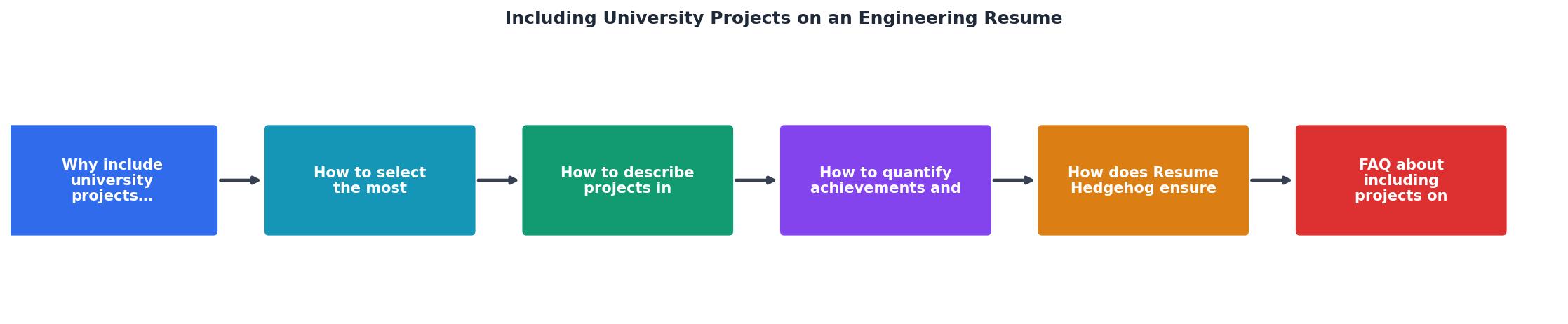
Follow these steps for each application:
- Read the job posting - Highlight required skills, tools, and responsibilities.
- Match projects - Identify which of your projects demonstrate those skills.
- Mirror language - Use the same terminology the posting uses. If they say "microservices," do not write "distributed modules."
- Reorder bullets - Put the most relevant project first in your Projects section.
- Check ATS compatibility - Run your resume through Resume Hedgehog to verify keyword alignment and formatting.
Format your projects section
Where you place projects on your resume matters. For new graduates, the Projects section typically goes directly after Education and before (or instead of) a thin Work Experience section.
Use this format for each entry:
- Project Name | Technologies Used | Date
- Bullet 1: What you built + quantified result
- Bullet 2: Your specific contribution or role
- Bullet 3: Technical challenge you solved
University Project Resume Checklist
Your progress is saved automatically in your browser.
FAQ
Frequently Asked Questions
Additional Resources
- How—and When—to Include Projects on Your Resume (Plus ... - Include important details. You should add enough information about each project that it can be easily understood by anyone who reads your resume ...
- Resume Tips for Engineering Majors - Include all related projects, including those you have done on your own. ... Include any involvement in student clubs, professional organizations, and ...
- Showcasing Previous Engineering Projects on Your Resume - Showcasing previous engineering projects on your resume means clearly presenting the projects you've worked on to demonstrate your skills, problem-solving ...

Get the 356 complete recruitment audit (free PDF)
Download the free PDF with 356 reasons hiring stalls, plus optional daily email tips. No credit card.
Get the free PDF 356 reasons · Free download