
Most resumes describe what candidates did, managed a team, built features, led campaigns. Few explain the impact. Hiring managers see dozens of resumes with identical-sounding bullets every week. The ones that stand out don't just list responsibilities; they quantify results. Adding performance metrics transforms vague accomplishments into proof that you deliver measurable value, and that difference is often the tipping point between an interview invite and rejection.
Photo by RDNE Stock project from Pexels
TL;DR:- Quantifiable achievements make your resume stand out to both ATS systems and hiring managers
- Focus on metrics that show business impact: revenue growth, time saved, efficiency gains, user engagement, or cost reduction
- Use the format: Action + Metric + Context to make each achievement clear and memorable
- Source your data from performance reviews, project documentation, team reports, or public company metrics
- Not every accomplishment needs a number, but the strongest ones do
Why performance metrics matter

Recruiters and hiring managers spend seconds scanning each resume. In that window, they filter for two things: does this person have the right skills, and did they succeed in past roles? Metrics answer the second question immediately.
Without metrics, a resume bullet reads like this: "Improved customer retention through targeted outreach." With metrics, it becomes: "Improved customer retention from 72% to 89% year-over-year through targeted email campaigns, retaining $1.2M in annual recurring revenue." The second version is specific, believable, and speaks the language of business impact.
Beyond the human reader, metrics help you pass Applicant Tracking Systems (ATS). These systems scan for keyword matches and relevance signals. When your bullet contains concrete numbers tied to role-specific outcomes, the ATS recognizes domain expertise and prioritizes your application.
Metrics also serve a practical purpose during interviews. When you quantify an achievement, you give yourself talking points. An interviewer asks "Tell us about a time you drove growth", and you have a specific, memorized story: "I led a redesign that reduced checkout abandonment from 18% to 11%, recovering 1,200 lost sales per month."
Identifying the right metrics for your role
Not all numbers are equally valuable. A metric matters if it directly reflects impact on the company's goals: revenue, cost savings, efficiency, user engagement, quality, or growth.
Start by asking: what did my work enable the company to do or avoid? Then find the number that proves it.
Revenue and financial impact are the gold standard. If your work influenced sales, reduced costs, or generated profit:- Sales revenue closed or influenced
- Subscription revenue retained
- Cost reduction (operational, marketing, infrastructure)
- Budget savings or negotiation gains
- Margin improvement
- Time saved per process (hours/week or %)
- Speed improvements (faster turnaround, reduced latency)
- Throughput gains (transactions, tickets, features shipped)
- Automation scope (% of tasks eliminated or reduced)
- Team capacity freed up for higher-value work
- User growth (% or absolute numbers)
- Engagement rate increases
- Retention or churn improvements
- Customer satisfaction (NPS, CSAT scores)
- Download or adoption growth
- Reduced support tickets or complaints
- Bug reduction or uptime improvement
- Error rate decrease
- Defect prevention
- Compliance audit pass rates
- Security vulnerabilities fixed
"That 100% improvement came from switching leads from spreadsheets to a CRM.">, "I don't have metrics to put in my resume"
Formatting metrics for clarity and impact
How you present a metric matters as much as which one you choose. A poorly formatted metric confuses the reader. A well-formatted one is instantly credible and memorable.
The strongest format is: Action + Metric + Context.
Action is the verb: improved, reduced, increased, optimized, led, built, shipped.
Metric is the number with its unit: 45% faster, $500K saved, 3x throughput, 89% uptime.
Context is the "so what", the business outcome or scope: resulting in 200 new customer acquisitions, or enabling the team to redeploy capacity.
Example: "Optimized checkout flow, reducing cart abandonment by 12% and recovering $180K in annual revenue."
That's action (optimized), metric (12%, $180K), and context (annual revenue).
Avoid vague metrics. "Significantly improved performance" tells nothing. "Improved API response time from 800ms to 120ms (85% reduction)" tells a story.
Use consistent units. If you claim a percentage, percentage should mean something clear: a relative change (from X to Y), not an ambiguous increase. "Improved productivity by 30%" means nothing without a baseline. "Reduced support response time from 24 hours to 16.8 hours (30% improvement)" makes sense.
When citing money, include the timeframe. "$500K saved" is less precise than "$500K saved annually" or "$250K saved in one quarter." Recurring metrics (annual, monthly) impress more than one-time wins because they signal ongoing impact.
Transforming job descriptions into metric-rich bullets
The job description is your starting point. It tells you what the role is supposed to accomplish. Your task is to find evidence that you accomplished it and attach numbers.
Here is how to convert a generic responsibility into a metric-driven achievement:
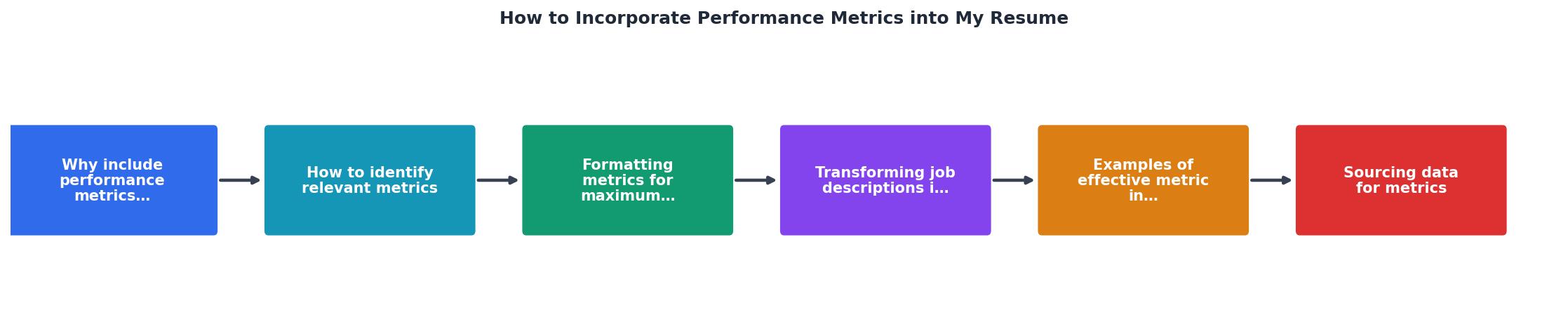
Step 1: Extract the outcome from the job description. If the posting says "manage customer relationships," the outcome is retention or revenue. If it says "lead cross-functional projects," the outcome is on-time delivery and scope success.
Step 2: Identify what changed. Did the customer cohort grow? Did defects drop? Did time-to-market shrink? Did satisfaction scores rise?
Step 3: Find the number. This is where many candidates get stuck. Your sources are performance reviews, project reports, Slack channels, emails, and conversations with past managers or colleagues. Ask directly: "How much did X improve after I did Y?"
Step 4: Add context that matters to the role. If you are applying for a sales role, revenue context wins. If you are applying for an ops role, efficiency context wins. Tailor the context to the job posting.
Step 5: Write the bullet. Keep it to one or two lines. Use active voice, past tense, and specific numbers.
Example progression:
- Generic: "Managed marketing campaigns"
- Outcome-focused: "Launched integrated marketing campaigns"
- Metric-added: "Launched integrated marketing campaigns that drove 18,000 qualified leads"
- Context-rich: "Launched integrated marketing campaigns that drove 18,000 qualified leads, contributing to $2.3M in new customer revenue"
Real examples of metric integration
The difference between a weak and strong resume becomes clear when you see examples side by side.
Example 1: Customer Support
Weak: "Handled customer support inquiries and improved satisfaction."
Strong: "Reduced average response time from 6 hours to 2.5 hours by implementing ticket prioritization system, improving customer satisfaction score from 78% to 91% and reducing churn by 8%."
The strong version includes a clear problem (slow response), a solution (system), and three measurable outcomes (response time, CSAT, churn). A support manager reading this knows exactly what the candidate is capable of.
Example 2: Software Development
Weak: "Built backend services and improved system performance."
Strong: "Architected and deployed three microservices that reduced API latency from 1,200ms to 340ms (72% improvement), enabling the mobile app to serve 500K daily active users without scaling infrastructure costs."
This bullet shows technical depth (microservices), measurable performance gain (72% latency reduction), and business impact (user scale without cost increase).
Example 3: Marketing / Growth
Weak: "Managed social media and grew audience."
Strong: "Built organic social strategy focused on community engagement, growing LinkedIn followers from 12K to 67K (458% growth), increasing average post reach from 800 to 5,200 impressions, and generating 340 qualified B2B leads annually."
Three separate metrics (follower growth, reach, leads) show the progression from awareness to action, which is what marketing executives care about.
Example 4: Project Management
Weak: "Led cross-functional projects on time and under budget."
Strong: "Led 8 cross-functional projects averaging 15-person teams, delivering 100% on schedule, 95% within budget variance, and achieving stakeholder satisfaction rating of 4.7/5, while reducing sprint-to-deployment cycle from 4 weeks to 2 weeks."
This demonstrates reliability (on-time, in-budget), collaboration (satisfaction), and operational efficiency (faster cycles).
Sourcing data for your metrics
The biggest barrier to metric-driven resumes is access to data. Many candidates assume they do not have numbers because they do not have a dashboard. That is not true.
Your data exists in multiple places.
Performance reviews. If you have annual or quarterly reviews, they often contain metrics: productivity improvements, revenue influenced, projects delivered, customer feedback scores. Mine these for specific numbers.
Email and Slack. Past project announcements, retrospectives, or "wins" posts often cite metrics. Search your email for phrases like "improved," "launched," "reduced," "achieved." You will find buried data.
Conversations with former managers or colleagues. They remember the projects and rough numbers. A short email asking "Do you remember how much we improved X when I worked on Y?" usually gets a response.
Public company announcements. If your employer publishes quarterly earnings, product milestones, or blog posts, check if your projects are mentioned with metrics. Sales figures, user growth, and product launches are often public.
Team or project reports. Many companies produce monthly or quarterly reports summarizing team performance. Request access to old reports from your tenure and extract relevant metrics.
Industry benchmarks. If you cannot find exact numbers, industry averages give you a baseline to compare against. "Improved from industry average of 2-day turnaround to 4-hour turnaround" is credible if you source the benchmark.
Your own logs and tracked work. If you tracked metrics yourself (GitHub stats, personal dashboards, spreadsheets), you have data. Commit counts, deploys, tickets resolved, and revenue influenced are all valid if you kept records.
The key is to be honest. If you cannot substantiate a number, do not claim it. But do push yourself to find the evidence. Most candidates underestimate how much data they have access to.
Interactive Metrics Impact Dashboard
To illustrate how metrics influence resume strength, here is an example of how different resume bullet styles compare in recruiter perception and ATS matching:
Resume Bullet Strength Comparison
Without Metrics
"Managed customer retention campaigns."
With Business Metrics
"Improved customer retention from 72% to 89%, retaining $1.2M annual revenue."
The example above shows how adding specific, business-aligned metrics increases both ATS detectability and human recruiter engagement. When your resume speaks in the language of outcomes and numbers, it resonates across both automated systems and hiring humans.
Steps to Integrate Metrics into Your Resume
Your progress is saved automatically in your browser.
FAQ
Frequently Asked Questions
Metrics turn your resume from a job description into proof. When you walk into an interview, you are not hoping the hiring manager notices you delivered results, you are backing that claim with numbers. That confidence is what gets you to the next round.
Additional Resources
- How to Quantify Resume Accomplishments (With Examples) - How to quantify accomplishments on a resume · 1. Track your work · 2. Gather your data · 3. Make use of ranges · 4. Focus on key metrics · 5. Double- ...
- "I don't have metrics to put in my resume" | Erin Lewber - Create specific, goal-targeted statements for each job you've performed. Start with just one big point per job. That should be attainable. Make ...
- 240 Metrics For Your Resume - Essentially, metrics on your resume are the best ways to show what kind of return on investment they will get in exchange for your salary. your ...

Get the 356 complete recruitment audit (free PDF)
Download the free PDF with 356 reasons hiring stalls, plus optional daily email tips. No credit card.
Get the free PDF 356 reasons · Free download