Integrating a Cover Letter with a Career Change Resume
When you're switching careers, your resume and cover letter aren't competing documents, they're a team. Your resume lists what you've done; your cover letter explains why it matters in your new field. Without integration, you send mixed signals. Recruiters see your experience but don't understand the bridge.

Photo by ANTONI SHKRABA production from Pexels
When you're switching careers, your resume and cover letter aren't competing documents, they're a team. Your resume lists what you've done; your cover letter explains why it matters in your new field. Without integration, you send mixed signals. Recruiters see your experience but don't understand the bridge. This guide shows how to weave them together so employers see you as a serious candidate, not a career-hopper.
TL;DR
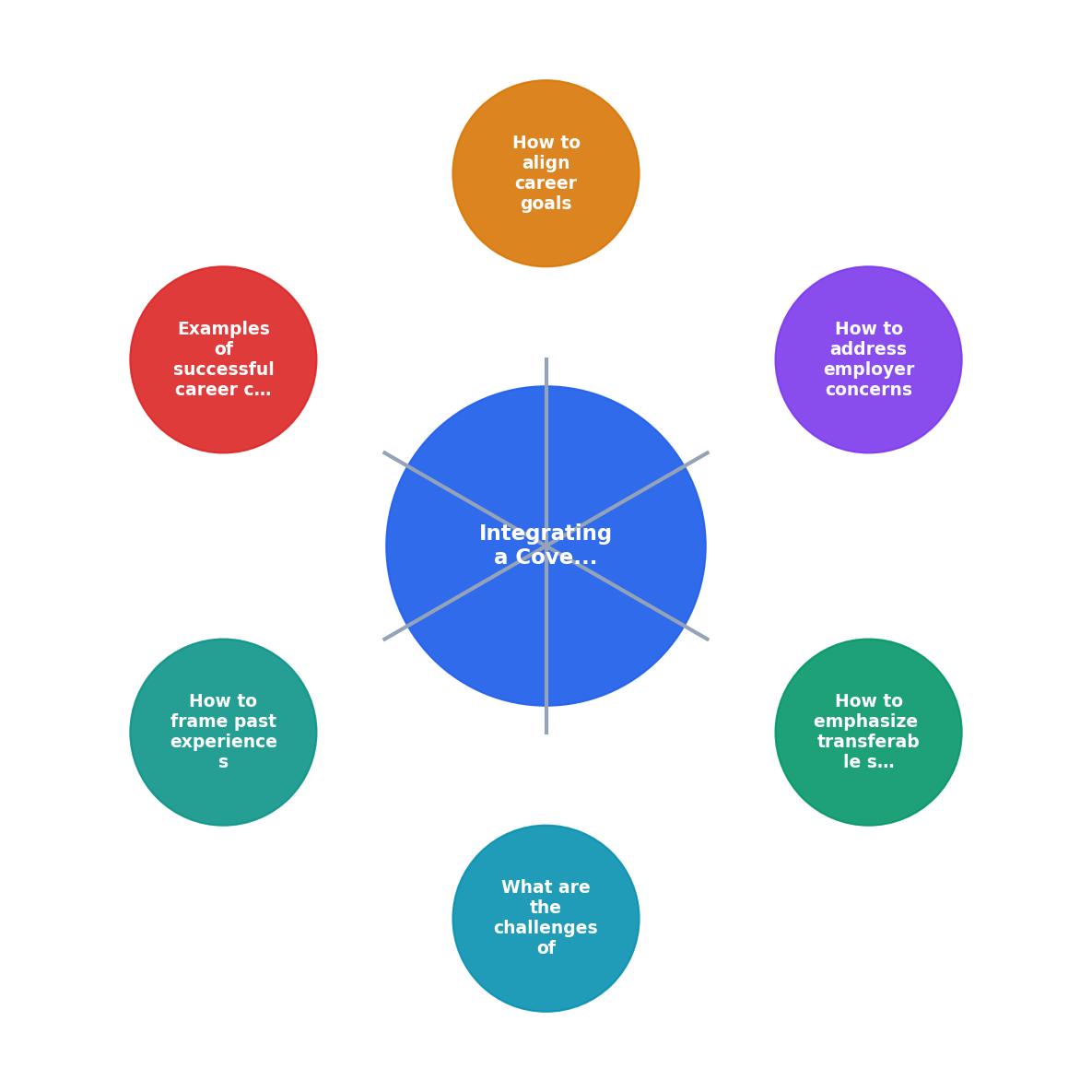
- Align your narrative: Your cover letter should tell the story your resume hints at, why this career move makes sense and how your past work prepares you for what's next.
- Emphasize transferable skills: Call out specific skills (project management, communication, problem-solving) and show them in action in both documents using the same language as the job description.
- Address the experience gap directly: Your cover letter is the place to acknowledge what you don't have and demonstrate why that gap is smaller than it looks.
- Reframe past roles: Show how your previous experience solves problems in your new field, even if the context was different.
A career change puts you in a tough spot. You have valuable experience, but it's in the wrong box. Hiring managers glance at your resume, see "teacher" or "restaurant manager," and assume you lack industry-specific chops. Your cover letter has one job: make them believe you're worth a closer look.
The trick is integration. Every skill and example in your cover letter should echo something on your resume, and every achievement on your resume should land harder because your cover letter provides context. Think of your resume as the evidence and your cover letter as the argument.
Understanding Career Change Barriers

Career changers face three real obstacles:
The keyword problem. You speak the language of your old field. Your resume probably mentions systems, processes, and priorities that mean nothing to your target industry. When you scan through a job description for their field, the terminology feels alien. Recruiters use their field's keywords to screen applications, and if your resume doesn't use them, you fail the filter before a human reads your name.
The experience gap. You don't have three years of direct experience in your new role. That job posting asks for it. You're wondering if you should even apply. Most career changers feel this sting.
The credibility question. Why should an employer trust you to make this switch? Have you studied the field? Will you bail in six months? Are you serious, or is this a phase?
Your resume alone can't answer these concerns. A generic resume just lists what you did. But a cover letter paired strategically with a reframed resume can turn these barriers into advantages.
Emphasizing Transferable Skills in Your Cover Letter
The cover letter is where you name and claim your transferable skills explicitly. Don't bury them. Lead with them.
Identify three to four core skills from your old role that matter in your new one. For a teacher moving into instructional design, these might be:- Designing learning experiences for diverse audiences
- Explaining complex concepts clearly
- Managing projects and timelines with precision
- Adapting content based on feedback
- Name the skill from the job description
- Show a specific example from your past work
- Connect it to success in the new role
"The role requires strong project management skills. In my seven years managing school operations, I coordinated schedules, budgets, and multiple stakeholder needs across 200+ students and six staff members. I tracked progress against timelines, resolved competing priorities, and delivered consistently, skills that directly translate to managing complex projects in a startup environment."
Notice: you're not saying "project management is important." You're showing you've done it, using their language, and linking it to outcomes. A hiring manager reads this and thinks, "This person isn't a novice. They know what managing a project means."
Bold these skill names in your cover letter when you introduce them. This also helps if your letter is scanned or summarized by an AI tool.
Addressing Experience Gaps Head-On
This is where most career changers stumble. They ignore the gap, hoping no one notices. Employers notice. They respect candor more.
Your cover letter should address the gap in one short, confident paragraph. Not an apology. An acknowledgment.
Example:
"I recognize I don't have two years of direct experience in product management, and I'm not claiming I do. What I do have is a track record of solving complex problems under pressure, shipping work on time, and learning fast. My background in operations taught me how to prioritize ruthlessly, work cross-functionally, and measure what matters. I've applied these skills in a different context, and I'm ready to apply them in yours, with the product-specific knowledge I'll build on the job."
This paragraph does three things:- It shows you understand what you don't know (not naive)
- It highlights what you do have that matters (confidence and self-awareness)
- It signals you're coachable and growth-minded (they won't have to babysit you)
Aligning Career Goals With Job Descriptions

Your cover letter should create a visible throughline from your past to your future. This isn't a narrative flourish, it's proof that your career move is deliberate.
In your opening, answer this unspoken question: Why this change, why now?
Don't write: "I've always been passionate about technology." Recruiters hear that 100 times a week. Instead:
"After seven years in nonprofit fundraising, I realized my greatest satisfaction came from the data work, analyzing donor trends, building dashboards, forecasting revenue. I wanted to move into a field where this analytical work was central, not peripheral. That's why I'm applying for roles in data analytics."
This tells them:- You've reflected on your career
- Your move is based on strengths you already have, not a vague passion
- You're not leaving your old field in frustration; you're moving toward something
By the end of your cover letter, a recruiter should feel like the job description could have been written about your experience. Not because you're faking it, but because you've done the work to show genuine alignment.
Reframing Past Experiences for Your New Industry
This is the art of translation. Your resume should show the same experiences as your old resume, but the framing changes everything.
Take a marketing manager applying to product management. Your old resume might say:
"Managed campaign lifecycle from launch to analysis, coordinating with design and engineering teams to deliver on time and on budget."
Your new resume says:
"Managed end-to-end product delivery across cross-functional teams (design, engineering), shipping features on schedule and within budget. Conducted post-launch analysis to inform iteration priorities."
Same work, different emphasis. In the first version, you're highlighting campaign execution. In the second, you're highlighting product thinking, that you understand the cycle of ship-measure-improve.
Your cover letter reinforces this reframing:
"Equally important, the paragraph addresses a painpoint, showing that the candidate can build a technology infrastructure on a lean budget to support growth.">, How to Write a Cover Letter When Trying to Make a Career Change
Integration in Action: Real Examples
Example 1: Teacher → Instructional Designer
Resume bullet: "Designed and delivered 200+ hours of coursework to diverse learners, achieving 91% completion rates and positive feedback scores."
Cover letter integration: "In my role as a teacher, I designed learning experiences for diverse learners, teenagers with different backgrounds, learning styles, and levels of prior knowledge. I measured success not by completion alone, but by whether students could apply what they learned. That's the same philosophy I'd bring to instructional design here: creating learning that sticks, not just content that deploys."
Example 2: Retail Manager → Project Manager
Resume bullet: "Managed 25-person team, $2.3M annual budget, inventory systems, and vendor relationships; improved on-time delivery by 18%."
Cover letter integration: "Managing a retail team taught me the fundamentals of project management: coordinating multiple workstreams, working with constraints (budget, time, personnel), and iterating based on results. The scale is different, but the skills, breaking down large goals into clear tasks, communicating across roles, and driving accountability, are the same ones I'd use to manage projects in your engineering organization."
Building Your Career-Change Application
Here's the process for integrating your resume and cover letter:
This interactive tool shows how your career-change narrative comes together:
Your Career-Change Narrative
This four-step approach ensures every part of your application reinforces the same message: you have the skills, you understand the role, and you're ready.
Career Change Application Checklist
Your progress is saved automatically in your browser.
FAQ
Frequently Asked Questions
Next Steps
A career change isn't a liability if you present it as a strategic move backed by real skills. Your resume shows what you've done; your cover letter explains why it matters. When they work together, they create a narrative that's hard to ignore. Start by identifying the three skills that bridge your old world and your new one, then build both documents around them. The integration isn't just honest, it's your competitive advantage.
Additional Resources
- How To Write a Career Change Cover Letter (With Examples) - How to write a career change cover letter · 1. Introduce yourself · 2. Express your excitement · 3. Outline your performance in previous jobs · 4.
- How to Write a Cover Letter When Trying to Make a Career ... - The best cover letters don't repeat the resume. They explain why the candidate is the right fit for that specific role. Like.
- here's an example of a great cover letter from a career ... - A reader recently sent me a cover letter that I want to share as a great example of explaining why you're applying for a job in a different ...

Get the 356 complete recruitment audit (free PDF)
Download the free PDF with 356 reasons hiring stalls, plus optional daily email tips. No credit card.
Get the free PDF 356 reasons · Free download