Integrating Sabbaticals into a Finance Resume
You took six months off to travel Southeast Asia, earn a CFA charter, or simply recover from burnout at a Big Four firm. Now you are staring at a blank line on your resume where that gap lives, wondering if a hiring manager at Goldman Sachs or a mid-market PE shop will see it as a red flag. The good news is that sabbaticals are far more common in finance than they were a decade ago, and the skills you picked up during that time can actually strengthen your candidacy if you present them correctly.

You took six months off to travel Southeast Asia, earn a CFA charter, or simply recover from burnout at a Big Four firm. Now you are staring at a blank line on your resume where that gap lives, wondering if a hiring manager at Goldman Sachs or a mid-market PE shop will see it as a red flag. The good news is that sabbaticals are far more common in finance than they were a decade ago, and the skills you picked up during that time can actually strengthen your candidacy if you present them correctly.

- Frame your sabbatical around concrete skills gained: certifications (CFA, FRM, CPA), language fluency, freelance consulting, or market research conducted abroad.
- Place the sabbatical in a dedicated "Professional Development" or "Career Break" section rather than hiding it.
- Use your cover letter to connect the sabbatical directly to the target role's requirements.
- Tools like Resume Hedgehog can help you match sabbatical-gained skills to the exact keywords a finance job posting demands.
Why Sabbaticals Matter in Finance
Finance is an industry that rewards continuous performance. Quarterly targets, deal cycles, and audit seasons leave little room for pauses. That reputation makes professionals nervous about stepping away. But the reality on the ground has shifted.
Many finance employers now recognize that a well-used sabbatical signals self-awareness, strategic thinking, and the kind of long-term planning they value in analysts and portfolio managers. A candidate who spent three months earning a Bloomberg Market Concepts certificate while traveling Europe is not a liability. They are someone who invests in themselves the same way they would invest in an asset.
The key distinction is how you present the break. A gap with no explanation invites assumptions. A gap with a clear narrative invites curiosity.
"The presentation of your resume can significantly impact how employers perceive your career gap.">, How to Refresh Your Finance Resume After Time Away, Kaplan Community
Format Your Resume for the Gap

There are three practical layout options for placing a sabbatical on a finance resume. Each works for different situations.
| Approach | Best For | Example Label |
|---|---|---|
| Dedicated section | Sabbaticals with certifications or structured learning | "Professional Development (Jan 2025 - Jul 2025)" |
| Inline with experience | Short breaks (under 4 months) between two roles | List it as a line item under the previous employer's end date |
| Functional/hybrid format | Career changers entering finance from another field | Group skills at the top, list chronology below |
The dedicated section approach works best for most finance professionals. Place it between your most recent role and the previous one. Use a clear date range. Give it a title like "Sabbatical / Professional Development" rather than leaving a mysterious gap.
Here is the process at a glance:
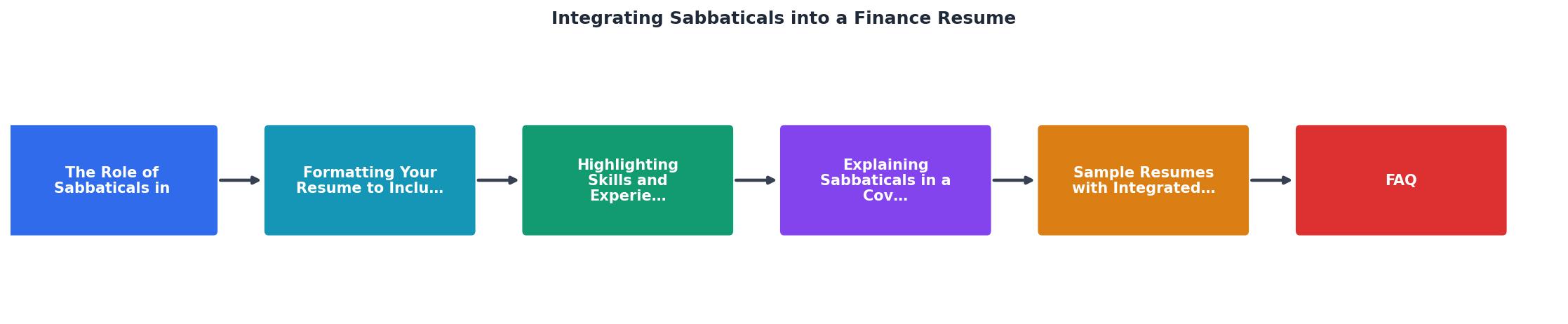
Follow these steps: Identify Skills, Choose Format, Write Bullets, Tailor to Job, Review and Submit. Each step builds on the previous one. Identify Skills means listing every certification, course, freelance project, or relevant experience from your time away. Choose Format means picking the dedicated section, inline, or hybrid approach. Write Bullets means turning those skills into achievement-oriented lines. Tailor to Job means matching your language to the job posting's keywords. Review and Submit means running a final check for ATS compatibility.
Skills Worth Highlighting
Not everything you did on sabbatical belongs on a finance resume. Backpacking through Patagonia is interesting at dinner, but it does not help you land a VP of FP&A role. Focus on what translates.
Certifications and coursework:- CFA Level I, II, or III progress
- Financial Risk Manager (FRM) designation
- Certified Public Accountant (CPA) exam sections
- Online courses from Wharton, Columbia, or MIT OpenCourseWare in financial modeling, valuation, or data analytics
- Financial modeling for startups (even pro bono)
- Tax preparation for small businesses
- Advisory work for nonprofits or family offices
- Studying emerging markets firsthand (e.g., fintech adoption in Kenya, real estate cycles in Vietnam)
- Learning a second language used in target markets (Mandarin, Portuguese, Arabic)
- Attending international finance conferences like the CFA Institute Annual Conference
- Python for financial analysis (pandas, NumPy)
- Advanced Excel/VBA modeling
- Tableau or Power BI for data visualization
- SQL for database querying
Sabbatical Skill to Job Match
Explain It in Your Cover Letter

Your resume shows what you did. Your cover letter explains why it matters for this specific role. Keep the sabbatical explanation to two or three sentences. Do not apologize. Do not over-explain.
Here is a structure that works:
- Acknowledge the break briefly. "After five years in equity research at Morgan Stanley, I took a planned sabbatical from January to July 2025."
- Connect it to growth. "During that time, I completed CFA Level III preparation and built financial models for two early-stage fintech companies."
- Bridge to the role. "That combination of deep study and hands-on modeling directly prepared me for the Senior Analyst position at your firm."
"I needed a break from the grind."(Too casual, signals burnout without resolution.)"I traveled the world to find myself."(Vague, no professional relevance.)Leaving the sabbatical out of the cover letter entirely.(Forces the interviewer to guess.)
Sample Resume Section
Below is a template you can adapt for your own sabbatical section. Place it between your two most recent roles in reverse chronological order.
PROFESSIONAL DEVELOPMENT | Jan 2025 - Jul 2025
Sabbatical - Career Investment Period
- Completed CFA Level III curriculum; exam scheduled for Aug 2025
- Built DCF and LBO models for two Series A fintech startups (pro bono)
- Completed "Financial Engineering and Risk Management" (Columbia University, Coursera)
- Studied Mandarin (HSK Level 3) to support Asia-Pacific market coverage goals
- Attended CFA Institute Annual Conference 2025 in Chicago
Notice the format: clear date range, descriptive title, bullet points with measurable or specific outcomes. Every line answers the question "What did you gain that makes you a better finance professional?"
Sabbatical Resume Integration Checklist
Your progress is saved automatically in your browser.
FAQ
Frequently Asked Questions
What was the most valuable skill or experience you gained during your sabbatical, and how did you frame it for finance employers? Share your approach in the comments.
Additional Resources
- How to Refresh Your Finance Resume After Time Away - Planned sabbatical focused on family caregiving responsibilities while maintaining professional development through finance certifications ...
- Finance Whiz Fully Leverages His Career Break - Brian: There were three areas I was focused on to plan my sabbatical: budget, housing, and my professional reputation. I was glad to be enrolled ...
- How to keep my resume active during sabbatical? So I can ... - It's happening guys! I've gotten lucky with investing my career savings, now have NW of just under 2 mil at age 26. Going to quit very soon - thinking ...

Get the 356 complete recruitment audit (free PDF)
Download the free PDF with 356 reasons hiring stalls, plus optional daily email tips. No credit card.
Get the free PDF 356 reasons · Free download