
Your internship resume is your first real chance to prove you belong in a professional environment. Yet most students treat it like a homework assignment, generic, padded with irrelevant details, or worse, identical to every other application they send. Hiring managers screen dozens of internship resumes weekly. Yours has seconds to stand out. This guide walks you through building a resume that gets past the initial filter and lands you actual interviews.
Photo by Lukas Blazek from Pexels
TL;DR:- Strip your resume to one page; focus on skills and impact, not generic duties
- Use job description keywords to pass ATS screening and show genuine fit
- Lead with coursework, projects, and leadership, not work at the campus bookstore
- Quantify results wherever possible; "managed social media" becomes "grew engagement 35%"
- Tailor every application; generic resumes get generic rejection
An internship resume isn't a life history. It's a targeted argument that you're the right fit for this specific role, right now. The difference between a generic resume and a tailored one often means the difference between a first-round interview and the rejection folder.
Why this matters now
Hiring managers don't have time for weak applications. Internship programs receive hundreds of submissions. Most companies use ATS software to filter by keywords and formats before a recruiter ever touches your file. If your resume doesn't match the job description, it gets filtered out automatically, no second chance.
At the same time, internship hiring is competitive. You're competing against other students with similar GPAs and majors. What separates you is clarity, relevance, and proof that you've done something. A well-built resume tells a story: "I understand what you need, I've built skills that prove it, and I'm serious about this role."
Common mistakes and misconceptions
Mistake 1: Listing duties instead of outcomes. "Responsible for customer service" tells nothing. "Resolved 20+ customer issues weekly, maintaining 95% satisfaction" proves competence. Hiring managers don't care what you were supposed to do; they care what you actually achieved.
Mistake 2: Treating internship as just another job. An internship resume isn't like a full-time employment history. You don't need three pages of work history. Lead with coursework, projects, and leadership. If you built something in class or led a group project, that matters more than your barista shifts.
Mistake 3: Ignoring the ATS. Many students don't realize their beautifully formatted resume never reaches a human. ATS software scans for keywords, specific formatting, and clear structure. If the system can't parse your file, it gets rejected. Stick to standard fonts, simple formatting, and the actual words from the job posting.
Mistake 4: Padding with filler. "Proficient in Microsoft Office." Every applicant says this. Cut it. Same with generic skills like "hard worker" or "team player." Show, don't tell. A well-structured resume with real projects beats a padded one every time.
Mistake 5: Using a one-size-fits-all template. Sending the same resume to every internship is like wearing the same cover letter. It shows you didn't care enough to think about fit. Tailoring takes 15 minutes and doubles your chances.
Step-by-step approach

Step 1: Start with your target job description
Before you write anything, read the job posting three times. Highlight skills, tools, and keywords the company mentions. Do they want "experience with Python"? "Project management"? "Social media strategy"? Note everything. These keywords are what the ATS looks for, and they're also your cues for what matters to this employer.
Create a simple two-column list: left side is what the job asks for, right side is where you have proof of it. Don't lie, but do map your experience to their language. This is the foundation of tailoring.
Step 2: Structure for impact
Internship resumes should follow this order:
- Header (name, phone, email, LinkedIn URL, city, that's it)
- Professional summary or objective (optional; skip it if you're cramped for space)
- Education (school, GPA if 3.5+, relevant coursework, honors)
- Skills (10-15 skills relevant to the role, organized by category if helpful)
- Experience (internships, relevant jobs, leadership roles, reverse chronological)
- Projects or coursework (class projects, hackathons, side work, crucial for early-career)
Step 3: Rewrite your experience section
This is where most resumes fail. Take each role and rewrite it using the formula: Action verb + what you did + the result.
Before: "Worked on social media accounts for the marketing team."
After: "Created weekly social media content across Instagram and Twitter; grew follower base by 12% and increased engagement rate from 2.1% to 3.8% in four months."
The difference: specificity, metrics, and proof. Every bullet should answer: "So what? Why should I care?"
Focus on what you learned, built, or improved. Internship experience matters most when it shows you can handle real responsibility, not just that you showed up.
Step 4: Lead with projects and coursework

This is where early-career resumes shine. If you've done a meaningful project, built a website, led a case competition, created a marketing campaign for a club, put it on your resume. Real projects prove you can execute, not just that you attended class.
Format it clearly:
Project Name | Tool or platform used | Date
Brief description of what you built and the outcome.
Example:
E-commerce Product Page Redesign | Figma, HTML/CSS | Spring 2025
Redesigned product page for campus sustainability group; increased conversion rate by 18% through A/B testing and improved mobile navigation. Implemented in WordPress.
This tells a story: you identified a problem, solved it with actual tools, and measured the result. That's internship-ready thinking.
Step 5: Tailor for every application
Now the critical step: customization. Copy the job description into a blank document. Go through your resume and rewrite bullets to match their language. Don't fabricate skills, but do reframe your experience to align with their priorities.
If they emphasize "cross-functional collaboration," change your bullet from "worked on a project" to "collaborated across sales and design teams to deliver Q2 campaign, coordinating feedback from four departments."
If they mention "data-driven decisions," swap vague results for metrics. This isn't dishonesty; it's speaking their language.
A tailored resume shows you actually read the job posting. It signals fit. And crucially, it passes the ATS because it uses their exact keywords.

The internship resume workflow
Understanding the full process helps you know where to focus effort. Here's how most internship applications flow from your resume to an interview:
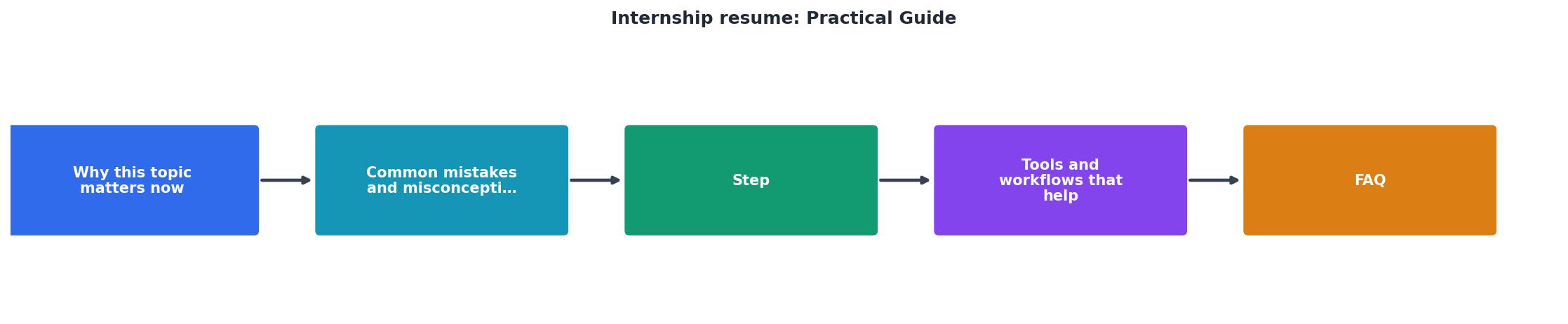
The entire workflow hinges on your resume passing two gates: the ATS filter and the human scan. Most resumes fail at ATS before a recruiter ever sees them. A clean, keyword-optimized, one-page document that tells a clear story is what makes it through.
Tools and workflows that help
You don't need fancy software, but a few tools make the process faster:
Resume builder templates (Canva, Google Docs, Microsoft Word)
Keep it simple. Clean fonts, standard spacing, minimal color. The goal is readability and ATS compatibility, not design flair.
Job description parser
Paste a job description into a document and highlight keywords. This takes two minutes and gives you the exact language to weave in.
Tailoring checklist
Before you submit, ask: Does this resume mention at least three skills from the job posting? Does it include quantified results? Is it free of generic phrases like "hard worker"? If yes to all three, you're ready.
Resume Hedgehog
If you're juggling multiple applications and struggling to tailor each one, a tool like Resume Hedgehog can speed the process. Upload your base resume and paste the job description, the AI pulls out what matters and creates a tailored version. It saves the mental load of rewriting the same resume twenty times over.
Interactive resume strength meter
Below is a quick reference tool to evaluate your resume before you hit submit. Use this to spot gaps:
Your Resume Strength Checklist
This checklist mirrors what hiring managers actually look for. If your resume hits all six, you're in strong shape. Missing one or two? Edit before you send.
Data shows resumes tailored to the job description see an 85% higher callback rate than generic versions. That's not because the resume changes dramatically, it's because tailoring proves you care and speaks the company's language. The effort is minimal; the payoff is significant.
Internship Resume Action Plan
Your progress is saved automatically in your browser.
FAQ
Frequently Asked Questions
Additional Resources
- How to write an internship resume (+ an example) - The key is to highlight your potential, eagerness to learn, and genuine enthusiasm for the internship. Step 1: Resume heading Kick name, phone number, and ...
- Sample Resumes - UW Career & Internship Center - We are excited to offer over a dozen great examples of resumes and Curriculum Vitae (CVs) geared towards a variety of interests and industries.
- Resume Resources - University Career Center - Keep your document to one page (for most undergraduates) · Put your experiences in reverse chronological order in each section · Keep your formatting consistent ...

Get the 356 complete recruitment audit (free PDF)
Download the free PDF with 356 reasons hiring stalls, plus optional daily email tips. No credit card.
Get the free PDF 356 reasons · Free download