Preparing for Interviews Using a Tailored Resume from Resume Hedgehog
You sent out dozens of applications, finally got the interview invite, and now you are staring at your resume wondering what the interviewer will actually ask about. Most candidates treat the resume and the interview as two separate events. They are not. A resume tailored to the job posting is the single best cheat sheet you can bring into any interview, because every bullet point on it is a potential question waiting to happen.

You sent out dozens of applications, finally got the interview invite, and now you are staring at your resume wondering what the interviewer will actually ask about. Most candidates treat the resume and the interview as two separate events. They are not. A resume tailored to the job posting is the single best cheat sheet you can bring into any interview, because every bullet point on it is a potential question waiting to happen.
Photo by Tima Miroshnichenko from Pexels
TL;DR:- A tailored resume maps directly to the questions an interviewer will ask, giving you a built-in study guide.
- Use each resume bullet as a prompt to prepare a short story with context, action, and result.
- Resume Hedgehog aligns your resume language with the job posting, so your talking points already match what the hiring team cares about.
Your resume is your interview script
Think about what an interviewer actually holds during a conversation: your resume. They scan it, pick a bullet, and ask you to elaborate. If that resume was tailored to the specific job posting, every line already speaks the language the interviewer expects. You do not need to translate on the fly.
When you use Resume Hedgehog to match your resume to a job description, the tool pulls in the exact keywords, skills, and phrases from the posting. That means the interviewer reads terms they recognize, and you have already rehearsed answers around those same terms. The alignment is automatic.
A generic resume forces you to guess which experiences the interviewer will focus on. A tailored resume narrows the field. You know the bullets. You know the keywords. You control the conversation before it starts.
Align resume content with questions

The core technique is simple: read each line of your tailored resume and turn it into a question. Then answer that question out loud.
Here is how to do it step by step:
- Print your tailored resume. Read it as if you are the interviewer seeing it for the first time.
- Highlight every claim. "Reduced onboarding time by 30%" is a claim. "Managed cross-functional team of 8" is a claim. Each one invites a follow-up.
- Write the obvious question. For "Reduced onboarding time by 30%," the question is: How did you reduce onboarding time?
- Draft a 60-second answer. Use the CAR format: Context (the situation), Action (what you did), Result (the measurable outcome).
- Practice aloud. Saying it once in your head is not practice. Saying it out loud three times is.
"Take the job title and key skills from the job posting and make sure they appear in your resume.">, How to Tailor Your Resume in 2 Minutes for Interviews
This quote captures the entire philosophy. When the job title and key skills already appear in your resume, the interviewer sees alignment instantly, and your prepared answers reinforce it.
Anticipate questions from your resume

Interviewers follow patterns. Knowing those patterns lets you predict questions with surprising accuracy.
Skills-based questions come from the skills section. If your tailored resume lists "Salesforce administration," expect: Tell me about your experience with Salesforce. What customizations have you built?
Achievement-based questions come from quantified bullets. "Grew email subscriber list by 12,000 in six months" will trigger: Walk me through that growth strategy.
Gap or transition questions come from timeline irregularities. If your resume shows a role change or a gap, prepare a concise, honest explanation.
Culture-fit questions come from soft skills woven into your experience section. "Collaborated with remote teams across three time zones" invites: How do you handle communication challenges with distributed teams?
The more precisely your resume mirrors the job posting, the more predictable the questions become. That predictability is your advantage.
Match questions to resume sections
Here is a practical mapping of common interview questions to the resume sections they typically originate from. Use this as a reference when preparing.
The following interactive card shows how specific resume sections map to the interview questions they generate. Review it before your next interview to identify which sections need the strongest prepared answers.
Resume Section → Interview Question
Each section of your resume feeds a different category of question. When you prepare, work through the resume top to bottom and draft at least one answer per section.
Use resume highlights as talking points

Your tailored resume already contains the highlights the employer cares about. The trick is turning those highlights into conversational talking points rather than reciting them word for word.
Pick your top three bullets. These are the achievements most relevant to the job posting. For a marketing manager role, that might be campaign ROI, team leadership, and a specific platform expertise like Google Ads or HubSpot.
Build a mini-story for each. A good interview answer has three parts:- Setup: one sentence on the situation ("Our lead pipeline had dropped 40% quarter over quarter.")
- Action: two sentences on what you specifically did ("I audited the existing funnel, identified a broken nurture sequence, and rebuilt it with segmented email tracks.")
- Outcome: one sentence with a number ("Pipeline recovered within eight weeks and exceeded the previous quarter by 15%.")
Three well-rehearsed stories cover most behavioral questions. You can adapt the same story to different question angles: teamwork, problem-solving, leadership, and conflict resolution often overlap in a single project.
Navigate interviews with confidence
The process from tailored resume to confident interview follows a clear path. Here is the full workflow at a glance:
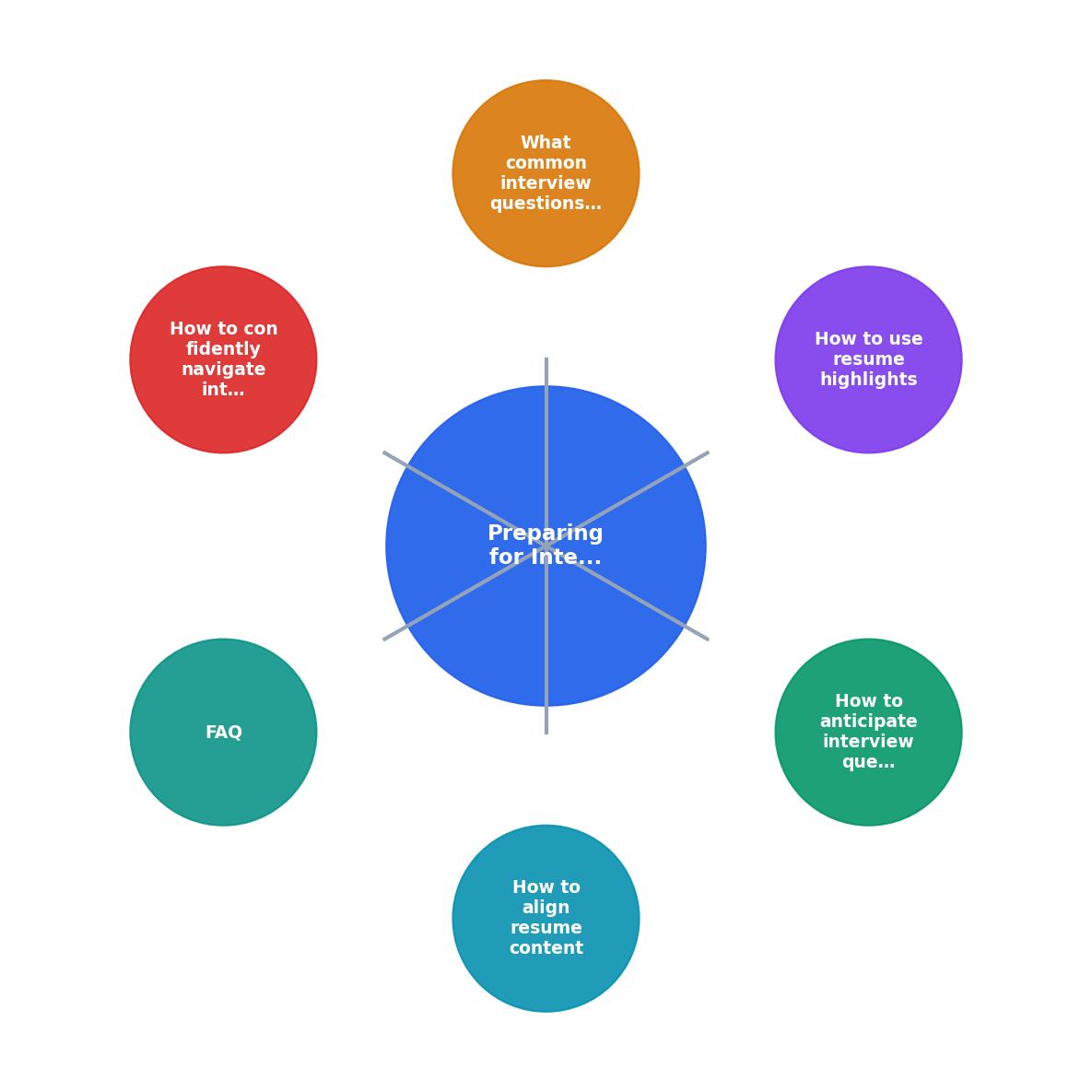
The steps in the diagram break down like this:
- Upload resume + paste job description into Resume Hedgehog.
- Review tailored resume and note every keyword and achievement the tool emphasized.
- Convert bullets to questions using the technique from the alignment section above.
- Draft CAR answers for each question.
- Practice aloud at least twice per answer.
- Bring the tailored resume to the interview (printed or on screen) as your reference.
| Generic Resume Prep | Tailored Resume Prep |
|---|---|
| Guess which questions will come up | Predict questions from resume bullets |
| Memorize generic STAR answers | Build specific stories around tailored content |
| Scramble to connect experience to role | Language already matches the job posting |
| Hope keywords land naturally | Keywords baked in by Resume Hedgehog |
| Feels uncertain, reactive | Feels prepared, proactive |
Interview Prep Checklist: Resume-to-Interview Alignment
Your progress is saved automatically in your browser.
FAQ
Frequently Asked Questions
Additional Resources
- How to Tailor Your Resume in 2 Minutes for Interviews - Here''s How to Tailor your Resume in 2 Minutes (And Actually Get Interviews) In any industry at any level and even if you have failed before ...
- How to Tailor Your Resume for Interviews - Tailoring your resume for interviews means customizing your application to closely match the specific requirements of each job description, ...
- Tailoring Your Resume - Center for Career Readiness - Read the job description and highlight keywords and phrases. · Notice what's mentioned multiple times or is emphasized. · Speak directly to those items and ...

Get the 356 complete recruitment audit (free PDF)
Download the free PDF with 356 reasons hiring stalls, plus optional daily email tips. No credit card.
Get the free PDF 356 reasons · Free download