Anticipating Interview Questions After a Career Change
You rewrote your resume, landed the interview, and now the hiring manager wants to know why you left teaching to become a UX researcher. Every career changer faces this moment. The questions are predictable if you know where to look, and your resume is the single best cheat sheet for figuring out exactly what an interviewer will ask. This guide walks you through the process of turning your own resume into an interview prep tool so you walk in ready, not rattled.


You rewrote your resume, landed the interview, and now the hiring manager wants to know why you left teaching to become a UX researcher. Every career changer faces this moment. The questions are predictable if you know where to look, and your resume is the single best cheat sheet for figuring out exactly what an interviewer will ask. This guide walks you through the process of turning your own resume into an interview prep tool so you walk in ready, not rattled.
Photo by Mikhail Nilov from Pexels
TL;DR:- Your resume already contains the clues to 80% of the questions you will face.
- Interviewers focus on three areas: skills relevance, motivation for the switch, and experience gaps.
- Craft responses that translate old-career accomplishments into new-career language, and practice them out loud before the interview.
Why your resume predicts the questions
Every line on your resume is a potential conversation starter. When a hiring manager reads "managed a team of 15 educators" on a resume targeting a project management role, they mentally form a question: How does managing teachers translate to managing software developers? That question is coming. Count on it.
The trick is reading your own resume through the interviewer's eyes. Look for three things:
- Job titles that don't match the target role
- Skills listed without context in the new industry
- Chronological gaps or sudden shifts in your timeline
How to use your resume as a prep tool

Start with a simple exercise. Take your tailored resume and go through it section by section. For each bullet point, ask yourself: "If I were hiring for this role and saw this line, what would I want to know?"
Here is the process broken down into steps:
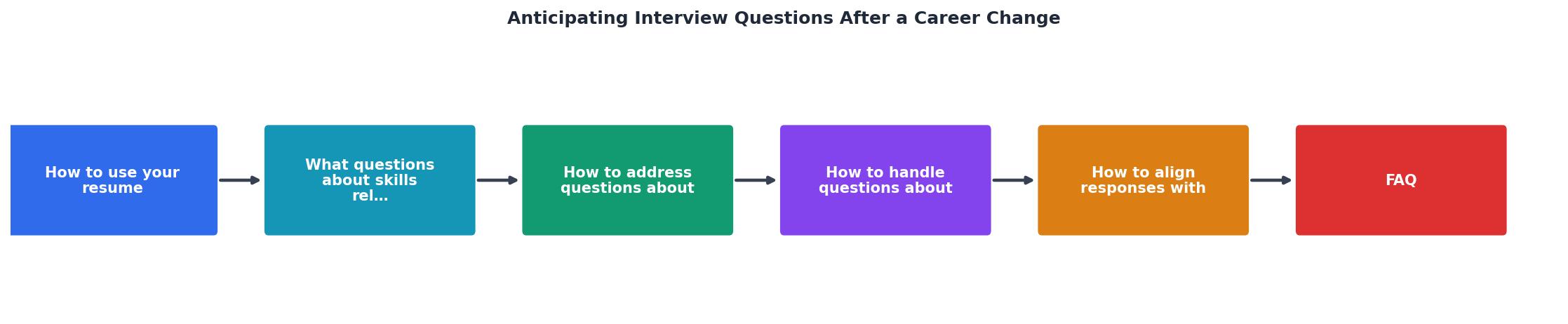
Follow these steps to build your question list:
- Review each bullet on your resume and note the skill or achievement it highlights.
- Flag mismatches between the bullet's original context and the target role's expectations.
- Draft a question the interviewer would logically ask about each mismatch.
- Write a bridge answer that connects the old context to the new role's needs.
- Practice aloud until the answer sounds natural, not rehearsed.
Questions about skills relevance

Transferable skills are the backbone of any career change resume, and interviewers will test whether you actually understand how those skills transfer. Expect questions like:
- "Which skills from your previous career are most relevant here?"
- "Can you give an example of using [specific skill] in a context similar to ours?"
- "What skills do you still need to develop for this role?"
Here is a framework for answering skills-relevance questions:
- Name the skill specifically (not "communication" but "stakeholder reporting to non-technical audiences").
- Give a concrete example from your previous career.
- Draw the parallel to the target role explicitly.
- Quantify the result whenever possible.
Explaining your motivation
This is the question career changers dread most: "Why did you leave [old field]?" The wrong answer focuses on what you ran away from. The right answer focuses on what you are running toward.
"The best piece of advice that I ever received from a career mentor was not to search for or take a new job primarily out of desperation and/or unhappiness.">, Gen Y: Questions to Ask Yourself When Considering a Job Change
Structure your motivation answer in three parts:
- What sparked your interest in the new field (a specific project, a realization, a side project that grew).
- What steps you took to validate the interest (courses, volunteering, informational interviews, certifications).
- Why this company specifically fits your new direction.
That answer shows intention, effort, and specificity. It leaves no room for the interviewer to wonder if you are just escaping burnout.
Handling experience gap questions

Gaps come in two forms for career changers: time gaps (you took a break to retrain) and experience gaps (you lack direct industry experience). Both are normal. Both need clear answers.
For time gaps, state what you did during the gap. "I spent 10 months completing a UX design bootcamp, freelancing for two local nonprofits, and building a portfolio of five case studies" turns a gap into a strength.
For experience gaps, redirect to adjacent experience. A military logistics officer applying for a civilian operations manager role has never worked in a corporate office, but has coordinated supply chains under extreme constraints, managed budgets, and led teams of 30+ people. The experience is there; the vocabulary just needs translating.
Common gap-related questions to prepare for:
- "You have no direct experience in our industry. How will you get up to speed?"
- "Your last role in [old field] was two years ago. What have you been doing since?"
- "How do you plan to handle the learning curve?"
The following interactive card shows the typical question categories career changers face and how often each category appears in interviews:
Interview Question Categories for Career Changers
Aligning responses with your new career
The goal of every answer is to make the interviewer forget you are a career changer and start seeing you as a candidate who happens to bring a broader perspective. That means every response should land on the new role, not linger on the old one.
Use the Past-Bridge-Future formula:
- Past: "In my previous role as a [old title], I [specific accomplishment]."
- Bridge: "That experience taught me [transferable skill], which directly applies to [new role requirement]."
- Future: "In this position, I plan to use that skill to [specific contribution]."
Tools like Resume Hedgehog can help you build a resume that already speaks the language of your target role, which makes the bridge step much easier. When your resume uses the right terminology, your interview answers naturally follow the same vocabulary.
| Weak Answer Pattern | Strong Answer Pattern |
|---|---|
| "I wanted something different" | "I completed X certification and built Y project to prepare" |
| "My old skills are transferable" | "Specifically, my experience in A maps to your need for B" |
| "I'm a fast learner" | "I learned Z tool in 3 months and delivered this result" |
| Focuses on the old career | Lands on the new role's requirements |
Career Change Interview Prep Checklist
Your progress is saved automatically in your browser.
FAQ
Frequently Asked Questions
Additional Resources
- 34 Interview Questions About a Change in Career (With ... - 10 general career change interview questions · What appealed to you about the opportunity to work with our company? · Do you consider yourself ...
- Gen Y: Questions to Ask Yourself When Considering a Job ... - Does my current company, manager, or team provide opportunities for professional growth and promotions? Is there a career path for me within this organization?
- Ace Your Career Change Interview With This Guide - Explain how your career change decision relates to your long-term career goals. Demonstrate to potential employers that you are seriously considering your ...
Get the 356 complete recruitment audit (free PDF)
Download the free PDF with 356 reasons hiring stalls, plus optional daily email tips. No credit card.
Get the free PDF 356 reasons · Free download