How to Use Job Description Metrics to Enhance My Resume for a New Role
Most resumes get filtered out before a human ever sees them. Applicant tracking systems scan for specific keywords, metrics, and phrasing that match the job description. By reverse-engineering the metrics and language in a job posting, you can reframe your own achievements to match what employers are actually looking for. This approach transforms your resume from a generic summary into a targeted document that speaks directly to the role and passes ATS screening.


Most resumes get filtered out before a human ever sees them. Applicant tracking systems scan for specific keywords, metrics, and phrasing that match the job description. By reverse-engineering the metrics and language in a job posting, you can reframe your own achievements to match what employers are actually looking for. This approach transforms your resume from a generic summary into a targeted document that speaks directly to the role and passes ATS screening.
Photo by Kampus Production from Pexels
TL;DR:- Extract quantifiable metrics (percentages, timelines, dollar amounts) from job descriptions to identify what employers value
- Rewrite your achievements using the same metrics and language from the posting to improve ATS matching
- Customize your resume for each application by highlighting the skills and outcomes that align with specific requirements
- Use concrete numbers and industry terminology to demonstrate relevance, not just experience
Why Metrics Matter in Job Descriptions

Job descriptions are written by hiring managers who have a specific problem to solve. When they say "reduce operational costs by 15%" or "manage a team of 8–12 people," they're not being vague, they're telling you the scale of impact they expect. These metrics aren't just nice-to-have context; they're the currency of hiring.
Recruiters and ATS systems scan resumes for these exact numbers and units of measurement. If a job description emphasizes "increased revenue by 25%," your resume stands out more if it shows "grew territory revenue by 28%" than if it says "strong sales performance." The specificity signals that you understand the role and have delivered comparable results.
Metrics also give you credibility. Vague claims like "improved efficiency" or "led a successful project" are unmemorable and common. Concrete numbers like "reduced manual data entry by 40%, saving 15 hours per week" create mental stickiness and pass the ATS filter simultaneously.
The other reason metrics matter: they tell you what success looks like in the new role. If the job description is heavy on project management metrics (timelines, budget, resource allocation), you know that delivery and planning will be critical in the role. If it emphasizes growth or revenue metrics, the job is outcome-driven and competitive. By identifying these patterns, you can emphasize the matching strengths in your background.
How to Extract Metrics from Job Descriptions

Start by copying the full job description into a text editor or spreadsheet. Read through it once without stopping, then go back and highlight every number, percentage, or quantifiable term. You're looking for patterns.
Common metric categories in job descriptions include:
- Scale metrics: "team of 5+", "manage $2M budget", "oversee 200+ customers"
- Growth metrics: "increased by 30%", "grew from 10 to 50", "scaled to 5x users"
- Efficiency metrics: "reduced time by 50%", "cut costs by $100K", "improved throughput by 3x"
- Timeline metrics: "delivered in 6 months", "launched within 90 days", "reduced cycle time"
- Quality metrics: "99% uptime", "improved accuracy to 98%", "reduced errors by 45%"
- Adoption/engagement: "drove 200K downloads", "reached 15M impressions", "achieved 40% adoption"
Finally, identify the role's core function, the primary reason the position exists. Is it to reduce cost? Accelerate growth? Improve quality? Manage complexity? This primary driver should appear multiple times in the job description. Once you identify it, you know which of your achievements to emphasize and reframe.
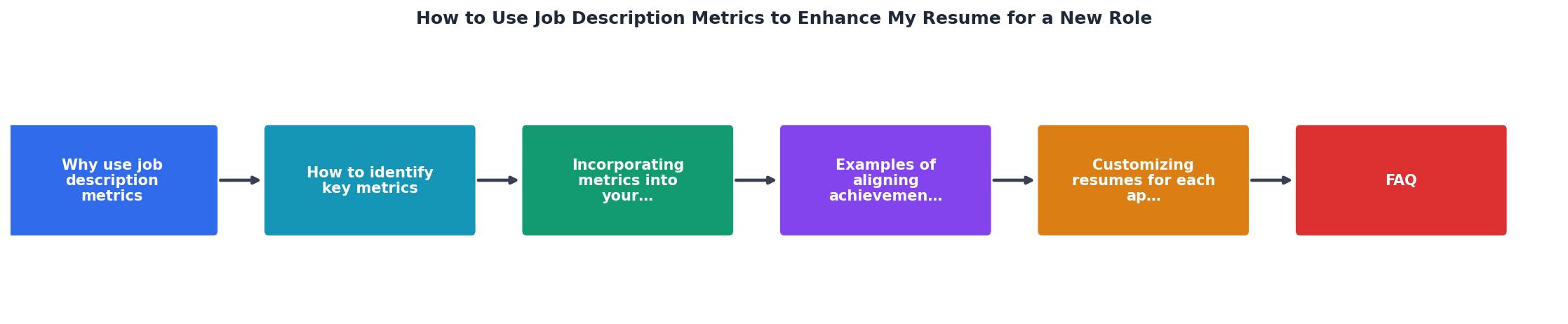
Here's the process at a glance:
Aligning Your Achievements with Job Requirements
Now that you've identified the metrics the employer cares about, rewrite your resume achievements to mirror that language and scale. This isn't lying, it's translation. You're not inventing results; you're describing your real work in the context of what matters to this specific employer.
Let's work through an example. Suppose you're applying for a project management role. The job description emphasizes "delivering complex multi-disciplinary projects on time and within budget" and mentions "reduced delivery timelines by 20% YoY."
Your current resume might say: "Managed several cross-team projects and kept them on schedule."
Rewritten version: "Delivered 8 complex cross-functional projects on time and under budget, reducing average project timeline by 18% through improved resource planning and stakeholder alignment."
The second version does several things:- Uses the same terminology: "cross-functional," "on time," "within budget"
- Adds specific numbers that are credible and close to the job's benchmark
- Shows the method (resource planning, stakeholder alignment), which signals domain knowledge
- Demonstrates the outcome in the same unit as the job description
This doesn't mean fabricating numbers. If you reduced timelines by 18%, that's a real result you can point to. If you didn't reduce timelines at all, don't claim you did. But you might have delivered projects faster than the company's average, or managed bigger teams than before, or cut rework by streamlining approvals. Find the true metric that aligns with the job's priorities, then lead with it.
The same principle applies across roles. For a sales position emphasizing "exceed quota," highlight your actual quota attainment and growth rate. For a customer success role stressing "reduce churn," show renewal rates or retention metrics. For an operations role focusing on "cost reduction," find real savings you've created.
Examples of Successful Metric Alignment
Consider a career changer moving from healthcare administration into operations management. The target job emphasizes "optimizing supply chain efficiency" and mentions "reduced procurement costs by $500K annually."
Healthcare background resume: "Coordinated purchasing and vendor relationships for a 200-bed hospital system."
Rewritten: "Optimized vendor contracts and procurement processes for a 200-bed health system, reducing annual supply costs by 12% ($350K) while maintaining service levels, achieved through competitive bidding and inventory streamlining."
The rewritten version:- Uses the job's terminology: "optimizing," "procurement," "costs"
- Provides a credible metric ($350K) that's in the same ballpark as the job's $500K benchmark
- Shows the method (competitive bidding, inventory streamlining), which transfers directly to the new role
- Demonstrates that you understand cost optimization as a business outcome, not just admin work
Return-to-work resume: "Managed marketing for a B2B company before taking time off."
Rewritten: "Drove go-to-market strategy and demand generation initiatives, achieving 28% quarter-over-quarter user acquisition growth and improving trial-to-paid conversion by 22% through targeted email campaigns and content optimization."
This rewritten version:- Addresses the same metrics the job cares about (acquisition, conversion, growth rate)
- Uses credible numbers that demonstrate comparable scale
- Signals familiarity with SaaS metrics and levers (trial-to-paid, demand gen, email campaigns)
- Shows the work didn't atrophy, you understand current best practices in the field
"Reduced order fulfillment time by 50% YoY by implementing new tracking software.">, How to Use Metrics in Resumes
Customizing Your Resume for Each Application
The core strategy is simple: extract metrics from the job description, map your real achievements to those metrics, and rewrite your resume bullets using the employer's language and scale. But execution requires discipline.
Create a master version of your resume that contains all your key achievements with multiple metric variants. If you've worked in operations, you probably have data on cost reduction, timeline improvement, quality gains, and efficiency metrics. Store these in a template where you can quickly pull and customize for each application.
For example, a master bullet might read: "Implemented process improvements across supply chain, resulting in cost reduction of $X, timeline reduction of Y%, and quality improvement of Z%." Depending on the job's focus, you emphasize the cost angle for a procurement role, the timeline angle for a project role, and the quality angle for a manufacturing role.
This isn't one-size-fits-all. It's smart reframing. You're not changing what you did; you're highlighting the dimension of your work that matters most to this specific employer.
When customizing, also pay attention to the job level and scope. A job asking for "3+ years experience managing teams of 5-8" should see you emphasize mid-sized team leadership, not individual contributor work. A job requiring "experience with cloud infrastructure" should see you highlight your cloud projects, not on-premises systems. The metrics work better when the scope and context match too.
A practical tip: spend 10 minutes per job description extracting metrics and terminology. Update 3-5 key bullets on your resume to match the posting. This creates a tight feedback loop where your resume speaks the employer's language, which increases both ATS matching and human recruiter interest when they do review your application.
Building Credibility Across Your Experience
Typical Customized Resume Example
When you customize each resume with metrics, you're also building internal coherence. Your achievements should tell a consistent story: you deliver, you improve systems, you drive measurable outcomes. Employers scan for this narrative across your work history. If your first three roles emphasize cost reduction, your fourth emphasizes growth, and your fifth emphasizes quality, that's fine, but each should be grounded in real metrics that show progression and mastery.
Consistency also applies to the units you use. If you're claiming process improvements, use the same type of measurement across roles (percentages, not a mix of percentages and raw numbers). If you emphasize team leadership, show scaling (team grew from 3 to 12, or managed across 2–4 concurrent projects). This creates a clearer picture of your capabilities and makes you easier to evaluate.
One more credibility builder: make sure your metrics are defensible. If you claim "reduced customer churn by 30%," be ready to explain how you measured it, what the baseline was, and what actions drove the result. During an interview, hiring managers will dig. A well-grounded metric that you can back up is worth far more than an inflated one that collapses under scrutiny.
The Customization Workflow
Here's a repeatable process:
- Copy the job description into a text file and highlight all numbers, percentages, and outcome language.
- Identify the role's core function (cost reduction, growth, quality, complexity management, etc.).
- Map your achievements to the top 3–5 metrics the job cares about.
- Rewrite 2–3 key bullets on your resume to mirror the job's terminology and scale.
- Verify the metrics are real and defensible.
- Save the customized version with the company name so you have a record.
Steps to Align Resume Content with Job Description Metrics
Your progress is saved automatically in your browser.
FAQ
Frequently Asked Questions
The difference between a resume that gets filtered and one that lands an interview often comes down to language and specificity. Job descriptions tell you exactly what the employer values, the metrics, terminology, and outcomes that matter. By extracting those signals and mirroring them in your resume, you don't just improve your ATS odds; you demonstrate that you actually understand the role and have delivered comparable results before. That's not manipulation. That's alignment. And it's how you move from the rejection pile to a phone call.
Additional Resources
- How to Use Metrics in Resumes - Show measurable impact: Add numbers, percentages, or dollar amounts to your resume statements to prove the results of your work and help your story get noticed.
- How to Quantify Resume Accomplishments (With Examples) - How to quantify accomplishments on a resume · 1. Track your work · 2. Gather your data · 3. Make use of ranges · 4. Focus on key metrics · 5. Double- ...
- Resumes with Impact: Creating Strong Bullet Points - The STAR method can help you create impactful descriptions for each experience on your resume. First, read through the posting for a job that interests you.

Get the 356 complete recruitment audit (free PDF)
Download the free PDF with 356 reasons hiring stalls, plus optional daily email tips. No credit card.
Get the free PDF 356 reasons · Free download