Key Phrases for a Resume When Switching to the Education Sector
Switching into education from another industry means your resume needs to speak a completely different language. Hiring managers at schools, universities, and edtech companies scan for specific terminology that signals you understand how learning works, not just how business works. The right phrases on your resume bridge the gap between what you have done and what an education employer needs to see.


Switching into education from another industry means your resume needs to speak a completely different language. Hiring managers at schools, universities, and edtech companies scan for specific terminology that signals you understand how learning works, not just how business works. The right phrases on your resume bridge the gap between what you have done and what an education employer needs to see.
Photo by Sora Shimazaki from Pexels
TL;DR:- Use education-specific phrases like "curriculum development," "differentiated instruction," and "student outcomes" to pass ATS filters and impress hiring committees.
- Reframe your corporate or non-education experience using transferable skill language: "training facilitation" becomes "instructional delivery," "team mentoring" becomes "student advising."
- Structure your resume with a professional summary that leads with your teaching philosophy or education mission, not your old job title.
Why Phrasing Matters in Education
Your resume from a corporate, nonprofit, or military background uses vocabulary that education hiring committees do not recognize as relevant. A school principal reading "managed cross-functional stakeholder alignment" will not connect that to classroom management. But "coordinated multi-department collaboration to improve student learning outcomes" lands immediately.
Applicant tracking systems in education districts filter resumes the same way corporate ATS tools do. They scan for keywords tied to the job posting. If the posting says "formative assessment" and your resume says "performance evaluation," the system may never surface your application.
"According to iHire's 2020 Talent Retention Report, 66 percent of survey respondents have recently considered changing careers.">, How to Write a Career Change Resume
That statistic tells you something: career changers are everywhere, and education hiring teams have seen plenty of resumes from outside the field. The ones that get interviews are the ones that already sound like they belong.
Key Educational Phrases and Skills
Here is a concrete list of phrases that education employers actively look for. These are not generic buzzwords. Each one maps to a real competency that schools, districts, and edtech organizations value.
Curriculum and instruction phrases:- Curriculum development and curriculum mapping
- Differentiated instruction (adapting teaching to varied learner needs)
- Lesson planning and unit design
- Formative assessment and summative assessment
- Standards-based grading
- Bloom's Taxonomy alignment
- Backward design (Understanding by Design / UbD framework)
- Student outcomes and student achievement data
- Individualized Education Program (IEP) compliance
- Social-emotional learning (SEL)
- Classroom management strategies
- Student engagement and retention
- Culturally responsive teaching
- Stakeholder engagement (parents, community, school board)
- Professional development facilitation
- Data-driven decision making
- Grant writing and budget management
- Accreditation compliance
- Title I / Title III program knowledge
- Learning Management System (LMS) administration (Canvas, Blackboard, Google Classroom)
- Blended learning and hybrid instruction
- EdTech integration
- Digital literacy instruction
- Asynchronous and synchronous learning design
Adapting Your Experience

The trick is not inventing experience you do not have. It is reframing what you already did using education terminology. Here is how specific corporate tasks translate:
| Corporate/Previous Role Language | Education Sector Translation |
|---|---|
| Led onboarding training for 30+ new hires | Designed and facilitated instructional programs for diverse adult learners |
| Created SOPs and process documentation | Developed curriculum materials and instructional guides |
| Managed team of 8 direct reports | Mentored and supervised cohort of emerging professionals |
| Analyzed quarterly KPIs | Used data-driven assessment to measure learning outcomes |
| Delivered client presentations | Delivered instructional content to varied audiences |
| Resolved customer complaints | Applied conflict resolution and restorative practices |
| Managed $500K departmental budget | Administered program budgets aligned with institutional goals |
Notice the pattern: every translation uses an active verb, references a learning or education context, and includes a measurable or specific detail. "Diverse adult learners" is not fluff. It signals you understand that education audiences are heterogeneous, which is exactly what a hiring committee wants to hear.
If you spent years in project management, you have experience with scope planning, milestone tracking, and cross-team coordination. In education, that becomes "coordinated multi-stakeholder curriculum rollout across grade levels, meeting accreditation deadlines." Same skill, different vocabulary.
The following diagram shows the adaptation process at a glance:
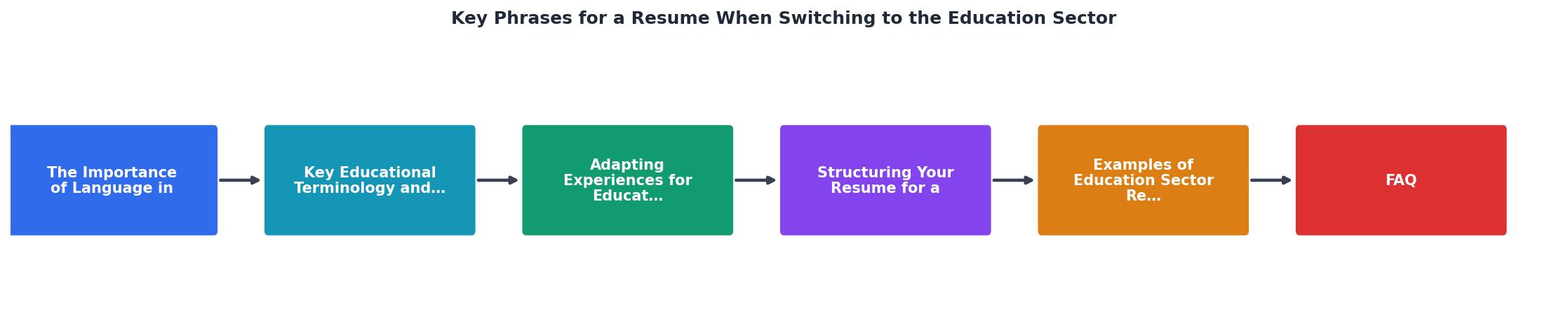
The steps are straightforward: Identify Transferable Skills, Research Education Keywords, Rewrite Bullet Points, Align With Job Posting, and Review With ATS Tool. Each step builds on the previous one, and skipping the research phase is where most career changers stumble.
Structuring Your Resume for the Switch

A chronological resume that leads with your old job title works against you. Instead, use a combination (hybrid) format that puts your relevant skills and education-aligned accomplishments first.
Professional summary (3-4 lines at the top):
Open with your target role and education philosophy, not your previous title. Example: "Instructional design professional with 8 years of training facilitation experience transitioning to K-12 education. Committed to differentiated instruction and data-driven student outcomes. Experienced in curriculum development, LMS administration, and stakeholder engagement."
Relevant skills section:
Place this directly below the summary. List 8-12 skills using exact phrases from the job posting. Group them into categories like "Instruction & Curriculum," "Technology," and "Leadership."
Professional experience:
For each role, write 3-5 bullet points using the education translations from the table above. Start every bullet with an action verb: designed, facilitated, assessed, coordinated, implemented, mentored.
Education and certifications:
If you are pursuing a teaching certificate, alternative certification program, or relevant coursework, list it here even if it is in progress. "Expected completion: December 2026" is perfectly valid and shows commitment.
Volunteer and related experience:
Tutoring, coaching, Sunday school teaching, mentoring programs, PTA involvement. These are gold for career changers. They demonstrate direct contact with learners.
Here is an example dashboard showing how a well-optimized education resume compares to an untranslated one when scored against a typical teaching job posting:
Before: Corporate Language
After: Education Vocabulary
The difference is stark. Same person, same experience, completely different results based on language alone.
Education Resume Template
Use this checklist as a step-by-step guide when building or revising your resume for an education role. Each item maps to a section or technique covered above.
Education Career Switch Resume Checklist
Your progress is saved automatically in your browser.
FAQ
Frequently Asked Questions
What part of your experience has been hardest to translate into education language? Share your trickiest bullet point and let's figure out the right phrasing together.
Additional Resources
- How to Write a Career Change Resume - Template - Wharton - When you're changing careers, your resume needs to emphasize relevant skills. Learn how to write a career change resume & download our example template.
- Revamping Your Resume for a Career Change - Write down everything you did with those teachers to do on the job training, and then put it in terms that will remain truthful to your work, ...
- What keywords and phrases to use for the education sector? - Common keywords include curriculum development, instructional design, student assessment, classroom management, learning outcomes, educational technology, ...
Get the 356 complete recruitment audit (free PDF)
Download the free PDF with 356 reasons hiring stalls, plus optional daily email tips. No credit card.
Get the free PDF 356 reasons · Free download