Is Listing Hobbies Beneficial on a Resume for a Career Switch?
When you're switching careers, every line on your resume is real estate. You're already fighting an uphill battle: hiring managers see a gap, a mismatch, or years in the "wrong" field. The question becomes ruthless fast: does this hobby help me land an interview in my new industry, or does it waste space and make me look unfocused?

When you're switching careers, every line on your resume is real estate. You're already fighting an uphill battle: hiring managers see a gap, a mismatch, or years in the "wrong" field. The question becomes ruthless fast: does this hobby help me land an interview in my new industry, or does it waste space and make me look unfocused?
The answer is yes and no. Hobbies can be your secret weapon in a career transition, but only if they're strategic. A poorly chosen hobby actually hurts your odds. A well-chosen one signals transferable skills, drive, and cultural fit that a hiring manager can't ignore.
Photo by cottonbro studio from Pexels
TL;DR:- Hobbies on a career-switch resume work best when they demonstrate transferable skills or cultural alignment with your target role.
- Include hobbies that show leadership, problem-solving, creativity, or technical depth, not just leisure.
- Exclude hobbies that are generic, time-consuming without obvious value, or contradict your target field.
- Frame hobbies concretely: what did you build, organize, or achieve, not just "I enjoy X."
When you switch fields, hiring managers face a trust problem. You're unproven in their world. They want signals that you'll survive the transition. A hobby listing can either reinforce that you're serious and capable, or it can make you look like you're hedging bets and not fully committed. That's why strategic selection matters so much.
The real opportunity with hobbies during a career switch is translation. You're not just listing what you do for fun, you're demonstrating how your existing skills, interests, and work ethic apply to the new field. A project manager moving into UX design who mentions running a community gardening program isn't just saying "I like plants." They're showing they understand stakeholder management, planning constraints, and turning chaos into order. That's UX.
Why hobbies matter in a career transition

Recruiters screening resumes for career changers are looking for one clear signal: relevance. Your job history doesn't provide it. Your skills section might not either. But hobbies can fill that gap if they're chosen deliberately.
Here's why hobbies work for career switchers:
They prove initiative. If you're teaching yourself web development through side projects or leading a nonprofit board, you're showing you take action without waiting for permission. Career changers who succeed are self-starters. Hobbies prove that.
They demonstrate transferable skills. Public speaking at Toastmasters, organizing community events, building furniture, running a blog, each one translates directly to professional competencies. A hiring manager sees past the word "hobby" and recognizes the skill underneath.
They show cultural fit. If the company values sustainability and you volunteer for an environmental nonprofit, that alignment matters. If they're building a collaborative product and you coach a sports team, you've already shown you work well in teams.
They address experience gaps. You can't lie about years in the field, but you can show that you're actively building expertise. A data analyst switching from finance who lists "machine learning projects on Kaggle" is saying "I'm serious about this, and I'm learning."
"Most are ruled out for a lack of relevant experience (the job, the companies they've worked in, the size of teams) or they're too hoppy or the CV is too scattered.">, Hobbies on your CV.
The last part of that quote is critical: "too hoppy." A resume that looks scattered, jumping from one industry to another without coherence, signals you don't know what you want. Hobbies can either reinforce that scattered feeling or anchor your narrative. The difference is deliberate selection.
How to identify hobbies worth including

Not every hobby belongs on your resume, especially during a career switch. Your goal is to include only those that either demonstrate a relevant skill or signal the kind of person who thrives in your target role.
Ask yourself these questions for each hobby:
Does it demonstrate a transferable skill? Writing a blog about your industry shows communication and thought leadership. Building computers shows technical depth and attention to detail. Organizing a community group shows project management. If the answer is no, the hobby probably stays off the resume.
Is it relevant to the target role or industry culture? A software engineer switching to environmental consulting doesn't need to mention their competitive gaming hobby. But if they volunteer for a conservation organization, that belongs. Match the hobby to the destination, not your current role.
Does it show depth or commitment? "Photography" is generic. "Documenting wildlife for a nature publication" shows expertise and contribution. One-off activities don't carry the same weight as hobbies you've pursued seriously for months or years.
Would it prompt a positive conversation in an interview? The best hobbies are ones that naturally lead to a recruiter asking "Tell me more about that." If a hiring manager reads your hobby and has nothing to ask, it's not earning its space.
Does it contradict or complicate your narrative? If you're switching into a demanding role that requires focus, listing hobbies that consume massive time might raise questions. A coding bootcamp graduate switching into software development doesn't need to mention a 10-hour-a-week side business.
Concrete examples of hobbies that work
A teacher transitioning to instructional design: "Designing course curriculum and teaching materials for community ESL programs." This shows design thinking, pedagogy knowledge, and hands-on learning design.
A marketer moving to data analysis: "Self-taught Python and SQL through personal analytics projects; competed in Kaggle competitions focusing on predictive modeling." This proves technical capability and serious commitment to the new field.
A sales professional entering product management: "Led cross-functional volunteer teams at nonprofit; managed stakeholder priorities and product roadmap for community outreach initiatives." This translates directly to PM responsibilities.
A finance analyst switching to UX research: "Conducted user research and usability testing for a consumer app project; synthesized data and produced actionable insights for design improvements." This is literally UX work experience, just not paid.
Each example takes a hobby and reframes it as evidence of relevant capability.
Process for deciding what to include
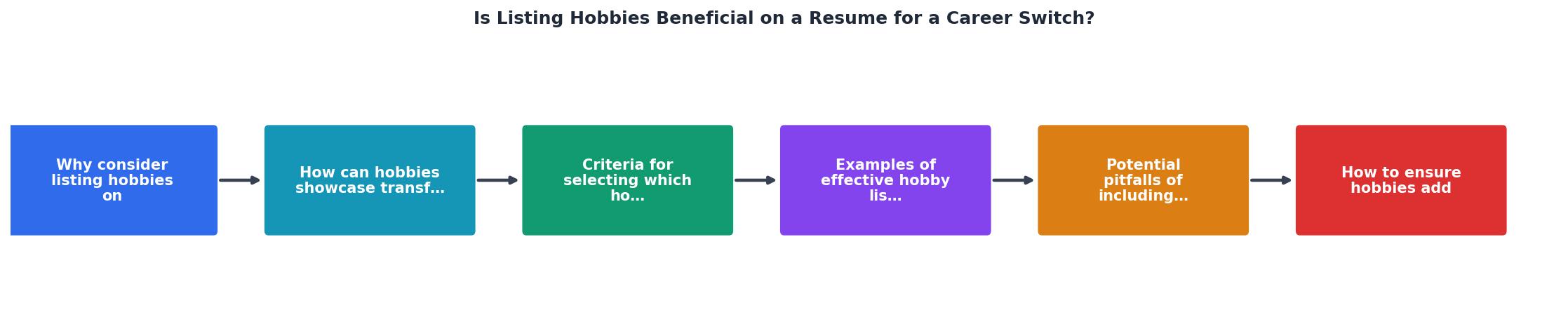
Pitfalls to avoid
Including hobbies on a career-switch resume can backfire. Watch for these mistakes:
The generic hobby. "Reading," "cooking," "traveling", these say nothing specific and waste space. Every resume includes these. Unless you can tie the hobby to something concrete ("Researched food culture through travel blogs published on Medium"), leave it off.
The scattered signal. If you list hobbies that have nothing to do with each other or your target role, you reinforce the perception that you're unfocused. A hiring manager reads your resume thinking "So what do you actually want to do?"
The time-sink problem. If your hobbies consume 20 hours a week and you're switching into a demanding field, you risk appearing uncommitted to your new direction. Be realistic about what the employer will infer.
The contradictory hobby. A lawyer switching into a calm, contemplative field probably shouldn't emphasize their hobby of high-stakes poker tournaments. Know your audience.
The outdated hobby. "Blogged about tech from 2012-2014", if you're not active in it now, it looks like you've abandoned the skill. Hobbies should feel current.
To help you decide which hobbies belong on your career-switch resume, here's a quick selector. For each hobby you're considering, check whether it demonstrates transferable skill, shows current commitment, and signals cultural fit:
Hobby Resume Check
How to frame hobbies for maximum impact
Once you've decided which hobbies to include, how you present them matters as much as which ones you choose.
Use action verbs and concrete outcomes. Instead of "Photography enthusiast," write "Documented product launches and team culture for company blog; portfolio features 150+ published images." Instead of "I enjoy painting," write "Created and sold original watercolor prints through online gallery; 30+ commissions completed."
Quantify when possible. Numbers stick. "Led 15-person volunteer team," "Published 40 articles on tech topics," "Built 12 web projects using React and Node.js", these are more memorable than "interested in building things."
Connect the skill to the job description. If the role emphasizes collaboration and you organize a community group, lead with that angle. If it's about creativity and innovation, frame your hobbies through that lens.
Place hobbies strategically. In a career switch, hobbies that demonstrate target-field skills should go in a dedicated section near the top of your resume, not buried at the bottom. They're not an afterthought, they're evidence.
Key takeaway
Checklist: Hobby selection for your career-switch resume
Hobby Inclusion Checklist for Career Switchers
Your progress is saved automatically in your browser.
FAQ
Frequently Asked Questions
When you're building your career-switch resume, remember that every element should answer one question: Does this help the hiring manager see why I'll succeed in this new field? Your hobbies are no exception. Choose them strategically, frame them concretely, and they become evidence of your capability and commitment. Ignore that discipline, and they become noise.
Additional Resources
- Guide to Including Hobbies and Interests on a Resume - If you are looking to make a career change or you want hiring managers to see you in a different light, including hobbies can help.
- Hobbies on your CV. | Lee Harding - Listing hobbies and interests can add value, especially when: You're switching careers or are new to an industry. They show your fit with the ...
- Listing Hobbies on Your Resume: How to Add a Personal ... - Including your hobbies on a resume shares unique information about you that can highlight skills important to the job you're applying for.

Get the 356 complete recruitment audit (free PDF)
Download the free PDF with 356 reasons hiring stalls, plus optional daily email tips. No credit card.
Get the free PDF 356 reasons · Free download