Addressing Long Career Breaks in a Marketing Resume
You stepped away from marketing for two years, maybe five, and now every job application feels like a confession. The gap sits on your resume like a blank page in a portfolio, and you know recruiters notice it before they notice anything else. The good news is that a career break does not erase your skills, and with the right resume structure, you can shift the conversation from what you missed to what you bring.

You stepped away from marketing for two years, maybe five, and now every job application feels like a confession. The gap sits on your resume like a blank page in a portfolio, and you know recruiters notice it before they notice anything else. The good news is that a career break does not erase your skills, and with the right resume structure, you can shift the conversation from what you missed to what you bring.
Photo by Lukas Blazek from Pexels
TL;DR:- Structure your marketing resume around skills and outcomes rather than a strict timeline to minimize the visual weight of a gap.
- Fill the break with real evidence: freelance projects, online certifications (Google Analytics, HubSpot), volunteer campaigns, or a personal blog.
- Write a professional summary that addresses the break in one sentence and pivots immediately to your value proposition.
- Use your cover letter to give context honestly, then redirect to what you can deliver starting day one.
Why Career Breaks Scare Marketing Hiring Managers
Marketing moves fast. Platforms change quarterly, algorithms shift overnight, and the tools a content strategist used in 2021 look nothing like the stack in 2026. Hiring managers worry that a candidate who stepped away has fallen behind on marketing automation, AI-driven analytics, and short-form video strategy.
That concern is real, but it is also manageable. The gap itself is not the problem. The problem is a resume that offers no evidence you stayed curious. If you can show even modest engagement with the field during your break, you neutralize the biggest objection before the interview starts.
Common reasons marketing professionals take breaks include parental leave, caregiving, health recovery, relocation, burnout, and pursuing education. None of these are disqualifying. What matters is how you frame the return.
Structuring Your Resume Around Skills

A chronological resume puts the gap front and center. A hybrid (combination) resume leads with a skills section, then lists experience. This format lets you group accomplishments by category rather than date.
Here is what works for marketing returners:
- Professional Summary (3-4 lines) at the top, addressing the break briefly.
- Core Competencies section listing 8-12 relevant skills: SEO, paid media, content strategy, email marketing, CRM platforms, A/B testing, brand positioning, social media management.
- Selected Achievements with 3-5 bullet points showing measurable results from your pre-break career.
- Experience in reverse chronological order, with the break noted simply (e.g., "Career Break | 2023-2025 | Family caregiving").
- Education & Certifications at the bottom, with recent certifications listed first.
The hybrid format does not erase the break. It changes the reading order so the recruiter encounters your value before encountering the gap.
Showcasing Recent Experiences
The strongest thing you can do during or after a career break is create evidence. Even small projects count. Here are concrete examples:
- Freelance work: Managed social media for a local bakery, ran a Facebook Ads campaign for a friend's Etsy shop, wrote blog posts for a nonprofit. List these under a "Freelance Marketing Consultant" heading with dates.
- Certifications: Google Analytics 4 Certification, HubSpot Inbound Marketing, Meta Blueprint, Semrush SEO Toolkit Course. These are free or low-cost and signal current knowledge.
- Personal projects: Launched a niche blog, grew an Instagram account to 2,000 followers, ran a newsletter on Substack. Treat these like portfolio pieces.
- Volunteer campaigns: Organized a fundraiser's email campaign, designed flyers for a school event, managed a community group's social presence.
Writing a Summary That Works

Your professional summary is the first thing a recruiter reads. It needs to do three things in 3-4 sentences:
- State your identity and experience level ("Marketing professional with 7 years of experience in B2B content strategy and demand generation").
- Acknowledge the break without apologizing ("Returning after a two-year career break for family caregiving").
- Pivot to current readiness ("Recently completed Google Analytics 4 and HubSpot certifications; eager to apply updated skills to a growth-stage team").
"Results-driven marketing manager with 8 years of experience leading content, email, and paid acquisition campaigns for SaaS companies. After a two-year career break, I completed certifications in GA4 and HubSpot Marketing Hub and managed freelance campaigns generating 40% open rates. Looking to bring strategic thinking and hands-on execution to a mid-size marketing team."
That summary answers the gap question and moves on. No over-explaining, no emotional justification.
Addressing the Break in Your Cover Letter
The cover letter gives you space the resume does not. Use one paragraph, ideally the second, to address the break directly. Keep it to 2-3 sentences.
A strong pattern:
- Sentence 1: State the break and reason briefly ("I took a planned two-year break to care for a family member").
- Sentence 2: Mention what you did to stay connected ("During that time, I completed three marketing certifications and managed social campaigns for two local businesses").
- Sentence 3: Redirect to the role ("I am excited to bring that refreshed perspective to [Company]'s content team").
"The situation could be explained, and the recruiter could guide the conversation to focus on 'How good their actual work experience is'.">, How do you explain a 5
Do not dedicate the entire cover letter to the break. One paragraph handles it. The rest of the letter should focus on why you are a strong fit for this specific role.
Step-by-Step Resume Update Process
This is the process for updating your marketing resume after a career break, from audit to final submission.
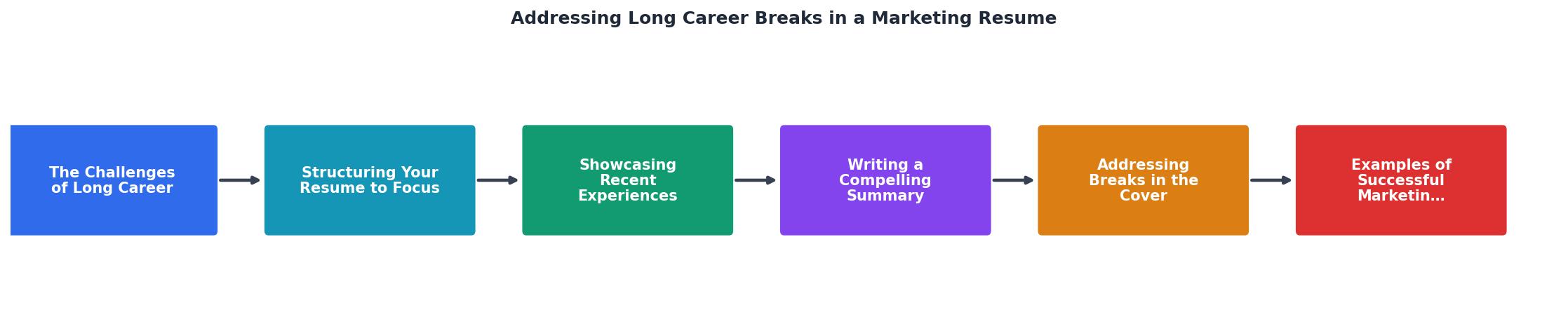
Follow these steps in order: Audit, Upskill, Build Evidence, Restructure, Tailor, Review, Submit. Each step builds on the previous one, and skipping the upskill or evidence-building phases leaves your resume without the proof recruiters need.
The interactive card below shows a typical timeline for a marketing professional returning after a two-year break. These timeframes assume part-time effort while managing other responsibilities.
Resume Comeback Timeline (2-Year Break)
Key Skills to Highlight After a Break
Marketing hiring managers in 2026 look for a specific mix of strategic and technical skills. If you can demonstrate competence in even half of these, the break becomes a footnote.
| Always In Demand | Rising Fast in 2026 |
|---|---|
| SEO & keyword research | AI prompt engineering for content |
| Email marketing & automation | Short-form video production (Reels, TikTok) |
| Google Analytics / GA4 | First-party data strategy |
| Content strategy & copywriting | Marketing attribution modeling |
| Paid search (Google Ads) | Community-led growth |
| Social media management | Conversational marketing (chatbots) |
Pick the skills that match your target role and weave them into your summary, skills section, and bullet points. Use the exact terminology from the job description. If the posting says "demand generation," do not write "lead gen" on your resume. Mirror the language.
Tools like Resume Hedgehog can help you match your resume language to a specific job posting automatically, which is especially useful when you are re-entering a field and the terminology has shifted since you left.
Marketing Resume Post-Break Update Checklist
Your progress is saved automatically in your browser.
FAQ
Frequently Asked Questions
What was the biggest challenge you faced when updating your resume after a career break? Share your experience in the comments.
Additional Resources
- Resume Samples Following a Career Break - Discover effective strategies for updating your resume after taking a career break by following these instructions and reviewing career ...
- How do you explain a 5-year career gap on your CV? - A simple, honest explanation without going into unnecessary detail can help employers see the person, not just the timeline. More importantly, ...
- How to Explain a Career Break in a Cover Letter - USC Online - “If it's not that long of a career break, you don't need to mention it. A month or two or three or four, don't say anything in the cover letter.

Get the 356 complete recruitment audit (free PDF)
Download the free PDF with 356 reasons hiring stalls, plus optional daily email tips. No credit card.
Get the free PDF 356 reasons · Free download