
You've heard it a hundred times: keep your resume to one page. But does that advice hold up when an Applicant Tracking System is scanning your application? The truth is messier than you think. A one-page resume can help ATS parse your information cleanly, but it can also strip away critical details that push you past the screening phase. The answer depends entirely on your experience level, the role you're targeting, and how you structure your content.
Photo by Vitaly Gariev from Pexels
TL;DR:- A one-page resume is beneficial for ATS parsing due to its concise format, but longer resumes work just as well if formatted correctly.
- Experienced professionals (10+ years) often need two pages to convey qualifications without cutting essential achievements.
- ATS systems don't penalize length; they penalize poor formatting, missing keywords, and unclear structure.
- The real optimization is content relevance and keyword match to the job description, not page count.
Here's what most hiring managers and resume coaches don't explicitly say: ATS systems don't care about page count. They care about structure, formatting, and keywords. A two-page resume with clean formatting and relevant skills will pass through ATS just as easily as a one-page resume with vague bullet points. The obsession with the one-page rule comes from human recruiters who had to print resumes and store them in filing cabinets. That constraint is gone. What matters now is whether your resume can be parsed, whether it contains the keywords the system is searching for, and whether the most relevant information rises to the top.
What is ATS and how does it work?

An Applicant Tracking System is software that hiring teams use to post job openings, collect applications, and filter candidates automatically. When you upload your resume, the ATS extracts text from your file and scores it based on how well it matches the job description. It's looking for keyword matches, skill alignment, experience level, and education credentials.
The system reads resumes sequentially, line by line, from top to bottom. It parses contact information, work history, skills, education, and certifications. Depending on the ATS configuration, it may also extract dates, company names, and job titles. Some advanced systems use natural language processing to understand context and infer skills from job descriptions.
Here's the critical part: ATS doesn't care whether your resume is one page or five pages. It cares whether it can read the text. Common failures include:
- Resumes saved as image files (JPG, PNG) instead of text-based formats
- Complex multi-column layouts that confuse parsing algorithms
- Unusual fonts or graphics that obscure text
- Headers and footers that get stripped or misread
- Inconsistent date formatting
Why one-page resumes get recommended
The one-page rule became gospel because of perceived benefits:
- Brevity filters laziness. A one-page resume forces you to cut fluff and prioritize impact. If you can't describe your value in a page, you probably haven't distilled your story.
- Human recruiters prefer scanning. Recruiters often scroll through 50+ applications a day. A concise resume that hits them with relevance immediately wins attention. Multi-page resumes get skimmed less thoroughly.
- It works for entry-level and early-career roles. Someone with two years of experience genuinely doesn't have ten pages of material. A one-page resume matches their experience level and looks polished.
- It's a filter for carefulness. Poor summarization, rambling bullet points, and irrelevant details suggest the candidate isn't detail-oriented. A tight one-page resume shows discipline.
When a one-page resume actually hurts you

If you have 12 years of software engineering experience, squeezing that onto one page means deleting roles, projects, technologies, and achievements. Those deletions eliminate keywords that might match the job posting. If the role requires experience with AWS, Kubernetes, and Terraform, and you skip those tools to save space, the ATS won't see them.
"Many times, the ATS system scans your resume first, looking for keywords and parsing it in a specific order, so shortening your resume to one page makes absolutely no sense.">, No, a one page resume is not better.
Here are situations where a longer resume outperforms one-page versions:
- Senior roles (8+ years). A VP of Engineering with 12 years of experience across four companies will lose critical context on a single page. Two pages allow you to show scope of responsibility, team size, and measurable outcomes.
- Roles with diverse skill stacks. A data scientist with expertise in Python, R, SQL, machine learning, cloud platforms, and statistical modeling has more than one page of legitimate skills to showcase.
- Roles with specialized credentials. A healthcare professional with certifications, continuing education, relevant coursework, and clinical experience needs space to list them.
- Career transitions requiring proof of relevance. Someone moving from consulting to product management needs to highlight consulting projects that demonstrate product thinking, market analysis, and cross-functional collaboration. That takes room.
- Academic or research-heavy positions. Professors, researchers, and technical IC roles often require a CV format longer than one page to capture publications, grants, speaking engagements, and institutional service.
How ATS actually parses resume length
Here's what the data shows: ATS parsing efficiency has no correlation with page length. A well-structured two-page resume parses as cleanly as a one-page resume. The difference comes down to formatting.
This process diagram shows how ATS typically handles document intake:
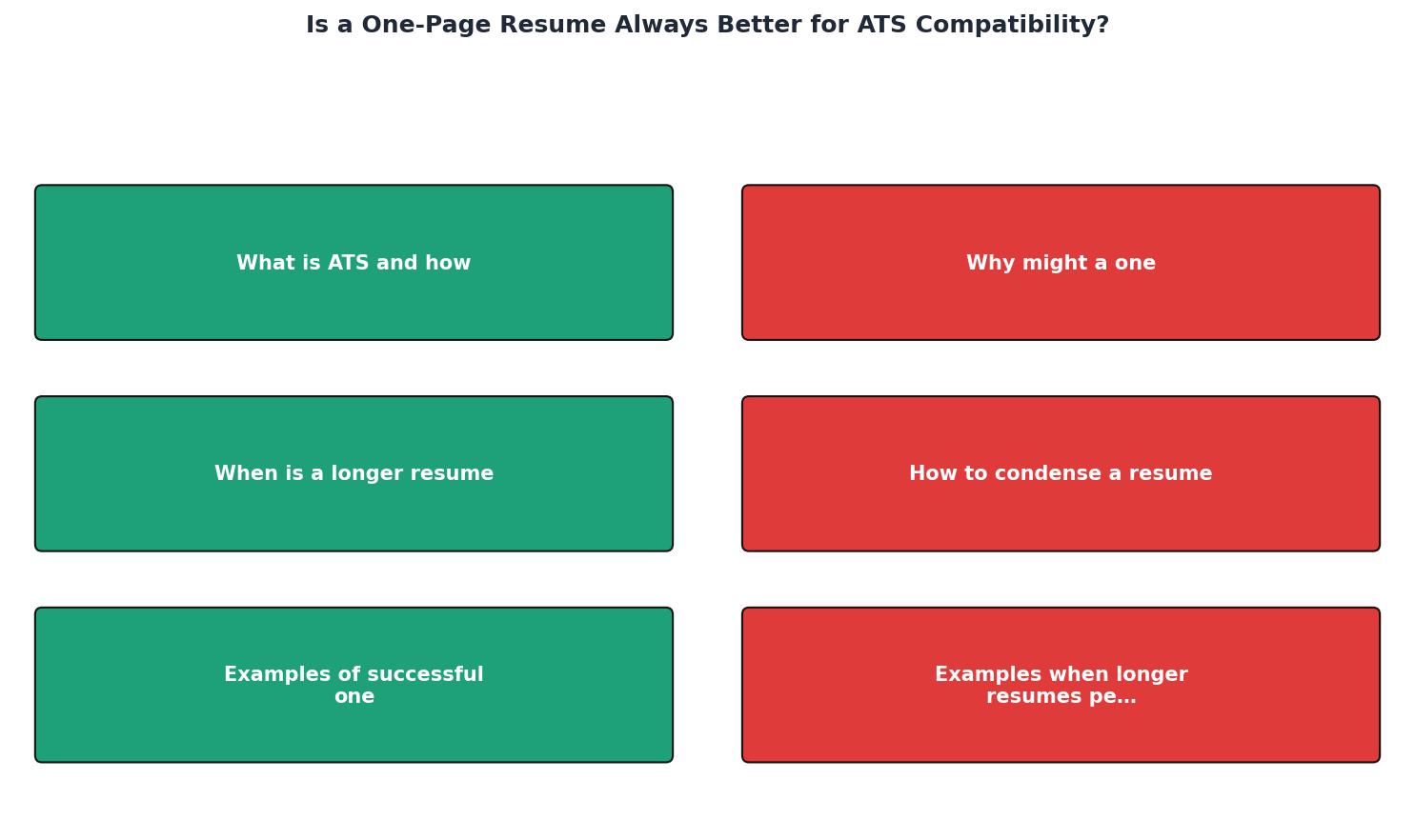
- Header extraction, Name, phone, email
- Section parsing, Experience, skills, education
- Keyword matching, Comparing extracted text against job description
- Scoring, Ranking candidates by match percentage
Condensing without losing impact
If you do decide to aim for one page (or are targeting roles where brevity is standard), here's how to cut smartly:
Keep these elements no matter what:- Contact information and professional summary or headline
- Your most relevant 3-5 roles (or last 10 years, whichever is shorter)
- Quantified achievements for each role
- Core technical skills matching the job description
- Relevant education and certifications
- Outdated skills (if you used VB.NET in 2010, drop it unless the role explicitly requires legacy tech)
- Generic responsibilities ("Responsible for managing stakeholders" with no outcome)
- Soft-skill-only bullet points with no business impact
- Multi-line explanations; use one punchy line instead
- Volunteer roles unless directly relevant to the target role
- High school achievements (only list college and above)
- Instead of "Led a team of 8 developers in the migration of a legacy monolith to microservices," write "Led 8-person team migrating $2M monolith to microservices, reducing latency 40%."
- Instead of listing three separate marketing roles at the same company, combine them into one entry showing progression.
- Replace role descriptions with bullet points; drop introductory sentences.
Real examples: when one-page vs. two-page won
One-page resume wins:- Entry-level engineer with one internship and a bootcamp certificate applying to junior developer roles
- Recent MBA graduate applying for associate positions (limited professional history)
- Candidate with 3-4 years of experience in a single industry, consistent progression
- Senior software engineer with 10 years across three companies, multiple languages, cloud platforms, and major projects
- Product manager transitioning from consulting, showing six years of deal work, cross-industry exposure, and relevant PM skills
- Healthcare administrator with 12 years, multiple certifications, continuing education, and institutional roles
Key formatting rules that matter more than length
Regardless of length, these formatting practices have a direct impact on ATS parsing success:
- Use standard fonts. Stick with Arial, Calibri, or Times New Roman. Decorative fonts confuse parsers.
- Avoid tables and graphics. Use plain text or simple bullet points. Tables often get misread.
- Use consistent date formatting. Pick MM/YYYY or Month Year and stick with it throughout.
- Put your contact info at the top. ATS expects name and email in the header.
- Use standard section headers. "Experience," "Skills," "Education" (not "Professional Journey" or "What I've Done").
- No columns. Multi-column layouts get parsed out of order.
- Save as PDF or DOCX. Avoid RTF, TXT, or image formats when possible.
- Use clear hierarchy. Company name → job title → dates → bullet points.
When to prioritize one page anyway
One-Page Resume is Genuinely Optimal For:
- Any role in creative industries (design, UX, advertising) where visual economy signals good taste
- Early-career roles where two pages implies over-qualification or lack of judgment
- Competitive high-volume hiring where brevity improves human recruiter scan time
- Certain geographic markets (UK, France, Germany often prefer one-page)
- ATS systems with strict page-count filters (rare, but they exist)
In these contexts, a one-page resume isn't just acceptable, it's the professional standard. The creative industry, for example, views a tight one-page resume as a signal that you can edit ruthlessly and present information with intention. Ignoring that norm works against you.
Geographic norms matter. In Europe, one-page CVs are traditional and expected. In the US and Canada, a two-page resume is standard for mid-to-senior roles. If you're applying to European roles, keep it to one page. If you're applying for senior US roles, two pages are expected and won't hurt your chances with ATS.
Practical approach: tailoring to the role, not the format
The strongest strategy is to tailor your resume to the job posting, then let length fall where it naturally lands. Here's how:
- Read the job description and pull out 15-20 key phrases and skills
- Build your resume to include those phrases naturally within your work history and skills section
- Prioritize achievements that demonstrate those skills (use numbers: budgets, team size, revenue impact, time saved)
- Cut roles and projects that don't support the target role
- Format cleanly and let the page count be what it is
One-Page Resume Optimization Checklist
Your progress is saved automatically in your browser.
FAQ
Frequently Asked Questions
Additional Resources
- No, a one page resume is not better. | Jennifer Schlador - Length doesn't matter to an ATS system. Despite the many resume writers of the past few days saying that one page resumes are better. This isn't ...
- One-Page vs Two-Page Resume: What ATS Prefers in 2026 - Applicant Tracking Systems (ATS) in 2026 no longer favor one-page resumes over two-page ones. Instead, they prioritize signal density - the ...
- A Two-Page (or More) Resume is Ok! But Only in These ... - Two-page resumes allow job seekers to present their qualifications, ensure readability, and successfully navigate the ATS. They are especially ...

Get the 356 complete recruitment audit (free PDF)
Download the free PDF with 356 reasons hiring stalls, plus optional daily email tips. No credit card.
Get the free PDF 356 reasons · Free download