Optimizing Your Resume for ATS in a Career Change
Changing careers can be a daunting task, especially when you're trying to get past an Applicant Tracking System (ATS) that seems designed to weed out anyone who doesn't fit a specific mold. But what if you could tailor your resume to not only pass through these digital gatekeepers but also stand out to hiring managers? This article will guide you through the process of optimizing your resume for ATS when you're making a career change, ensuring that your skills and experiences are presented in the best possible light.

Changing careers can be a daunting task, especially when you're trying to get past an Applicant Tracking System (ATS) that seems designed to weed out anyone who doesn't fit a specific mold. But what if you could tailor your resume to not only pass through these digital gatekeepers but also stand out to hiring managers? This article will guide you through the process of optimizing your resume for ATS when you're making a career change, ensuring that your skills and experiences are presented in the best possible light.
Photo by Markus Winkler from Pexels
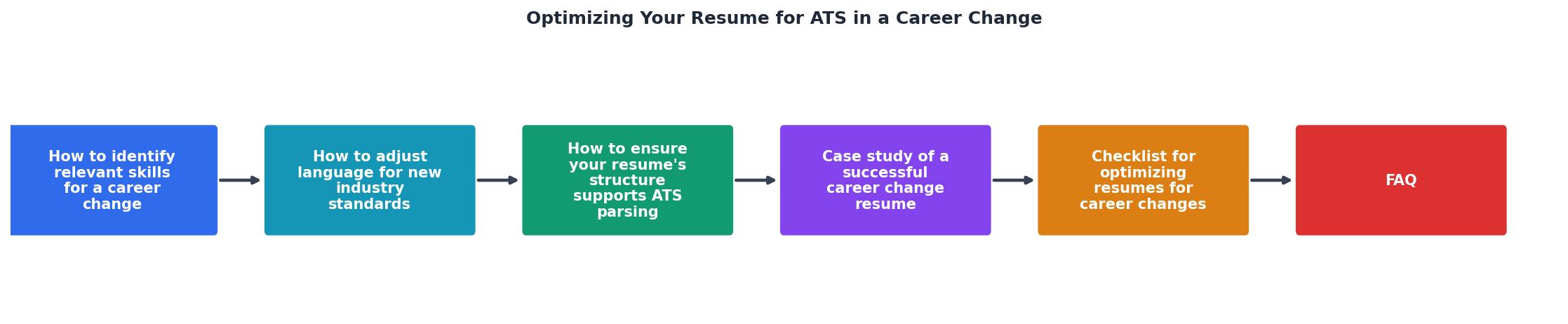
TL;DR: Optimize your resume for ATS during a career change by identifying relevant skills, adjusting language to match new industry standards, and ensuring structural compatibility. Follow a case study and checklist for effective transition.
When you're transitioning to a new career, the challenge is not just about acquiring new skills but also about presenting your existing skills in a way that aligns with your new target industry. Many job seekers find themselves overwhelmed, unsure of how to translate their past experiences into the language of a new field. This guide will provide you with actionable steps to bridge that gap, making your resume both ATS-compliant and appealing to human eyes.
Identifying Relevant Skills for a Career Change
The first step in optimizing your resume for a career change is to identify which of your current skills are transferable to your new career path. This requires a deep understanding of both your own experiences and the requirements of the new industry.

Techniques for Skill Identification
- Analyze Job Descriptions: Start by collecting several job postings in your target field. Highlight the skills and experiences that are mentioned frequently.
- Self-Assessment: Reflect on your past roles and list out the skills you utilized. Consider both hard skills (e.g., software proficiency) and soft skills (e.g., leadership).
- Skill Mapping: Create a chart that matches your existing skills with those required in your new field. This can help you visualize the overlap and identify areas for development.
- Seek Feedback: Discuss your career change with mentors or colleagues who understand both your past and future industries. They can provide insights into how your skills translate.
Real-World Example
Consider a teacher transitioning to an instructional designer role. Many skills such as curriculum development, assessment creation, and classroom management are directly applicable to designing educational materials for corporate training.
Adjusting Language for New Industry Standards
Once you've identified your transferable skills, the next step is to adjust your resume's language to align with the jargon and standards of your new industry. This is crucial for both ATS parsing and making a strong impression on hiring managers.

Examples and Tips
- Use Industry Keywords: Incorporate keywords from job descriptions into your resume. This includes specific software, methodologies, and competencies.
- Adopt Industry Formats: Look at resumes from professionals in your target field. Note the structure, style, and language they use.
- Focus on Results: Whenever possible, quantify your achievements. Numbers and statistics can make your accomplishments more tangible.
Ensuring Your Resume's Structure Supports ATS Parsing
An ATS-compatible resume requires careful attention to structure and format. Many resumes are discarded because they are not formatted in a way that these systems can understand.
Formatting Guidelines
- Use Standard Headings: Stick to conventional headings like "Experience," "Education," and "Skills." ATS systems rely on these to categorize information.
- Avoid Complex Formatting: Fancy designs and graphics can confuse ATS. Stick to a simple, clean layout.
- Save as a Plain Document: Use formats like .docx or .pdf, but ensure that the PDF is text-based rather than image-based.
Case Study of a Successful Career Change Resume
Let's look at a case study to illustrate these principles in action. Meet Sarah, a former marketing manager who successfully transitioned into a project management role.
Analysis and Insights
- Skill Mapping: Sarah identified her skills in strategic planning and team management as relevant to project management.
- Language Adjustment: She adopted project management terminology, replacing terms like "campaign management" with "project lifecycle management."
- Structured for ATS: Her resume was formatted with clear headings and bullet points, ensuring easy parsing by ATS.
Checklist for Optimizing Resumes for Career Changes
A checklist can help you ensure that you have covered all necessary bases when optimizing your resume for a career change.
Optimizing Your Resume for Career Change
Your progress is saved automatically in your browser.
FAQ
Frequently Asked Questions
Key takeaway: Successfully optimizing your resume for a career change involves identifying transferable skills, adjusting language for the new industry, and ensuring ATS compatibility.
To visualize the impact of these strategies, consider this interactive element that shows the typical process of optimizing a resume for a career change. It highlights the key steps and their importance.
Step 1: Skill Identification
Analyze your current skills and map them to the requirements of your new career.
Step 2: Language Adjustment
Adopt the terminology and keywords of your target industry.
Step 3: Structural Formatting
Ensure your resume is formatted for ATS compatibility.
Changing careers is a bold move, but with the right strategies, you can make a seamless transition. How has your resume evolved during your career change journey? Share your experiences and insights in the comments below!
Additional Resources
- How to Create a Resume for a Career Change - Pro Tip: Use keywords from job descriptions to optimize your resume for Applicant Tracking Systems (ATS). Hiring software often filters out ...
- How to Optimize Your Resume for ATS - Learn how to optimize your resume for ATS. Use formatting, keywords, and structure that help you pass the scan and land interviews faster.
- Career Change Resume Guide (2026): How to Rewrite ... - Step-by-step guides on rewriting your resume for a new field; ATS strategies specifically for career changers; Real examples of successful ...

Get the 356 complete recruitment audit (free PDF)
Download the free PDF with 356 reasons hiring stalls, plus optional daily email tips. No credit card.
Get the free PDF 356 reasons · Free download