Presenting Parental Leave Gaps on a Healthcare Resume
You took time off to raise a child, and now your healthcare resume has a gap that feels like a flashing red light. Hiring managers in hospitals, clinics, and long-term care facilities see hundreds of resumes each week, and a blank stretch of months or years can trigger questions you never get the chance to answer. The good news is that parental leave gaps are common, completely explainable, and with the right formatting and framing, they can actually demonstrate qualities employers want: commitment, planning, and the ability to manage competing priorities.

You took time off to raise a child, and now your healthcare resume has a gap that feels like a flashing red light. Hiring managers in hospitals, clinics, and long-term care facilities see hundreds of resumes each week, and a blank stretch of months or years can trigger questions you never get the chance to answer. The good news is that parental leave gaps are common, completely explainable, and with the right formatting and framing, they can actually demonstrate qualities employers want: commitment, planning, and the ability to manage competing priorities.

- Frame your parental leave as a deliberate career decision, not a gap to apologize for.
- Fill the timeline with real professional development: renewed certifications, CEU courses, volunteer clinical hours, or healthcare-related community work.
- Use a strong summary section and a targeted cover letter to reassure employers you are current, licensed, and ready to contribute from day one.
Why Parental Leave Gaps Matter
Healthcare hiring moves fast. A nurse manager reviewing 60 applications for a med-surg position spends roughly six to seven seconds on an initial resume scan. During that scan, unexplained chronological gaps stand out immediately.
The concern is not that you took leave. It is that your clinical skills, certifications, or knowledge of updated protocols might have lapsed. In healthcare specifically, where patient safety depends on current competencies, hiring managers want proof that you stayed engaged with the profession. Addressing the gap head-on removes doubt and shifts the conversation to what you bring to the role.
A gap that is acknowledged and supported with evidence of ongoing learning reads completely differently from a gap that is ignored. One signals self-awareness and professionalism. The other signals a resume the applicant did not bother to update.
Choose the Right Resume Format

The format you pick determines how visible the gap is before you even write a word.
- Chronological format lists positions by date, most recent first. This is the standard in healthcare and what most ATS systems parse best. If your leave was under 12 months, stick with chronological and simply include a one-line entry for the leave period.
- Functional format groups experience by skill category (patient assessment, medication administration, care coordination) rather than by date. This de-emphasizes timelines but can raise suspicion with experienced recruiters who wonder what you are hiding.
- Combination (hybrid) format leads with a skills summary, then follows with a brief chronological work history. For parental leave gaps longer than a year, this is often the strongest choice. You lead with competencies, then show the timeline honestly.
| Chronological | Hybrid | Functional |
|---|---|---|
| Best for gaps under 12 months | Best for gaps over 12 months | Least recommended |
| ATS-friendly | ATS-friendly with care | Often flagged by recruiters |
| Gap is visible but explainable | Skills lead, gap is secondary | Timeline hidden, raises questions |
Highlight Professional Development
This is where you turn a gap into an asset. Even if you were primarily focused on parenting, any professional activity during that period belongs on your resume.
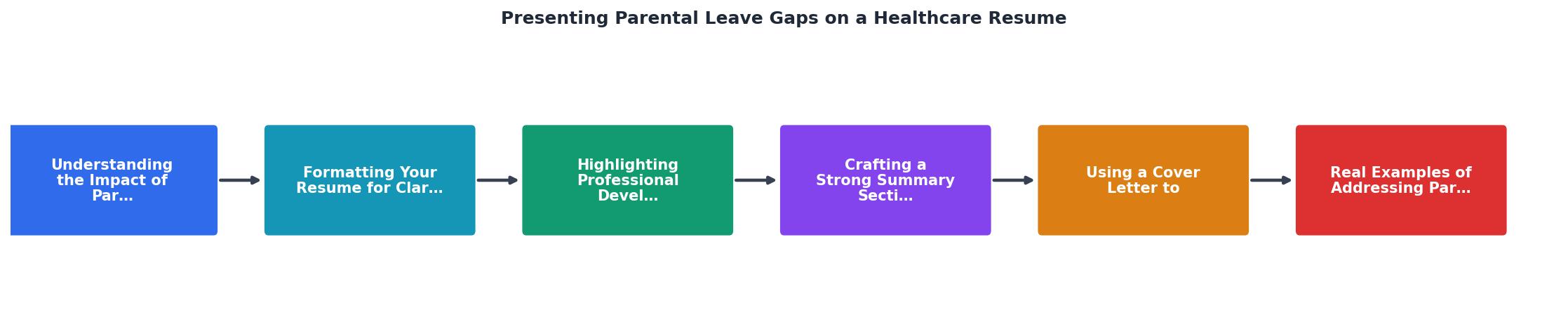
Here is a quick overview of how the entire process fits together, from identifying your gap to submitting a polished application:
Activities that count as professional development during parental leave:
- CEU courses completed online through providers like Medscape, Nurse.com, or your state board's approved list.
- Certification renewals such as BLS, ACLS, PALS, or specialty certifications (CCRN, CEN, OCN).
- Volunteer clinical hours at free clinics, community health fairs, or vaccination drives.
- Professional association memberships maintained in organizations like the ANA, APTA, or ASHA.
- Healthcare-related volunteer work such as health education in schools, parish nursing, or crisis hotline shifts.
- Relevant reading and conferences including virtual conferences, webinars, or journal clubs.
"Think about why you want to go back to work.">, How to address the parental leave gap on your resume
That reflection shapes how you present yourself. If you are returning because you genuinely want to practice clinical care again, that motivation comes through in how you describe your leave and your readiness.
Craft a Strong Summary Section

Your summary section sits at the top of the resume, right below your name and contact information. It is the first thing a hiring manager reads, and it sets the frame for everything that follows.
A strong summary for a returning healthcare professional includes three elements:
- Your clinical identity. State your title, years of experience, and specialty. Example: "Registered Nurse with 8 years of experience in pediatric emergency care."
- Your current status. Mention active licensure and recent certifications. Example: "Active RN license (State of Texas), current BLS and PALS certifications."
- Your return framing. One sentence that acknowledges the leave and pivots to readiness. Example: "Returning from a planned parental leave with updated clinical competencies and a renewed commitment to patient-centered care."
Here is an example dashboard showing how a well-structured return-to-work resume compares to a generic one across key hiring criteria:
Resume Effectiveness: Optimized vs. Generic
Use Your Cover Letter Strategically
Your resume shows what you did. Your cover letter explains why and what comes next. For a parental leave return, the cover letter is where you connect the dots.
Keep it to three focused paragraphs:
- Opening: State the position you are applying for and your core qualification. Do not mention the gap here.
- Middle: Briefly acknowledge the leave (one sentence), then spend the rest of the paragraph on what you did to stay current and why you are excited about this specific role. Mention the facility by name, reference a recent initiative or value from their website, and connect it to your experience.
- Closing: Express enthusiasm, confirm your availability, and invite the next step.
That paragraph does not apologize. It does not over-explain. It states facts and connects them to the employer's needs.
Real Resume Section Examples
Here is how a parental leave entry looks on a chronological resume:
Professional Experience
Parental Leave | January 2024 - March 2025- Completed 30 CEU hours in acute care nursing (Medscape, Nurse.com)
- Renewed ACLS and PALS certifications (American Heart Association)
- Volunteered 60 hours at Downtown Free Clinic providing triage and patient intake
- Provided emergency nursing care to pediatric patients in a Level I trauma center
- Managed triage for an average of 45 patients per shift
If you want to save time tailoring your resume to each specific healthcare job posting, Resume Hedgehog can match your experience and parental leave activities to the exact language in the job description, so your resume speaks the employer's vocabulary.
Post-Parental Leave Healthcare Resume Checklist
Your progress is saved automatically in your browser.
FAQ
Frequently Asked Questions
What strategy worked best for you when returning to healthcare after parental leave? Share your experience so others can learn from it.
Additional Resources
- How To Explain an Employment Gap on Your Resume as ... - In this article, we share tips for parents re-entering the workforce to explain the gap in their resume.
- How to address the parental leave gap on your resume - The trick is keeping it "short, sweet and simple" (ie not listing all your parental responsibilities), to make sure you're giving precedence to your relevant ...
- How to Address Maternity Leave & Gaps in the Resume - Here are a few tips to strengthen and fill gaps in your resume, and position yourself effectively to re-enter the workforce after a career break.

Get the 356 complete recruitment audit (free PDF)
Download the free PDF with 356 reasons hiring stalls, plus optional daily email tips. No credit card.
Get the free PDF 356 reasons · Free download