Prioritizing Coursework and Projects in Entry-Level Resumes
Your resume is thin. No 10-year career to lean on, no track record of scaling teams or shipping products. What you have instead are class projects, coursework, and maybe an internship or two. The question isn't whether to include them, it's which ones matter and how to frame them so employers see competence, not just school stuff.

Your resume is thin. No 10-year career to lean on, no track record of scaling teams or shipping products. What you have instead are class projects, coursework, and maybe an internship or two. The question isn't whether to include them, it's which ones matter and how to frame them so employers see competence, not just school stuff.

- Select coursework and projects that directly align with the job description and demonstrate skills the employer values.
- Detail each project with specific outcomes: what you built, what problem it solved, and what you learned.
- Balance academic work with any real-world experience, leading with the strongest and most relevant items first.
The real skill isn't doing the coursework. It's curating it. Picking the three projects that scream "I understand what you do" beats listing ten generic assignments. That's what separates candidates who get interviews from those who disappear into the reject pile.
Criteria for Selecting Your Best Projects

Before you decide what goes on your resume, you need a filter. Not every project is resume-worthy, and including weak ones wastes the space you need for your strongest work.
Start with relevance to the target job. Read the job description closely. What skills do they emphasize? If they want a Python developer and you built a web scraper in Python, that project earns a slot. If you built a mobile app in Swift but they're hiring for backend work, it's less valuable, unless the project demonstrates architectural thinking or scalability concepts that transfer.
Next, prioritize projects where you solved a real problem or built something functional. Class projects that resulted in working code, deployed features, or measurable improvements beat theoretical exercises. A machine learning model you trained on a public dataset matters more if you explain what accuracy you achieved and why it matters for the problem domain.
Look for projects where you learned or used technologies mentioned in the job posting. This is your shortcut to relevance. If the role lists React, Django, AWS, or Figma, any solid project using those tools becomes interview-relevant. Employers assume competence in tools you've publicly used.
Consider the complexity and scope of what you built. A calculator app is simpler than a multi-page web application with authentication and a database. A single algorithmic problem is less impressive than a system you designed end-to-end. This doesn't mean only include massive projects, but signal that you handled real complexity.
Finally, choose projects where you can articulate your specific contribution clearly. Group work is common in school. If you were one of five people who built something, pick the parts you owned. Did you build the backend? Design the UI? Handle the database? Make it obvious what was yours.
Here's a practical filter: for each project, ask yourself these questions:
- Does this project use skills mentioned in the job description?
- Can I point to a real outcome (works, solves a problem, improves something)?
- Did I have clear ownership over a meaningful piece?
- Can I explain what I did and why in under 30 seconds?
Structuring Project Descriptions with Skills and Outcomes

Here's where most entry-level resumes fail: they describe projects like homework assignments instead of work accomplishments.
Wrong approach: "Built a to-do list application using React."
Right approach: "Built a React-based task management app used by 50+ classmates to organize study groups and assignments, reducing coordination overhead by 40% and achieving 95% feature adoption among beta testers."
The difference is outcome. The first tells employers what you did. The second tells them what impact it had.
When you write up a project, follow this structure:
[Project name or title], [Technologies used]
[One sentence describing what you built and why it mattered], resulting in [measurable outcome or impact].
Let's break this down:
Lead with the outcome, not the technology. Yes, mention the tech (employers filter by it), but lead with the problem you solved. "Designed and deployed a full-stack web application that tracks real-time cryptocurrency prices and alerts users to market opportunities" tells a better story than "Used React, Node.js, and MongoDB."
Be specific about your contribution. If it's a team project, say "Led frontend architecture" or "Implemented payment processing" so it's clear what you owned. Vague language like "contributed to" raises red flags that you're unclear about your role.
Use active verbs. Designed. Built. Implemented. Optimized. Automated. Reduced. Improved. These words signal agency and impact. Avoid passive constructions like "was created" or "involved."
Include a measurable outcome whenever possible. Improved performance by 30%. Reduced page load time from 8 seconds to 2 seconds. Achieved 92% test coverage. Processed data for 500+ users. These numbers prove you understand what matters.
Highlight the skills employers care about. If the job posting emphasizes scalability, mention that your project handles concurrent users or high-volume data. If they value user experience, describe usability improvements. Match the language and values of the job.
Here's a real example that works:
"Led $200k digital marketing campaign from conception to launch, resulting in 120% of target signups in first two months of campaign.">, How, and When, to Include Projects on Your Resume (Plus Examples!)
That one sentence packs specificity (numbers), scope (full lifecycle from conception to launch), and impact (exceeded target by 20%). Even if this came from a course project, it's written like a professional achievement.
Balancing Academic Work with Internships and Real Experience

Hierarchy matters on a resume. Real work beats coursework. If you have even one internship or freelance project, that should come before academic projects on your resume.
Why? Because employers assume school projects are assignments you had to do. Internships and freelance work are things you were hired to do. That's a meaningful distinction.
Here's how to organize your experience section:
- Professional experience first (internships, freelance projects, part-time roles)
- Relevant coursework or academic projects second (only if they're strong and directly relevant)
- Technical skills, GPA, certifications at the bottom (if they're impressive, 3.8+ GPA matters, 3.2 doesn't)
When listing academic projects alongside internship work, use consistent formatting so they blend naturally:
Internship or freelance project:
Marketing Analytics Intern, TechCorp, Summer 2025
Analyzed campaign performance data for 12+ initiatives using Python and SQL, identifying $50K in optimization opportunities and reducing customer acquisition cost by 18%.
Academic project (same format):
E-commerce Platform (Capstone Project), Spring 2025
Architected and launched a full-stack marketplace supporting concurrent transactions for 200+ users, implementing OAuth2 authentication and processing $15K in test transactions with 99.8% uptime.
Notice both follow the same pattern: title, date, one outcome-focused sentence. That consistency signals professionalism.
If you have both work experience and strong class projects, include 2-3 projects maximum. More dilutes impact. If you're a recent grad with no internship experience, 3-4 well-chosen projects is fine, they're what you have to show competence.
One important note: if you have real work experience that's not relevant to the role you're applying for, you can mention it briefly but lead with projects or skills that align with the target job. A cashier role isn't wrong to include, but it shouldn't occupy prime real estate on your resume when a coding project that matches the job description is waiting in the wings.
Formatting Tips for Maximum Impact
Your resume's formatting affects both ATS readability and human scanning. Keep these principles in mind:
Use clear section headers with consistent styling. Section headers should be uppercase (PROJECTS, EXPERIENCE) or title case (Projects, Experience), pick one and stick with it. This helps both ATS parsing and visual scanning.
Lead each project with the most relevant information. For academic projects, the title and technologies come first. For internships, the company and role come first. Then the outcome. This is the order employers look: position/project → company/context → impact.
Limit project descriptions to 1-2 lines. One sentence is ideal. Two is acceptable if you're describing a complex project. Three lines is too much, it buries your point and wastes space. Edit ruthlessly.
Use consistent date formatting. "Summer 2025" or "May 2025" or "05/2025", pick one style and use it everywhere. Inconsistency looks sloppy and can confuse ATS systems.
Bold the project or company name. This helps recruiters quickly scan your resume and find the relevant bits. Bold the most important detail: the name of what you built or where you worked.
Include links when relevant. If you built a web app that's live, include a short URL. If your project is on GitHub, link it. Employers often click these, it's a chance to show clean code and working software. Just make sure the link works and the code is something you're proud of.
Here's what a polished project entry looks like:
Real-Time Stock Price Dashboard, React, Node.js, WebSockets (GitHub: github.com/yourusername/stock-dashboard)
Built and deployed a live market tracker serving 150+ beta users, reducing data refresh latency from 5 seconds to 300ms through WebSocket optimization and improving UI responsiveness by 45%.
Notice the specifics: number of users, specific metric improvement (5s to 300ms), percentage gains (45%). This is what gets interviews.
Using a Process Diagram to Prioritize
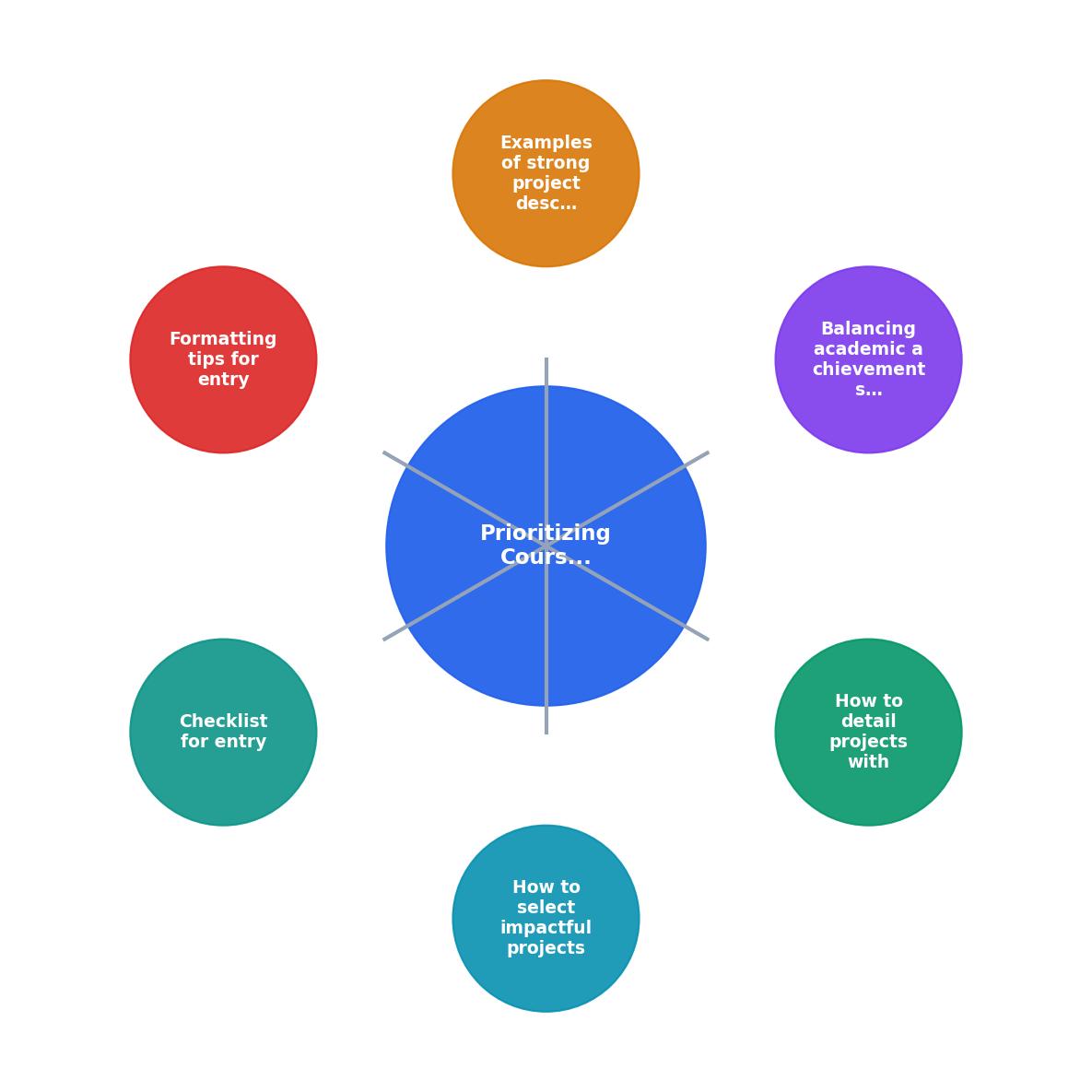
The diagram above shows the workflow for deciding what to include. Start by listing all your projects and coursework. Then filter by relevance to the job description. Next, assess complexity and your ownership. Finally, structure your top 2-4 projects with outcome-focused descriptions.
Don't overthink this. The goal is to surface your strongest, most relevant work quickly so recruiters see you as capable before they decide to skip your resume.
Interactive Resume Review Checklist
When you're ready to finalize your resume, use this checklist to make sure your projects shine:
Entry-Level Resume Project Checklist
Your progress is saved automatically in your browser.
Custom Interactive Resume Scoring Tool
Here's a quick visual tool to assess how well each of your projects scores for a specific job posting. Lower scores suggest the project might not deserve resume space for that particular role.
Use this as a mental model when evaluating your projects. For each project you're considering including, rate it against the four dimensions above: how closely does it match the job description's keywords and requirements, how complex and substantial is the project, how clearly can you articulate your role and what you learned, and can you point to measurable results or outcomes? Projects scoring high across these dimensions belong on your resume for that specific job.
FAQ
Frequently Asked Questions
The real work of building an entry-level resume isn't padding it with every project you've ever touched. It's the disciplined work of choosing the two, three, or four projects that best prove you can do the job you're applying for, and then describing them in a way that makes employers sit up and pay attention. Do that well, and you'll see more interviews than candidates who list every assignment they ever completed.
Additional Resources
- How To Write a Resume With No Experience - Add relevant coursework, academic projects, certificates or training. This section shows that you have foundational knowledge for entry-level ...
- How—and When—to Include Projects on Your Resume (Plus ... - an entry-level applicant looking to emphasize their research, writing, and presentation skills might include a capstone project on their resume.
- First Resume with NO Experience? Watch This Before Applying ... - I'll show you exactly how to write a resume that gets interviews. Whether you're applying for a part-time job a remote role an internship or

Get the 356 complete recruitment audit (free PDF)
Download the free PDF with 356 reasons hiring stalls, plus optional daily email tips. No credit card.
Get the free PDF 356 reasons · Free download