Making a Project Management Resume Compelling Post-Career Break
A two-year gap on a project management resume feels like a flashing red light to most job seekers. Hiring managers in PM roles expect continuity, certifications, and a track record of delivered projects. The good news is that a career break does not erase your ability to manage scope, timelines, and stakeholders. With the right resume structure and a few strategic additions, you can turn that gap into a story of growth rather than absence.

A two-year gap on a project management resume feels like a flashing red light to most job seekers. Hiring managers in PM roles expect continuity, certifications, and a track record of delivered projects. The good news is that a career break does not erase your ability to manage scope, timelines, and stakeholders. With the right resume structure and a few strategic additions, you can turn that gap into a story of growth rather than absence.
Photo by Markus Winkler from Pexels
TL;DR:- Reframe your career break by listing project-related activities you completed during the gap: volunteer coordination, freelance consulting, or certifications like PMP or CAPM.
- Use a hybrid resume format that leads with skills and achievements, not a strict chronological timeline.
- Write a brief, confident cover letter that addresses the break in two sentences and pivots to your commitment to the field.
Why Career Breaks Matter in PM
Project management hiring has a specific bias: recruiters look for recent, continuous delivery experience. A gap of 12 months or more can trigger assumptions about outdated tool knowledge, lost stakeholder management skills, or reduced familiarity with Agile and Scrum frameworks.
That number is not a reason to panic. It is a reason to be deliberate about how you present your timeline. The goal is not to hide the break. It is to surround it with evidence that you stayed sharp.
Project management is one of the few fields where informal experience counts heavily. Coordinating a school fundraiser, managing a home renovation with contractors and a budget, or leading a volunteer committee all involve scope definition, scheduling, risk management, and stakeholder communication. These are the same competencies listed in the PMBOK Guide.
The key is translating those activities into PM language on your resume.
Skills and Activities During the Break

Stop thinking of your break as empty space. Start cataloging what you actually did. Here are concrete categories to mine for resume content:
- Volunteer project coordination - Did you organize events, manage budgets, or lead teams for a nonprofit, school, or community group? That is project management.
- Freelance or consulting work - Even a single short-term engagement counts. List the client type, deliverables, and outcomes.
- Certifications earned - PMP, CAPM, PMI-ACP, Scrum Master (CSM), or even Google Project Management Certificate from Coursera. These show intentional skill maintenance.
- Online courses completed - Courses on Jira, Microsoft Project, Asana, or Monday.com demonstrate current tool proficiency.
- Personal projects with measurable outcomes - Managed a relocation across states? Coordinated care for a family member involving multiple providers and schedules? Quantify it.
"Volunteer Marketing Consultant (2022): Created social media campaigns for a nonprofit, boosting engagement by 30%.">, Resume Strategy after a Career Break
This example shows exactly the right approach: a clear role title, a date, a specific action, and a measurable result. Apply the same formula to every break activity you list.
Structure Your Resume for Impact

A strict reverse-chronological format is the worst choice for a resume with a gap. Instead, use a hybrid (combination) format that opens with a skills-based summary and then follows with work history.
Here is the recommended layout for project managers returning after a break:
Recommended resume sections, in order:
- Professional Summary - Three to four lines. State your total years of PM experience, your methodology expertise (Agile, Waterfall, hybrid), and one headline achievement. Mention the break only if it was for something impressive like earning a certification.
- Core Competencies - A grid or two-column list of 10 to 15 PM skills: stakeholder management, risk assessment, budget tracking, Gantt charting, sprint planning, vendor negotiation, etc.
- Professional Development & Volunteer Work - Everything you did during the break that relates to PM.
- Professional Experience - Your pre-break roles, with quantified achievements.
- Education & Certifications - Degrees, PMP/CAPM, and any relevant training.
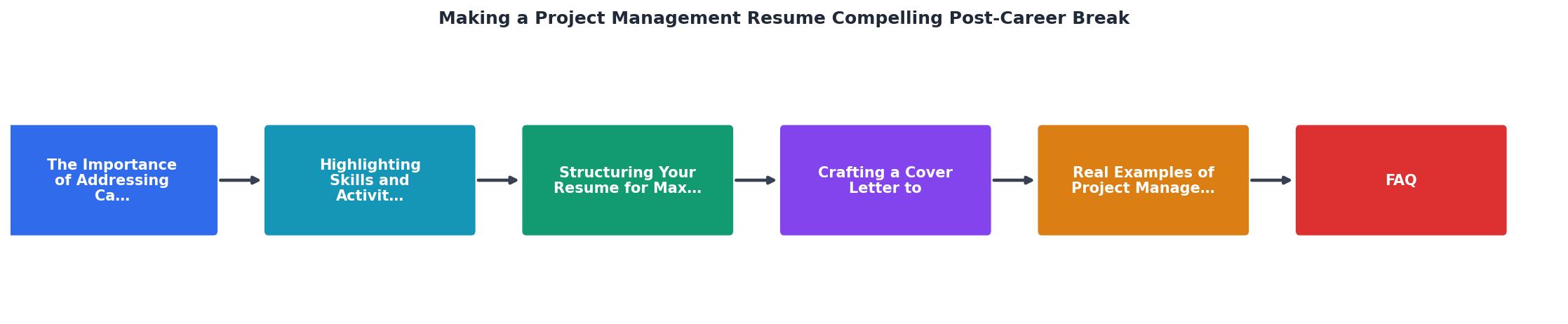
Follow the steps in the diagram: Audit Break Activities, Map to PM Skills, Choose Hybrid Format, Write Summary, Add Development Section, Quantify Achievements, Tailor to Job Posting.
Each bullet under Professional Experience should follow the CAR formula: Challenge, Action, Result. For example: "Inherited a delayed ERP migration (Challenge). Restructured the project timeline and reallocated two developers to the critical path (Action). Delivered the project 10 days ahead of the revised deadline, saving $45K in contractor costs (Result)."
The visual below shows how a well-structured PM resume after a career break compares to a generic chronological one:
| Generic Chronological Resume | Hybrid PM Resume Post-Break |
|---|---|
| Gap is the first thing noticed | Skills summary leads |
| No break activities listed | Volunteer/dev section fills the gap |
| Bullets describe duties | Bullets use CAR formula with metrics |
| One-size-fits-all summary | Summary tailored to target PM role |
| Tools mentioned vaguely | Specific tools: Jira, MS Project, Asana |
Craft a Cover Letter That Addresses the Gap

Your cover letter is where you control the narrative. Do not over-explain. Do not apologize. Two sentences are enough to address the break, then pivot immediately to what you bring.
Here is a template structure:
- Sentence 1: Acknowledge the break factually. "After a planned career pause to [reason], I am eager to return to project management."
- Sentence 2: Bridge to your readiness. "During this time, I earned my PMP certification and managed a $15K community renovation project from planning through completion."
- Rest of the letter: Focus entirely on how your experience matches the job posting. Reference specific requirements from the listing and connect them to your track record.
Lengthy personal explanations about why you took the breakApologetic language like "unfortunately" or "I regret"Leaving the gap unaddressed entirely (the recruiter will wonder)
Here is an example dashboard showing how a well-structured PM resume post-break performs compared to a generic one when scanned by applicant tracking systems:
PM Resume: Before vs. After Optimization
PM Resume Post-Break Checklist
Project Management Resume Post-Break Checklist
Your progress is saved automatically in your browser.
FAQ
Frequently Asked Questions
Additional Resources
- How to Update your Resume after a Career Break (Step by ... - Step 1: Decide What Kind of Role you're Targeting · Step 2: When you're Updating Your Resume after a Career Break do it Honestly · Step 3: Rewrite your ...
- Resume Strategy after a Career Break - She Means Business - 1. Don't Dodge the Break—Own It · 2. Highlight Transferable Skills · 3. Shout Out Continued Learning or Volunteering · 4. Consider a Skills-Based Resume · 5. Start ...
- How to Land a Project Management Job Today - Use a results-first structure for each project. Lead with the outcome, then describe how you achieved it. Keep it concise; avoid jargon-heavy ...

Get the 356 complete recruitment audit (free PDF)
Download the free PDF with 356 reasons hiring stalls, plus optional daily email tips. No credit card.
Get the free PDF 356 reasons · Free download