Project Manager Resume Checklist for Career Changers
You managed cross-functional teams, hit deadlines, and kept budgets on track in your previous career. None of that shows up on your resume because every bullet point screams your old job title. Career changers applying for project manager roles face a specific problem: the experience is there, but the language is wrong, and ATS software does not give partial credit for close enough.


You managed cross-functional teams, hit deadlines, and kept budgets on track in your previous career. None of that shows up on your resume because every bullet point screams your old job title. Career changers applying for project manager roles face a specific problem: the experience is there, but the language is wrong, and ATS software does not give partial credit for close enough.
Photo by cottonbro studio from Pexels
TL;DR:- Rewrite every resume bullet using project management terminology (scope, stakeholders, deliverables, risk mitigation) instead of your old industry jargon.
- Map each past responsibility to a recognized PM competency: scheduling, budgeting, resource allocation, or stakeholder communication.
- Use a structured checklist to verify your resume hits the keywords ATS systems scan for before you submit a single application.
Why Career Changers Struggle with PM Resumes
Most career changers already have project management skills. Teachers coordinate curriculum rollouts across departments. Military officers run logistics for hundreds of personnel. Restaurant managers handle vendor negotiations, scheduling, and cost control daily. The gap is not in ability. It is in vocabulary.
Applicant tracking systems scan for exact keyword matches. When a job posting asks for "stakeholder management" and your resume says "parent-teacher communication," the system scores you lower. Recruiters who do see your resume spend roughly six seconds on the first pass. If the PM language is missing, they move on.
The fix is translation, not fabrication. You are not inventing experience. You are describing the same work in the language hiring managers expect.
Common Mistakes That Kill Your Chances

Career changers make predictable errors. Knowing them saves you rounds of rejection.
- Keeping the old job title front and center. Your summary reads like a marketing manager resume with "project management" tacked on at the end. Flip it. Lead with PM competencies.
- Listing responsibilities instead of outcomes. "Managed a team of 8" tells a recruiter nothing. "Led an 8-person cross-functional team to deliver a $200K product launch 2 weeks ahead of schedule" tells them everything.
- Ignoring the job description keywords. Each posting is a cheat sheet. If it says "Agile," "Scrum," "risk register," or "Gantt chart," those words need to appear on your resume, backed by real examples.
- Skipping certifications entirely. You do not need a PMP to apply. But listing a CAPM, Google Project Management Certificate, or even "PMP in progress" signals commitment to the field.
- Using a generic resume for every application. A single resume sent to 50 different PM openings will underperform a tailored version every time. Tools like Resume Hedgehog can match your resume to each job description in minutes instead of hours.
Step-by-Step Resume Translation
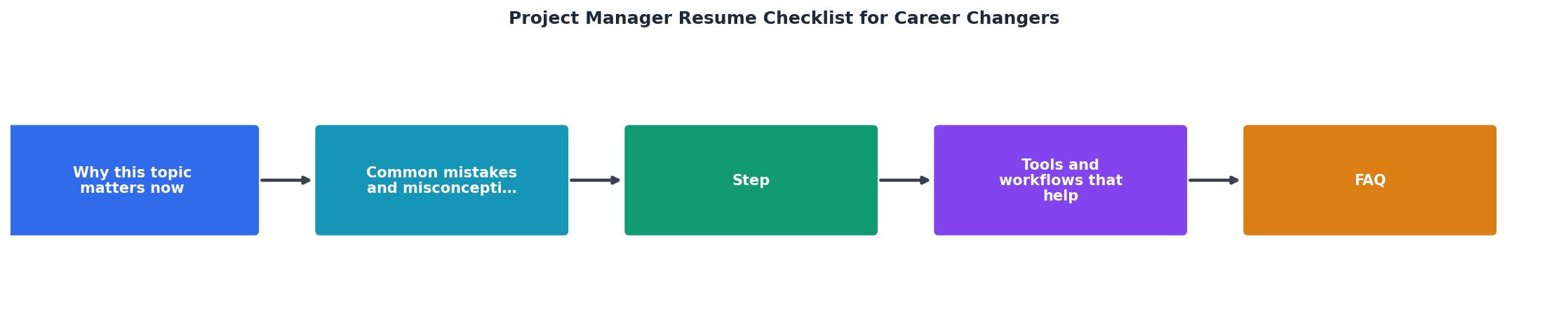
Follow these steps in order. Each one builds on the previous.
Step 1: Audit the Target Job Posting
Pull up three to five PM job descriptions in your target industry. Highlight every skill, tool, and methodology mentioned. Common ones include:
- Agile / Scrum / Waterfall
- Stakeholder management
- Risk assessment and mitigation
- Budget tracking and forecasting
- Jira, Asana, Microsoft Project, Monday.com
- Cross-functional team leadership
- Scope management and change control
Step 2: Map Your Experience
Take each bullet point from your current resume and ask: "Which PM competency does this demonstrate?" A few real examples:
- Teacher: "Coordinated a district-wide curriculum rollout across 12 schools" becomes "Managed a cross-functional initiative spanning 12 locations with 40+ stakeholders, delivering on a 6-month timeline."
- Military officer: "Oversaw logistics for a 200-person unit during deployment" becomes "Directed resource allocation and logistics planning for a 200-member operation under strict timeline and budget constraints."
- Restaurant manager: "Reduced food waste by 30% through new vendor contracts" becomes "Negotiated vendor agreements and implemented process improvements, reducing operational costs by 30%."
"Proven ability to effectively implement Agile methodologies, resulting in a 20% reduction in operational costs and a significant increase in overall team efficiency.">, Project Manager Resume: Template, Examples, and Tips for Writing One
Step 3: Restructure Your Resume Layout
Use this order for maximum impact:
- Professional summary (3-4 lines, PM-focused, mention years of relevant experience and one headline achievement)
- Core competencies (a grid of 8-12 PM keywords pulled from your master list)
- Professional experience (translated bullets, most recent first)
- Certifications and training (CAPM, Google PM Certificate, Scrum Master, etc.)
- Education
Step 4: Quantify Everything
Numbers catch the eye. Recruiters scan for them. Every bullet should include at least one metric:
- Team size managed
- Budget controlled
- Timeline met or beaten
- Percentage improvement
- Number of stakeholders coordinated
Step 5: Tailor Per Application
This is where most people give up because it takes time. Each job posting emphasizes different skills. One PM role wants heavy Agile experience. Another prioritizes vendor management. Adjust your summary, reorder your competencies grid, and swap bullet points to match.
Tools That Speed Up the Process

You do not need to do all of this manually. Several tools and workflows make the translation faster.
- Job description analyzers: Paste a posting into a tool that extracts the top keywords. Jobscan and Resume Worded both offer this.
- Resume tailoring tools: Resume Hedgehog lets you upload your resume and paste a job description, then produces an optimized, ATS-friendly version matched to that specific role.
- PM terminology glossaries: The PMI Lexicon of Project Management Terms is free and gives you the exact vocabulary hiring managers expect.
- Project management courses: Google's Project Management Professional Certificate on Coursera takes about six months part-time and gives you real artifacts (charter templates, risk registers) you can reference on your resume.
| Manual Tailoring | Tool-Assisted Tailoring |
|---|---|
| 45-60 min per application | 5-10 min per application |
| Easy to miss keywords | Automated keyword matching |
| Inconsistent formatting | Consistent ATS-friendly output |
| Hard to scale past 10 apps | Scales to 50+ applications |
Here is an example dashboard showing how a career changer's resume might score before and after applying this checklist:
ATS Match Score: Before vs. After
The Complete Checklist
Use this before submitting any PM application. Print it, bookmark it, or paste it into your project tracker.
Project Manager Resume Checklist for Career Changers
Your progress is saved automatically in your browser.
FAQ
Frequently Asked Questions
Additional Resources
- Project Manager Resume: Template, Examples, and Tips ... - Functional: Best for career changers who are transitioning into project management or individuals with notable gaps in their employment history.
- How to Write a Career Change Resume - Template - Wharton - 1. Craft a resume objective · 2. Include a skills summary · 3. Focus on the most relevant work experience · 4. Highlight your education (including certificates) · 5 ...
- Build a Resume That Stands Out for Project Manager Roles - 1. Lead with a summary that speaks to the role · 2. Quantify everything you can · 3. Use the right project management language · 4. Make ...

Get the 356 complete recruitment audit (free PDF)
Download the free PDF with 356 reasons hiring stalls, plus optional daily email tips. No credit card.
Get the free PDF 356 reasons · Free download