Adjusting Your Resume for a Shift from Sales to Healthcare
Your sales resume got you quota-crushing results for years, but now it reads like a foreign language to healthcare hiring managers. The skills that made you a top performer in sales are genuinely valuable in healthcare, yet the way you describe them needs a complete overhaul. This guide walks you through reframing every bullet point, plugging experience gaps, and loading your resume with the right terminology so it lands interviews in your new field.


Your sales resume got you quota-crushing results for years, but now it reads like a foreign language to healthcare hiring managers. The skills that made you a top performer in sales are genuinely valuable in healthcare, yet the way you describe them needs a complete overhaul. This guide walks you through reframing every bullet point, plugging experience gaps, and loading your resume with the right terminology so it lands interviews in your new field.
TL;DR:- Reframe sales achievements using healthcare language: "client retention" becomes "patient engagement," "pipeline management" becomes "care coordination."
- Emphasize communication, empathy, and organizational skills that directly transfer to patient-facing and administrative healthcare roles.
- Fill experience gaps with healthcare certifications, volunteer hours, and targeted keywords pulled from actual job postings.
Why Sales Skills Transfer to Healthcare
Sales professionals spend years building skills that healthcare employers actively seek. You already know how to listen to someone under stress, explain complex information clearly, and manage dozens of moving parts at once. The disconnect is not about ability. It is about vocabulary.
A hiring manager at a hospital network does not care that you exceeded Q3 targets by 140%. They care that you can coordinate patient intake, communicate treatment plans, and handle sensitive conversations with empathy. The underlying competencies are identical. The labels are different.
The good news: roughly 70% of core sales competencies (relationship building, active listening, CRM/data management, objection handling, follow-up discipline) map directly onto healthcare job requirements. You just need to translate them.
Translate Sales Achievements
Start with your strongest sales accomplishments and rewrite each one through a healthcare lens. Here is the method:
- Identify the core skill behind the achievement (not the sales metric).
- Find the healthcare equivalent of that skill.
- Rewrite the bullet using healthcare terminology and context.
Before-and-after examples
Managed a portfolio of 120+ B2B accounts generating $2.4M annually.→ Coordinated ongoing relationships with 120+ stakeholders, ensuring consistent communication and timely follow-up across a complex service network.Exceeded quarterly sales targets by 35% through consultative selling.→ Applied consultative communication techniques to assess individual needs, resulting in a 35% improvement in engagement outcomes.Reduced client churn by 18% through proactive outreach and needs assessment.→ Decreased disengagement rates by 18% using proactive outreach, needs assessment, and personalized follow-up protocols.Trained 8 junior sales reps on CRM workflows and cold-calling scripts.→ Mentored 8 team members on documentation systems and patient/client communication best practices.
"You have everything to gain and nothing to lose if you commit 100% just like Samuel and his team do.">, How To Write Your Medical Sales Resume With Cathy Lanzalaco
Key Transferable Skills
Not every sales skill needs heavy translation. Some transfer almost word-for-word. Here are the ones healthcare employers value most:
- Active listening: In sales, you listened to close. In healthcare, you listen to understand patient concerns, family needs, and care team input.
- Empathy and rapport building: Patients and families need someone who can connect on a human level. Your years of building client trust are directly relevant.
- Organization and multitasking: Managing a sales pipeline with 50+ deals is structurally similar to coordinating patient schedules, referrals, and follow-ups.
- Data entry and CRM proficiency: Salesforce, HubSpot, and similar tools share DNA with electronic health record (EHR) systems like Epic and Cerner. Mention your comfort with structured data systems.
- Conflict resolution: Handling objections in sales translates to de-escalating tense situations with patients or navigating insurance disputes.
- Goal-oriented mindset: Healthcare roles have metrics too: patient satisfaction scores, appointment adherence rates, readmission reduction targets.
Communication skills transfer at the highest rate. If you spent years explaining product features to non-technical buyers, you already know how to break down complex medical information for patients.
Find Healthcare-Specific Keywords

Applicant Tracking Systems (ATS) in healthcare filter resumes the same way they do in every other industry: keyword matching. If your resume says "client" instead of "patient," the ATS scores you lower before a human ever reads it.
Here is how to find the right keywords:
- Pull up 5-10 job postings for your target role (patient coordinator, medical office administrator, healthcare sales rep, community health worker, etc.).
- Copy the full text of each posting into a document.
- Highlight terms that appear in 3 or more postings. Those are your priority keywords.
- Cross-reference with your existing resume. Replace sales terms with their healthcare equivalents.
Healthcare keyword reference
Here is a starting list of terms that appear frequently across healthcare job postings:
- Patient advocacy
- Care coordination
- HIPAA compliance
- Electronic Health Records (EHR/EMR)
- Patient intake and registration
- Insurance verification
- Clinical documentation
- Patient satisfaction
- Interdisciplinary team collaboration
- Quality improvement
- Discharge planning
- Medical terminology
- Vital signs (for clinical roles)
- CPR/BLS certification
A tool like Resume Hedgehog can speed this up significantly. Upload your current sales resume, paste the healthcare job description, and it identifies exactly which keywords you are missing and where to place them.
Address Experience Gaps

The biggest objection you will face: "You don't have healthcare experience." Here is how to neutralize it.
Volunteer work
Even 20-40 hours of volunteering at a hospital, clinic, or community health organization gives you legitimate healthcare experience to list. Roles to look for:
- Hospital volunteer (patient transport, front desk, gift shop)
- Free clinic intake volunteer
- Health fair organizer through local nonprofits
- Crisis hotline volunteer
Certifications that close the gap
Certain certifications signal to healthcare employers that you are serious about the transition:
- CPR/BLS Certification (American Heart Association): Takes one day, costs under $75, and is required for most patient-facing roles.
- Certified Medical Administrative Assistant (CMAA): Covers medical office procedures, billing basics, and patient communication.
- HIPAA Compliance Training: Available online, often free, and shows you understand healthcare privacy regulations.
- Certified Patient Care Technician (CPCT): For those targeting clinical support roles.
- Medical Terminology Certificate: Community colleges and online platforms offer these in 4-8 weeks.
Most of these certifications take three months or less. Some take a single weekend. The point is not to become a clinician overnight. The point is to show you invested real effort in learning the healthcare landscape.
The summary statement
Your resume summary is where you bridge the gap explicitly. Here is a template:
Results-driven professional with [X] years of experience in client relationship management, consultative communication, and data-driven decision-making. Currently transitioning to healthcare with [certification name] and [volunteer experience]. Proven ability to build trust, coordinate complex processes, and deliver measurable outcomes in fast-paced environments.
Build Your Healthcare Resume
This section walks through the actual structure of your new resume, step by step.
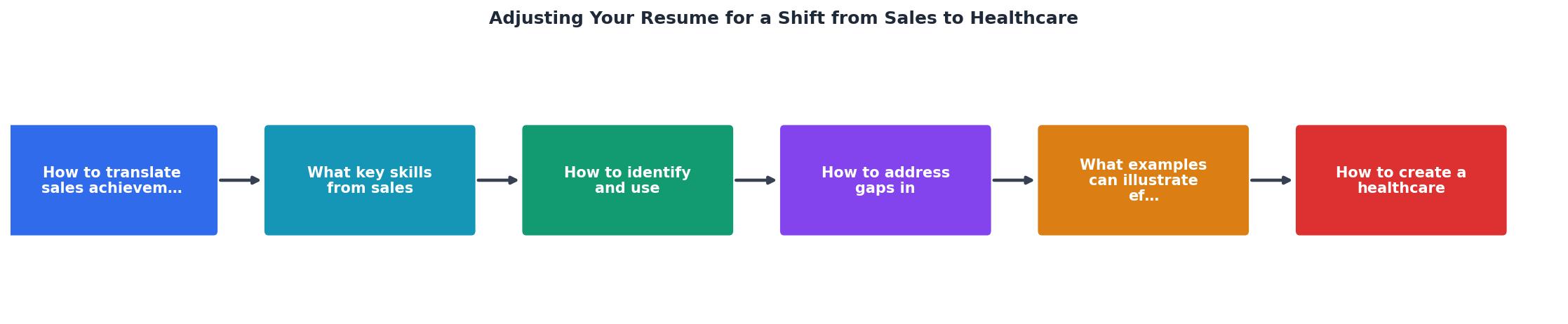
Follow these steps in order:
- Audit current resume - List every bullet point and tag the underlying skill.
- Research target roles - Collect keywords from 5-10 job postings.
- Rewrite bullets - Translate each one using healthcare language.
- Add certifications - Place them prominently, right after your summary.
- Include volunteer work - Create a dedicated healthcare experience section.
- Optimize for ATS - Run your resume through a keyword-matching tool.
- Get feedback - Have someone in healthcare review it before submitting.
| Sales Resume | Healthcare Resume |
|---|---|
| Professional Summary mentions "revenue growth" | Summary mentions "patient outcomes" and "care coordination" |
| Skills section lists "Salesforce, cold calling, negotiation" | Skills section lists "EHR systems, patient intake, HIPAA compliance" |
| Experience bullets focus on quotas and deals | Experience bullets focus on relationship management and process improvement |
| Education section only | Education + Certifications section with CPR/BLS, CMAA |
| No volunteer work listed | Dedicated Healthcare Experience section |
Here is an example of how a typical career changer's resume skill translation might look in practice:
Sales → Healthcare Skill Translation
How your existing skills map to healthcare roles
Sample Resume Bullet Points
Concrete examples help more than abstract advice. Here are ready-to-use bullet points for common sales-to-healthcare transitions:
For Patient Coordinator roles:- Coordinated scheduling and follow-up for 80+ individuals weekly, maintaining a 95% appointment adherence rate.
- Conducted intake assessments to identify individual needs and connect them with appropriate resources.
- Maintained accurate records in database systems, ensuring compliance with organizational documentation standards.
- Managed front-desk operations including patient registration, insurance verification, and appointment scheduling for a high-volume practice.
- Streamlined administrative workflows, reducing patient wait times by 20%.
- Trained 5 staff members on new EHR system implementation and documentation protocols.
- Built trust-based relationships with 150+ community members through consistent outreach and culturally sensitive communication.
- Organized health education events reaching 300+ participants per quarter.
- Tracked engagement metrics and reported outcomes to program leadership using data management tools.
Sales-to-Healthcare Resume Adjustment Checklist
Your progress is saved automatically in your browser.
FAQ
Frequently Asked Questions
What part of your sales background are you finding hardest to translate into healthcare terms? Share your trickiest bullet point and let's figure it out together.
Additional Resources
- How To Write Your Medical Sales Resume With Cathy ... - She offers tips and insights on how to write a winning medical sales resume that will help you stand out from the competition and land your dream job.
- Switching to medical sales: 3 career paths for clinical ... - Step 1: Fix your LinkedIn headline. Change "Recent Graduate" to "Aspiring Medical Sales Professional." Hiring managers need to see you're ...
- Updating Your Resume for a Career Change - 1. Use a combination resume format · 2. Include a resume summary or objective · 3. Add a skills section · 4. Showcase relevant certifications or ...

Get the 356 complete recruitment audit (free PDF)
Download the free PDF with 356 reasons hiring stalls, plus optional daily email tips. No credit card.
Get the free PDF 356 reasons · Free download