Best Practices for Resume Circulation in Industry Networks
Sending your resume into the void of online job boards is one thing. Getting it into the hands of actual decision-makers through industry networks is something else entirely. For career changers and professionals re-entering the workforce, the right network connection can bypass the ATS black hole and land your resume on a hiring manager's desk before the role is even posted publicly. This guide walks through exactly how to identify those networks, craft messages that get responses, and circulate your resume without burning bridges or compromising your privacy.

Sending your resume into the void of online job boards is one thing. Getting it into the hands of actual decision-makers through industry networks is something else entirely. For career changers and professionals re-entering the workforce, the right network connection can bypass the ATS black hole and land your resume on a hiring manager's desk before the role is even posted publicly. This guide walks through exactly how to identify those networks, craft messages that get responses, and circulate your resume without burning bridges or compromising your privacy.
Photo by Brett Sayles from Pexels
TL;DR:- Identify 3-5 industry-specific networks (professional associations, LinkedIn groups, Slack communities, alumni chapters) where hiring conversations actually happen.
- Write short, personalized messages that frame your transferable skills in the language of your target field.
- Use professional associations for warm introductions, job boards, and resume review events.
- Protect your privacy by controlling which version of your resume goes where and tracking every send.
Why Networks Beat Job Boards
Most job seekers treat resume distribution like a numbers game: upload to 10 boards, apply to 50 listings, wait. That approach has a roughly 2-5% callback rate for cold applications. Industry networks flip the equation. When someone inside a company forwards your resume to a recruiter, that resume gets read. Not scanned by software. Read by a human.
This matters even more when you are switching careers. A resume that says "teacher for 12 years" looks irrelevant on a job board for instructional design roles. But when a fellow member of the Association for Talent Development forwards that same resume with a note saying "this person built a curriculum that trained 400 employees last year," the framing changes completely.
The core idea: your resume is a document, but your network is the delivery system. Optimize both.
Identify the Right Networks

Not all networks are equal. A Facebook group with 50,000 members and zero moderation is not the same as a 200-person Slack workspace where hiring managers post roles before they hit LinkedIn. Here is how to find the ones that matter for your target industry:
- Professional associations with job boards and mentorship programs. Examples: SHRM (human resources), AIGA (design), PMI (project management), IEEE (engineering). Most have local chapters with monthly meetups.
- LinkedIn Groups that are actively moderated and industry-specific. Search for groups tied to your target role, not just your current one. A career changer moving into UX should join "UX Research & Design" groups, not "Former Teachers Network."
- Slack and Discord communities. Rands Leadership Slack (tech leadership), Superpath (content marketing), dbt Community (data/analytics), and Elpha (women in tech) all have active job channels.
- Alumni networks. Your university, bootcamp, or certification program likely has a private network. These are gold because shared background creates instant trust.
- Conference and event communities. Attending even one industry conference gives you access to a post-event Slack, a LinkedIn connection list, and follow-up conversations.
Start with three to five networks. Joining 20 groups and lurking in all of them is worse than actively participating in three.
Craft Personalized Messages
Generic messages get ignored. "Hi, I'm looking for a new role, here's my resume" tells the recipient nothing about why they should care. A personalized message does three things: explains the connection, states the ask clearly, and makes it easy to help.
Here is what works:
- Reference something specific. Mention a post they wrote, a talk they gave, or a shared group. "I saw your post in the PMI Chicago chapter about hybrid project management" is ten times better than "I found you on LinkedIn."
- State your transition clearly. "I'm moving from classroom teaching into corporate learning and development" gives the reader context in one sentence.
- Frame your skills in their language. Do not say "I managed a classroom of 30 students." Say "I designed and delivered training programs for groups of 30, measured learning outcomes, and iterated on curriculum quarterly."
- Make the ask small. "Would you be open to a 15-minute call about how you broke into this field?" works better than "Can you refer me to your company?"
Here is a template you can adapt:
Resume Circulation Message Checklist
Your progress is saved automatically in your browser.
"The goal of networking is simple: When a data role opens up, you're the first person the recruiter thinks of (because they've already seen your work and spoken to you).">, Why Networking Surpasses Resume Optimization
Leverage Professional Associations

Professional associations are underused by career changers. Most people think of them as something you join after you land the job. In reality, they are one of the best ways to get the job in the first place.
Here is what associations typically offer that helps with resume circulation:
- Member directories. You can search for people by role, company, and location. This is a curated contact list for your target industry.
- Job boards. Association job boards tend to have fewer applicants and more specialized roles than Indeed or LinkedIn. The AIGA Design Jobs board, for example, attracts employers specifically looking for design professionals.
- Resume review events. Many chapters run "resume clinics" where experienced professionals review your resume and give feedback. This is free consulting from people who hire in your target field.
- Mentorship programs. A mentor in your target industry can introduce you to their network, review your resume, and coach you on industry norms.
- Annual conferences. Even virtual conferences have networking sessions. Exchanging resumes at a conference is expected, not awkward.
The Circulation Process Step by Step

Circulating a resume through industry networks is not random. It follows a repeatable process. The diagram below shows the flow at a glance:
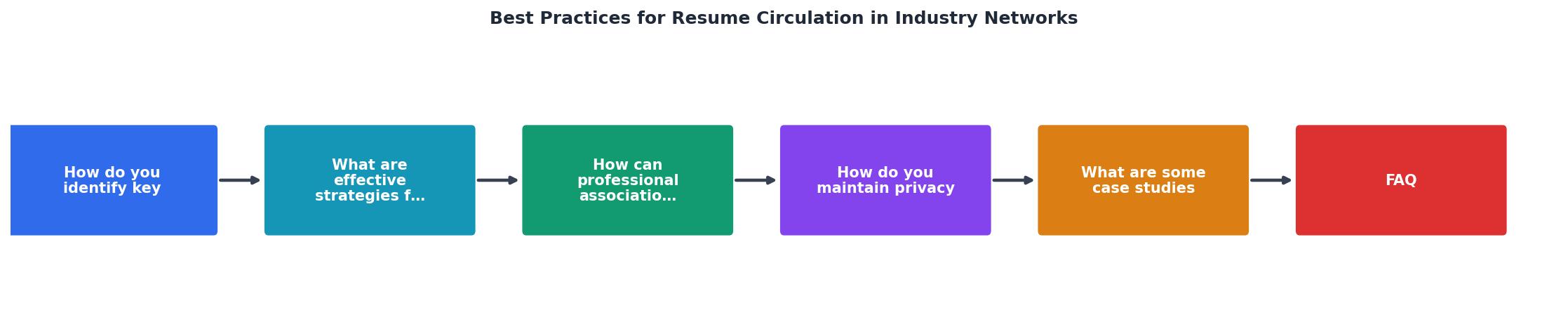
The steps break down like this:
- Identify target networks. Pick 3-5 groups where your target employers and peers are active.
- Tailor your resume. Create a version of your resume that speaks the language of the target industry. Tools like Resume Hedgehog can help you match your resume to specific job descriptions in your new field, translating your existing experience into the right keywords.
- Engage before asking. Spend 2-3 weeks contributing to discussions, commenting on posts, and sharing relevant content before you ask anyone for help.
- Send personalized outreach. Use the checklist above. Target 5-10 people per week.
- Track every send. Log who received which version of your resume, when, and any follow-up dates.
- Follow up. One follow-up after 5-7 days. If no response, move on.
- Thank and update. When you land interviews or offers, circle back and thank the people who helped. This keeps the relationship alive for future opportunities.
30-Day Resume Circulation Tracker
Those numbers are realistic for someone who puts in 30-45 minutes per day on network outreach. Two interviews from 32 messages is a far better ratio than two interviews from 200 cold applications.
Maintain Privacy and Professionalism
Circulating your resume through networks means your document is out there. People forward it. People screenshot it. People save it in folders they forget about for years. Here is how to stay in control:
- Create a "network version" of your resume. Remove your street address. Use a dedicated email address (e.g., yourname.career@gmail.com) so you can track where inquiries come from. Include your LinkedIn URL and phone number, but skip anything you would not want a stranger to have.
- Watermark or version your resumes. Add a small footer like "v3 - UX Design - June 2026" so you know which version is circulating and where.
- Set boundaries on forwarding. When you send your resume to a contact, it is fine to say "Feel free to share this with your team, but I'd appreciate a heads-up so I can follow up appropriately."
- Google yourself. Before you start circulating, search your name. Clean up anything that contradicts the professional image your resume presents.
- Do not badmouth your current or former employer. Even in private messages within a network, assume anything you write could be forwarded.
| Public Posting | Private Circulation |
|---|---|
| Shared only with chosen contacts | |
| You track every recipient | |
| Reaches targeted, relevant people | |
| Links can be revoked | |
| Tailored version per network |
Real Examples That Worked
Example 1: Teacher to Instructional Designer. A former high school science teacher joined the ATD (Association for Talent Development) local chapter in Dallas. She attended three monthly meetups, volunteered to help organize a panel event, and asked the panel moderator for a 15-minute coffee chat. That moderator forwarded her resume to a learning team at a healthcare company. She got an interview within two weeks and an offer within six.
Example 2: Military to Project Management. A veteran transitioning to civilian project management joined PMI and the Veterati mentoring platform. His PMI mentor reviewed his resume, helped him translate military terminology into corporate language, and introduced him to two hiring managers at defense contractors. One of those introductions led to a role that was never posted publicly.
Example 3: Career Break Returner. A marketing professional returning after a four-year parental leave joined a women-in-marketing Slack community. She spent three weeks commenting on threads and sharing articles before posting a brief introduction about her return. Four members reached out privately to offer resume feedback, and one connected her with a recruiter specializing in returnship programs.
The pattern in all three: join, contribute, build trust, then ask. Nobody succeeded by joining a group and immediately blasting their resume to every member.
FAQ
Frequently Asked Questions
Additional Resources
- Why Networking Surpasses Resume Optimization - Networking surpasses resume optimization because direct connections and referrals open doors to hidden opportunities and help you stand out beyond what any ...
- How Skill Development & Networking Boost Your Resume - Emphasize Professional Organizations. Illustrate what you've added. Showcase Volunteer Work. Begin with a master document. Positioning with your network. ...
- How to Write and Use Networking Resumes with Examples ... - Learn how and when to use a networking resume in your job search, plus get 8 templates and examples of professional networking resumes.

Get the 356 complete recruitment audit (free PDF)
Download the free PDF with 356 reasons hiring stalls, plus optional daily email tips. No credit card.
Get the free PDF 356 reasons · Free download