Resume optimization guide #10: tech resume template 2026
Most tech resumes in 2026 get rejected before a human ever reads them. The formatting is wrong, the keywords are missing, and the structure confuses automated screening systems. This guide gives you a concrete, field-tested tech resume template built for how hiring actually works right now, along with the exact steps to fill it out and submit it with confidence.

Most tech resumes in 2026 get rejected before a human ever reads them. The formatting is wrong, the keywords are missing, and the structure confuses automated screening systems. This guide gives you a concrete, field-tested tech resume template built for how hiring actually works right now, along with the exact steps to fill it out and submit it with confidence.
Photo by Lukas Blazek from Pexels
TL;DR:- A single-column, ATS-parseable layout with five clearly labeled sections (header, summary, skills, experience, education) outperforms multi-column or graphic-heavy designs in 2026 tech hiring.
- Every bullet under experience should follow the Result-Action-Context pattern and include at least one measurable outcome.
- Tailoring your resume to each job posting by matching its exact keywords is the single highest-impact optimization you can make.
Why tech resumes changed in 2026
The tech hiring pipeline looks different than it did even two years ago. Applicant tracking systems got smarter, but they also got pickier. Layouts that worked in 2024 now break parsing in popular ATS platforms like Greenhouse, Lever, and Workday.
Three shifts drove this change:
- AI-assisted screening now evaluates semantic relevance, not just keyword matches. A resume that lists "Python" but never describes what you built with it scores lower than one that says "Built a data pipeline in Python processing 2M records daily."
- Remote-first hiring expanded applicant pools. A single backend engineering role at a mid-size company attracts 300+ applications. Recruiters spend 6-8 seconds on initial scans.
- Skills-based hiring gained traction. Companies like Google, IBM, and Accenture dropped degree requirements for many roles. Your skills section carries more weight than your education section.
Common template mistakes

I review tech resumes regularly, and the same problems show up over and over. Here are the ones that cost interviews:
- Two-column layouts. They look clean in PDF but ATS parsers read them left-to-right across both columns, jumbling your content into nonsense. Stick to a single column.
- Graphics, icons, and progress bars for skills. A circle that is 80% filled tells a parser nothing. It tells a recruiter nothing either. Write "Python (5 years, production)" instead.
- Generic summary statements. This one deserves its own callout:
"Experienced software engineer with 7 years of experience looking for challenging role in a fast-paced environment.">, The 2026 Tech Resume Template: What Hiring Managers Actually Want
That summary could belong to anyone. It communicates zero differentiation. Replace it with a summary that names your specialty, your strongest measurable result, and the type of role you target.
- Listing responsibilities instead of results. "Responsible for maintaining CI/CD pipelines" is a job description, not an achievement. "Reduced deployment failures by 40% by restructuring CI/CD pipelines with GitHub Actions" is a resume bullet.
Objective statementsare dead. Replace them with a professional summary.
The 2026 tech resume template

Here is the exact structure, section by section. Each section has a specific job to do.
Header
Name, phone, email, LinkedIn URL, GitHub/portfolio URL (if relevant), city and state (no full address). Put your name in a larger font size (18-22pt) and everything else in standard body text (10-12pt). No photo. No "Curriculum Vitae" label.
Professional summary
Three sentences maximum. Sentence one: your title, years of experience, and core specialty. Sentence two: your biggest measurable achievement. Sentence three: what you bring to the target role.
Example: "Senior backend engineer with 6 years building distributed systems in Go and Python. Led the migration of a monolithic payment service to microservices, cutting latency by 60% and saving $180K/year in infrastructure costs. Looking to bring scalable architecture expertise to a fintech platform team."
Technical skills
Group skills into categories. Use the exact terms from job postings. A clean format:
- Languages: Go, Python, TypeScript, SQL
- Frameworks: FastAPI, React, gRPC
- Infrastructure: AWS (ECS, Lambda, RDS), Terraform, Docker, Kubernetes
- Tools: GitHub Actions, Datadog, PagerDuty, Jira
Experience
Reverse chronological. For each role: company name, your title, dates (month/year), and 3-5 bullet points. Every bullet follows the Result-Action-Context pattern:
- Result first: "Reduced page load time by 35%"
- Action: "by implementing server-side rendering and lazy loading"
- Context: "for a React e-commerce platform serving 500K monthly users"
Numbers make bullets credible. Percentages, dollar amounts, user counts, time saved. If you cannot measure it, describe the scope (team size, codebase size, user base).
Education
Degree, institution, graduation year. If you graduated more than 5 years ago, skip the GPA. Relevant certifications (AWS Solutions Architect, Google Cloud Professional) go here too.
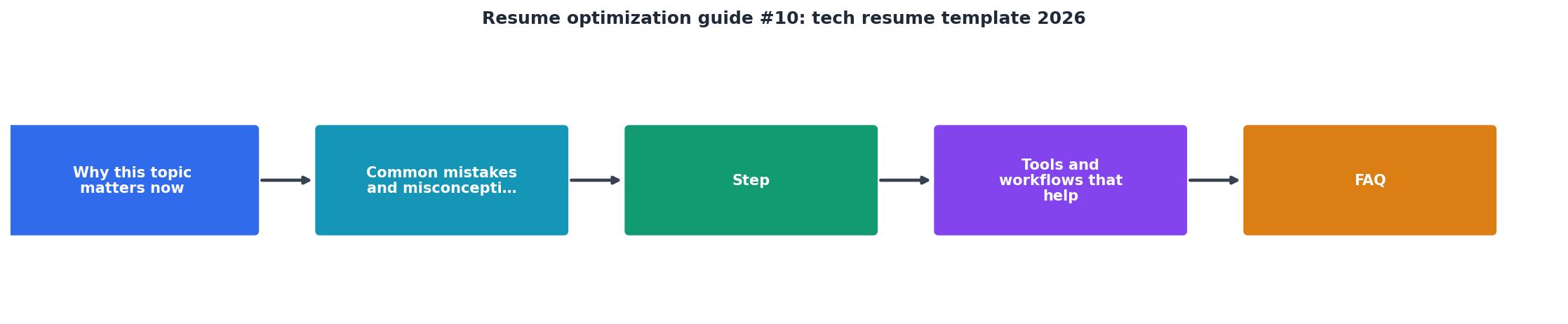
The diagram above shows the flow: Header → Summary → Skills → Experience → Education. Each section feeds the next. The summary sets the frame, skills prove breadth, experience proves depth, and education provides credentials.
Tailoring for each application
A template is a starting point. The real optimization happens when you tailor it to a specific job posting. Here is the process:
- Copy the job description into a plain text file.
- Highlight repeated terms. If "Kubernetes" appears three times, it is a priority keyword.
- Match your skills section to those terms. Use the exact phrasing from the posting. If they say "CI/CD," do not write "continuous integration/continuous deployment."
- Reorder your experience bullets so the most relevant ones come first for each role.
- Adjust your summary to mirror the role title and core requirement.
The following dashboard shows what a well-optimized tech resume typically achieves compared to a generic one, based on common hiring funnel benchmarks:
Generic vs. Tailored Tech Resume
Tools and workflows that help
You do not need to do everything by hand. A solid workflow combines a few focused tools:
- Resume Hedgehog for automated job-description matching and ATS optimization. Paste the posting, upload your base resume, get a tailored PDF.
- Google Docs or Notion for maintaining your master resume (the complete version with every role and bullet you have ever written). You pull from this when tailoring.
- Jobscan or similar ATS checkers for a second-opinion keyword score before submitting.
- Grammarly or LanguageTool for catching typos. One misspelling in a tech resume signals carelessness.
resume-stripe-backend-2026-08.pdf). When you get the interview call three weeks later, you will know exactly which version they read.2026 Tech Resume Optimization Checklist
Your progress is saved automatically in your browser.
FAQ
Frequently Asked Questions
Additional Resources
- The 2026 Tech Resume Template: What Hiring Managers ... - This guide gives you the structure, content strategy, and specific formatting decisions that make tech resumes work in 2026,
- Best ATS Resume Templates 2026: 9 Free Downloads ... - Get 9 free ATS-friendly resume templates, each tested to parse cleanly on Workday, Taleo, and Greenhouse. Word and Google Docs versions, download instantly.
- Resume Format Best Practices for Tech Recruiters - Consistent date formatting - Their suggestion: Pick "Jan 2020 - Dec 2023" or "01/2020 - 12/2023" and stick with it. Mixing formats looks sloppy.

Get the 356 complete recruitment audit (free PDF)
Download the free PDF with 356 reasons hiring stalls, plus optional daily email tips. No credit card.
Get the free PDF 356 reasons · Free download