Resume optimization guide #11: CEO resume template structure
Most CEO resumes read like a Wikipedia entry for a company, not a case for hiring the person who ran it. Boards and executive recruiters spend less than thirty seconds on an initial scan, and a bloated or poorly structured document kills your candidacy before anyone reads a single achievement. This guide breaks down the exact template structure that gets chief executive resumes past gatekeepers and onto the shortlist.

Most CEO resumes read like a Wikipedia entry for a company, not a case for hiring the person who ran it. Boards and executive recruiters spend less than thirty seconds on an initial scan, and a bloated or poorly structured document kills your candidacy before anyone reads a single achievement. This guide breaks down the exact template structure that gets chief executive resumes past gatekeepers and onto the shortlist.
Photo by Markus Winkler from Pexels
TL;DR:- A CEO resume needs six distinct sections: executive summary, core competencies, professional experience with quantified impact, board and advisory roles, education and credentials, and a selective extras section.
- Lead every section with outcomes (revenue, headcount, market share) rather than responsibilities.
- Keep the document to two pages maximum, structured for a 30-second executive scan.
Why CEO resume structure matters
A CEO resume is not a longer version of a director-level resume. It serves a different audience: board members, executive search consultants, and private equity partners who evaluate leadership track records across entire organizations. The structure itself signals whether you think like a chief executive or like a middle manager listing tasks.
Nearly three out of four executive recruiters report discarding resumes that lack clear structure or bury key achievements below the fold. That number alone justifies spending real time on your template before writing a single bullet point.
The right structure does three things simultaneously: it passes ATS keyword filters used by large search firms, it survives the 30-second human scan, and it builds a narrative arc from your executive summary through your most recent role.
Common CEO resume mistakes

Before building the template, here are the structural errors that sink executive resumes:
- Responsibility dumping. Listing "Oversaw 2,000 employees" without stating what changed under your leadership. Boards hire for transformation, not maintenance.
- Three-plus page documents. A CEO with 20 years of experience still needs a two-page resume. Older roles get compressed to two or three lines.
- Generic executive summaries. The phrase below appears on thousands of CEO resumes and communicates nothing specific:
"Experienced executive with a proven track record of success.">, 13 C
- Missing metrics. Every claim needs a number. Revenue growth percentage, cost reduction in dollars, market expansion into specific regions, headcount scaling from X to Y.
- Ignoring ATS entirely. Executive search firms like Korn Ferry, Spencer Stuart, and Heidrick & Struggles use applicant tracking systems. Fancy formatting, columns, and graphics break parsing.
The six-section CEO template
Here is the exact structure that works. Each section has a specific job in the document.
Section 1: Executive summary
Three to five lines at the top. This is your pitch, not your biography. Include your current or most recent title, the scale you operated at (revenue, headcount, geography), your signature achievement, and the type of role you target next.
Example: "CEO who scaled a B2B SaaS company from $12M to $94M ARR in four years, expanded into EMEA and APAC, and led a successful Series D raise of $180M. Seeking a growth-stage CEO or COO role in enterprise software."
Section 2: Core competencies
A simple grid of 9 to 12 keyword phrases. This section exists primarily for ATS matching. Use terms pulled directly from target job descriptions: P&L management, M&A integration, board governance, go-to-market strategy, organizational design, capital allocation.
Section 3: Professional experience
This is the core of the resume and takes roughly 60% of the space. For each role, include:
- Company name, your title, dates
- A one-line company descriptor (industry, revenue, headcount)
- Three to six bullet points, each starting with a strong verb and ending with a measurable result
Weak bullet: "Responsible for supply chain operations and logistics across multiple facilities."
Section 4: Board and advisory roles
Separate from professional experience. List board seats, advisory positions, and nonprofit governance roles. Include the organization name, your role, and dates. If you led a committee (audit, compensation, nominating), note it.
Section 5: Education and credentials
Degrees, MBA program, executive education (Harvard AMP, Stanford SEP, INSEAD). Certifications only if relevant to the target role. No GPAs, no graduation dates if you graduated more than 15 years ago.
Section 6: Selective extras
This is where you place industry awards, keynote speaking, published work, or patents. Keep it to three to five items. If an item does not strengthen your candidacy for the specific target role, cut it.
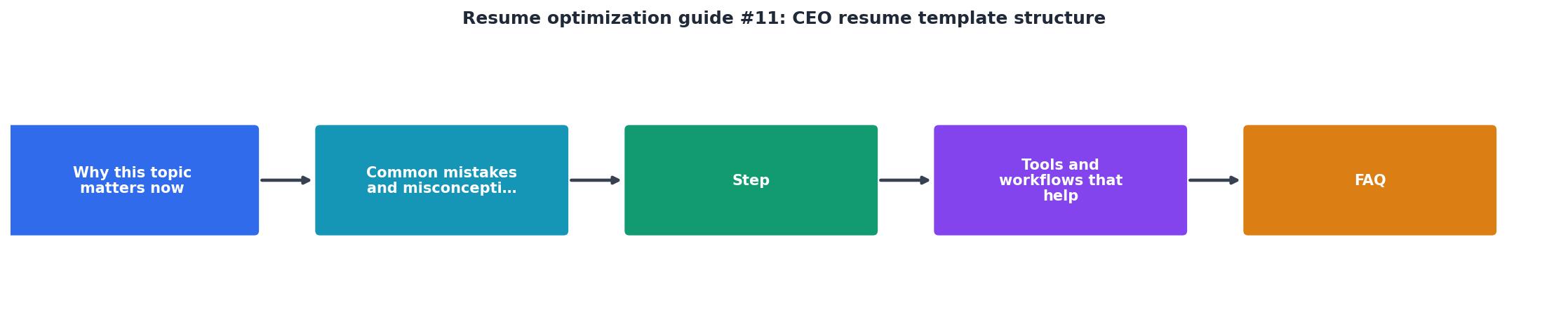
Step-by-step build process

Building a CEO resume from scratch takes a methodical approach. Follow these steps in order:
- Collect raw material. Pull together annual reports, board decks, performance reviews, and press releases from your tenure. You need hard numbers.
- Identify your narrative. What is the through-line across your career? Growth operator, turnaround specialist, digital transformation leader, global expansion CEO? Pick one primary identity.
- Draft the executive summary last. Write your experience bullets first, then distill the summary from your strongest results.
- Quantify every bullet. If a bullet does not contain a number, rewrite it or remove it. Percentages, dollar amounts, headcount, market share, NPS scores, time-to-market reductions.
- Tailor to each opportunity. A resume sent to a PE-backed growth company looks different from one sent to a Fortune 500 board. Adjust the executive summary and competencies grid for each target.
- Run ATS compatibility checks. Paste the job description and your resume into a tool like Resume Hedgehog to verify keyword alignment and formatting compatibility.
CEO Resume Space Allocation (2 Pages)
Tailoring for ATS and recruiters

Executive search firms parse resumes through the same ATS platforms (Bullhorn, Greenhouse, Lever) used for every other hire. The difference is that a human reviewer follows up faster at the C-suite level, so your resume needs to satisfy both audiences simultaneously.
For ATS compatibility:- Use standard section headings: "Professional Experience," "Education," not creative alternatives like "Career Journey" or "Where I've Led"
- Avoid tables, text boxes, headers/footers, and multi-column layouts
- Save as
.docxfor ATS submission and.pdffor direct sends to board members - Mirror exact phrases from the job description in your competencies grid and bullet points
- Front-load each bullet with the result, not the action
- Use bold sparingly to highlight the single most impressive metric in each role
- White space matters: recruiters scanning a dense wall of text will skip to the next candidate
CEO Resume Template Structure Checklist
Your progress is saved automatically in your browser.
FAQ
Frequently Asked Questions
What section of your CEO resume gives you the most trouble? Drop your question below and I will help you work through it.
Additional Resources
- 13 C-Level and Executive Resume Examples for 2026 - Real examples and templates of C-Level and Executive resumes, In this guide, you'll find resume examples for any C-suite role. Template 11 of 13: Chief ...
- ATS Resume Templates & Format Guide for 2026 - See the best ATS resume templates for 2026, learn how to optimize your resume for applicant tracking systems, and check real formatting examples.
- [CEO Resume Template & Examples [2026] - ATS-Optimized](https://mentorcruise.com/resume/ceo/) - Download ATS-optimized CEO resume templates with expert examples and tips. Proven templates used by professionals at top companies.

Get the 356 complete recruitment audit (free PDF)
Download the free PDF with 356 reasons hiring stalls, plus optional daily email tips. No credit card.
Get the free PDF 356 reasons · Free download