Resume optimization guide #13: Spanish job application CV
Applying for jobs in Spanish-speaking markets? Your resume needs more than translation, it needs to match local hiring standards, ATS systems, and cultural expectations that differ from English-speaking countries. Most job seekers either submit a direct translation or ignore Spanish formatting conventions entirely, landing their applications in rejection piles before a human ever sees them.

Applying for jobs in Spanish-speaking markets? Your resume needs more than translation, it needs to match local hiring standards, ATS systems, and cultural expectations that differ from English-speaking countries. Most job seekers either submit a direct translation or ignore Spanish formatting conventions entirely, landing their applications in rejection piles before a human ever sees them.
TL;DR:- Spanish CVs (Currículum Vitae) follow different formatting standards than English resumes, they're typically longer, more detailed, and include personal information that would never appear on a US resume.
- Use a reverse chronological format, include a professional photo, and adapt keywords to match Spanish job descriptions and ATS systems.
- Save your final version in PDF to preserve formatting, tailor content to each Spanish-language job posting, and test your document with ATS-friendly tools before submitting.
Why Spanish job applications demand a different approach
Spanish employers expect a specific document structure, not a converted English resume. A CV for Spanish markets typically runs two to three pages (versus one page in the US), includes a professional headshot, and contains sections like "Datos Personales" (personal data) that English-speaking recruiters would consider inappropriate.
ATS systems in Spain, Mexico, and Latin America are configured differently than their North American counterparts. They screen for Spanish-language keywords, recognize European date formats (DD/MM/YYYY), and parse sections in a different order. Submit an English resume or a poorly adapted one, and you lose before you even compete.
The stakes are higher if you're switching industries or entering a new Spanish-speaking market. Recruiters in these regions invest more time reviewing CVs, but only if the document follows their expectations. Cultural fit starts with format.
Common mistakes that kill your application
Most candidates make one of three errors when applying for Spanish-language jobs:
Direct translation without localization. Copying your English resume into a translator tool creates a document full of awkward phrasing and missing context. Spanish job descriptions use industry-specific terminology that doesn't translate directly. A "Marketing Manager" becomes a "Gerente de Mercadotecnia" in Mexico, "Responsable de Marketing" in Spain, or "Coordinador de Mercadotecnia" in other regions, each carries different weight and expectations.
Omitting required personal information. Spanish CVs traditionally include your date of birth, nationality, marital status, and a professional photo. English-speaking candidates often skip these, assuming they're discriminatory (which they would be in the US or UK). Spanish employers expect them and sometimes filter out CVs that lack this data.
Using the wrong date and phone format. Spanish dates run DD/MM/YYYY. Phone numbers include country codes (+34 for Spain, +52 for Mexico, +56 for Chile). Getting these wrong signals you don't understand the market and confuses ATS parsing.
Ignoring regional differences. Spanish CV conventions differ from Mexico, which differ from Argentina. A CV optimized for Madrid might not land well in Mexico City. Research the specific country and region you're targeting.

Step-by-step: Building your Spanish CV
Gather the right elements first
Before you write a single line, collect these pieces of information:
- Your full legal name and any professional name variant
- Date of birth in DD/MM/YYYY format
- Nationality
- Complete contact details: email, phone with country code, and LinkedIn profile URL (if applicable)
- A professional headshot (4x5 or 3x4 ratio, 300 dpi minimum, formal business attire)
- Complete employment history with Spanish job titles and company names
- Education credentials with institution names as they appear in Spanish records
- Languages with proficiency levels (fluent, intermediate, basic)
- Certifications and technical skills with Spanish terminology
Structure your CV in the Spanish format
The standard Spanish CV follows this order:
- Encabezado (Header): Name, date of birth, nationality, and professional photo.
- Datos de Contacto (Contact Information): Email, phone, LinkedIn, location.
- Objetivo Profesional (Professional Objective): Optional 2-3 sentence statement about your career target (use this sparingly, many modern Spanish CVs skip it).
- Experiencia Profesional (Professional Experience): Reverse chronological, with dates, company, title, location, and 3-5 bullet points per role.
- Educación (Education): Degree, institution, location, and graduation date.
- Idiomas (Languages): Language name and proficiency level using standardized scales (Native, Fluent, Professional, Intermediate, Basic).
- Competencias (Skills): Core technical and soft skills relevant to your target role.
- Certificaciones (Certifications): Professional licenses, courses, or training programs.

Adapt your keywords to Spanish job descriptions
Extract keywords directly from the Spanish job posting. If the posting uses "gestión de proyectos," use that exact phrase in your CV. Don't use synonyms or hope the ATS understands English terms.
For example, a US job posting might say "project management," but a Spanish posting might request:- Gestión de proyectos (Spain)
- Administración de proyectos (Mexico, Central America)
- Coordinación de proyectos (alternative phrasing)
- Copy the job description.
- Highlight all technical skills, tools, methodologies, and role-specific terms.
- Translate these into Spanish or confirm Spanish equivalents.
- Weave them into your experience section, skills section, and professional objective.
Write experience bullets in Spanish
Each bullet point should start with a strong action verb in Spanish, followed by a specific outcome or responsibility. Use these Spanish action verbs:
- Gestión (managed)
- Desarrollé (developed)
- Implementé (implemented)
- Lideré (led)
- Coordiné (coordinated)
- Optimicé (optimized)
- Mejoré (improved)
- Establecí (established)
Translated and adapted for Spanish: "Lideré un equipo de cinco profesionales, optimicé los tiempos de ejecución de proyectos en un 20% e incrementé la retención de clientes en un 15%."
Notice the structure is similar, but Spanish CVs often include percentages and quantified results more prominently. Spanish employers expect concrete numbers.

Handle dates, locations, and formatting
Spanish date format is always DD/MM/YYYY. So January 15, 2020 becomes 15/01/2020. This applies to employment dates, education dates, and any timeline information.
For locations, use the Spanish name when applicable: Ciudad de México (not Mexico City), Barcelona (not Catalonia), Madrid. Include the region or state only if it's relevant to international understanding.
Phone numbers must include the country code. +34 for Spain, +52 for Mexico, +56 for Chile, +1 for Colombia. Format: +[country code] [number]. This ensures the ATS parses it correctly and recruiters can reach you directly.
Use a clean, professional font: Arial, Calibri, or Times New Roman, 11-12 pt. Avoid decorative fonts or heavy graphics. Spanish CVs are more conservative in design than modern English resumes. Use a single column layout, consistent bullet points, and plenty of white space.
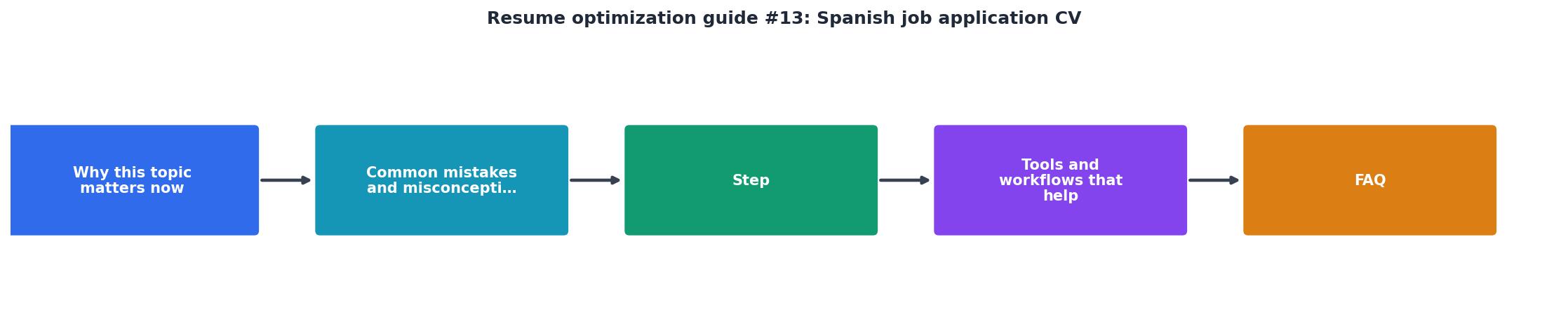
Key takeaway: A Spanish CV is not a translated English resume, it's a fundamentally different document with longer content, personal information, and regional formatting standards. Adapt structure, keywords, and dates to match the specific Spanish-speaking market you're targeting, then test your PDF before submitting.
Tools and workflows to get it right
Use these resources to build and validate your Spanish CV:
Canva Spanish CV templates - Canva offers templates designed for Spanish markets, with pre-built sections and professional layouts. You can customize colors, fonts, and content without designing from scratch.
Google Translate with manual review - Never rely on auto-translation alone. Use it as a starting point, then have a native Spanish speaker review it. Industry-specific terms often translate poorly.
LinkedIn in Spanish - Create a LinkedIn profile in Spanish and copy phrasing directly into your CV. LinkedIn's job descriptions and company descriptions use standardized Spanish terminology that recruiters recognize.
ATS simulation tools - Tools like Jobscan or RésuméCheck let you test your CV against Spanish job descriptions. They highlight missing keywords and format issues that ATS systems would catch.
Native review - Share your final CV with someone who works in your target industry in that Spanish-speaking country. They'll catch phrasing that sounds awkward, formatting mistakes, and missing cultural context.
Interactive CV optimization guide
To help you visualize the optimization process, here's a step-by-step dashboard showing how each component impacts your application success:
Spanish CV Optimization Steps
Add photo, personal data, and Spanish sections in correct order.
Extract and integrate Spanish job description keywords.
Use correct date formats, phone codes, and regional terminology.
Have a native speaker verify phrasing and cultural fit.
Save in PDF format to preserve all formatting and styling.
This visualization shows the cumulative effect of each optimization step. Missing even one step reduces your chances of passing ATS filters and reaching human reviewers.
Spanish CV Optimization Checklist
Your progress is saved automatically in your browser.
FAQ
Frequently Asked Questions
"Protip: Save your final Spanish resume in PDF format to preserve formatting across different systems and devices.">, Writing a Spanish Resume: 5 Tips to Impress Employers
The difference between a CV that lands an interview and one that gets filtered out often comes down to format, keywords, and localization. Spanish employers expect a specific structure, use regional terminology, and screen through ATS systems tuned to Spanish language patterns. Investing time upfront to build a proper Spanish CV, not just a translation, dramatically improves your odds.
Start by researching the specific country and industry you're targeting, then build your CV from scratch rather than translating an existing English resume. Tailor each application to match the job description's language and keywords. Have a native speaker review before you submit. Then test your final PDF to ensure formatting survives ATS parsing.
Additional Resources
- ATS Resume Builder Spain 2026: What Gets Your CV Seen - Spanish ATS systems work differently. What formatting passes, how keywords work in Spanish, and which resume builder actually works for jobs ...
- Writing a Spanish Resume: 5 Tips to Impress Employers - This guide covers five essential tips for creating a Spanish resume that impresses hiring managers and beats applicant tracking systems.
- Spanish & English | ATS Friendly Resume | Resume Format 2026 - ATS Friendly Resume | Resume Format 2026 | Resume Guide for Freshers & Experienced #españolshanu #Resume #ResumeTips #ATSResume #CV JobSearch ...
Can't find a job? We'll check your resume for free
Upload or paste your resume on our home page. Get a quality score and clear fixes in minutes. No signup required to start.
Check my resume free Free AI score · No signup to start