Resume optimization guide #3: medical resume keywords
You spent years earning certifications, logging clinical hours, and building real patient care experience. Then you apply to a hospital or clinic and hear nothing back. The problem is rarely your qualifications. It is almost always the specific words on your resume failing to match what the applicant tracking system expects to see for that medical role.

You spent years earning certifications, logging clinical hours, and building real patient care experience. Then you apply to a hospital or clinic and hear nothing back. The problem is rarely your qualifications. It is almost always the specific words on your resume failing to match what the applicant tracking system expects to see for that medical role.
Photo by Markus Winkler from Pexels
TL;DR:- Medical resumes get filtered by ATS software that scans for exact clinical keywords, certifications, and procedure names from the job posting.
- Generic healthcare terms like "patient care" are not enough. You need role-specific vocabulary: EHR system names, license abbreviations, clinical procedures, and compliance frameworks.
- Extract keywords directly from each job description, mirror them in your experience bullets, and validate the match before you submit.
The keyword gap in medical hiring
Healthcare hiring runs through the same ATS funnels as every other industry, but the stakes are different. A missing keyword on a software developer's resume means a lost interview. A missing keyword on a nurse's resume means a qualified caregiver never reaches the hiring manager at a facility that desperately needs staff.
"In fact, a study by Harvard Business School found that 88% of employers say their hiring systems filter out qualified candidates who don't precisely match the job description.">, 500+ Resume Keywords for the ATS (2026 Guide)
That 88% figure hits medical professionals especially hard. Healthcare job descriptions are dense with specific terminology: license types, EHR platforms, regulatory acronyms, and procedure codes. If your resume says "electronic records" but the posting says "Epic Systems," the ATS treats those as different things entirely.
The fix is not stuffing your resume with every medical term you can think of. It is a systematic process of identifying the exact keywords each employer uses and reflecting them accurately in your experience.
Only about 35% of medical resumes make it past the initial automated screening. The rest get filtered before a human ever reads them. That is not a reflection of candidate quality. It is a keyword alignment problem.
Common keyword mistakes

Medical professionals make a few predictable errors when writing their resumes. Recognizing these saves you from the same traps.
Using generic terms instead of specific ones. Writing "patient care" on a nursing resume is like writing "used computers" on a tech resume. It tells the ATS nothing useful. The job posting might ask for "acute patient assessment," "post-operative care," or "pediatric triage." Each of those is a distinct keyword the system looks for.
Spelling out what should be abbreviated (or vice versa). Healthcare loves acronyms. Some ATS systems match "BLS" but not "Basic Life Support." Others match both. The safest approach: include the abbreviation and the full term at least once. Write "Basic Life Support (BLS)" the first time, then use "BLS" afterward.
Ignoring EHR and technology keywords. Hospitals invest millions in systems like Epic, Cerner, Meditech, or Allscripts. If the job posting names a specific platform, that platform name belongs on your resume. "Proficient in electronic health records" does not match "Epic Hyperspace."
Listing certifications without context. Dropping "ACLS" in a skills section is fine, but pairing it with how you used it is better. "Administered ACLS protocols during cardiac emergencies in a 40-bed ICU" gives the ATS the keyword and gives the human reader a reason to care.
Medical keyword categories
Not all keywords carry equal weight. Here is how to think about them in categories, ranked by how heavily ATS systems typically weight them.
Licenses and certifications
These are binary filters. If the posting requires "RN license, State of California" and your resume does not include it, you are out. Common high-priority examples:
- RN, LPN, CNA, NP, PA-C
- BLS, ACLS, PALS, NRP
- CCRN, CEN, OCN, CNOR
- State-specific license numbers or designations
- DEA registration for prescribing roles
Clinical skills and procedures
These vary by specialty. A surgical nurse's keywords differ completely from a physical therapist's. Examples by role:
- ICU Nurse: ventilator management, hemodynamic monitoring, arterial line insertion, sedation protocols
- Medical-Surgical Nurse: wound care, IV therapy, medication administration, discharge planning
- Physical Therapist: gait training, manual therapy, therapeutic exercise, functional mobility assessment
- Medical Coder: ICD-10-CM, CPT coding, HCPCS, medical necessity review
Technology and systems
- EHR platforms: Epic, Cerner (now Oracle Health), Meditech, Allscripts, athenahealth
- Modules: Epic Hyperspace, Epic MyChart, Cerner PowerChart
- Other systems: Pyxis (medication dispensing), Vocera (communication), Kronos (scheduling)
Compliance and regulatory
- HIPAA compliance
- Joint Commission (JCAHO) standards
- OSHA regulations
- CMS guidelines
- Infection control protocols
Keyword Weight in Medical Job Postings
Notice that soft skills like "team player" and "compassionate" rank lowest. ATS systems rarely filter on those. Humans care about them, but you get to the human only after the keywords let you through.
Step-by-step keyword optimization
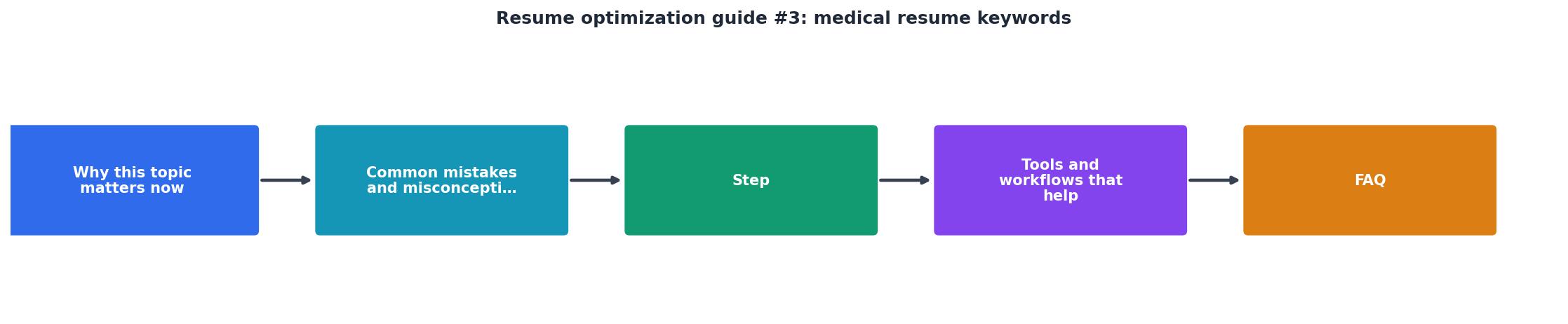
Here is the process, broken into five concrete steps. Each one builds on the last.
- Collect the job posting. Copy the full text into a document. Do not rely on memory or a quick skim.
- Highlight every noun, acronym, and technical term. Look for certifications (BLS, ACLS), systems (Epic, Cerner), procedures (IV insertion, wound vac management), and compliance terms (HIPAA, Joint Commission).
- Cross-reference your resume. Go line by line. For each highlighted keyword from the posting, check whether it appears on your resume. Mark matches and gaps.
- Fill the gaps honestly. If you have the skill or certification but did not include it, add it. If you lack it, do not fabricate it. Medical credentials are verified.
- Validate the match. Read your updated resume alongside the posting one more time. A tool like Resume Hedgehog can automate this comparison, showing you exactly which keywords from the job description your resume covers and which it misses.
Tools and workflows that help

Manual keyword matching works, but it is slow when you are applying to multiple positions. Here are practical approaches that speed things up.
Side-by-side comparison. Open the job posting on one half of your screen and your resume on the other. Use Ctrl+F to search your resume for each keyword from the posting. Simple, free, and effective for a handful of applications.
Word cloud generators. Paste the job description into a free word cloud tool. The largest words are the most frequently mentioned terms. Those are your priority keywords.
ATS-matching tools. Services like Resume Hedgehog let you upload your resume and paste the job description, then produce a tailored version that aligns your existing experience with the posting's language. This is especially useful when you are applying to 10 or more positions and cannot manually rewrite each time.
| Manual Keyword Matching | ATS-Matching Tool |
|---|---|
| Free | Credit-based or subscription |
| 30-45 min per application | 5-10 min per application |
| Easy to miss keywords | Systematic coverage |
| No formatting help | Outputs formatted resume |
| Good for 1-5 applications | Scales to 20+ applications |
Specialty-specific keyword lists. Professional associations often publish competency frameworks. The American Nurses Association, APTA (physical therapy), and AHIMA (health information) all maintain skill taxonomies. These are gold mines for keywords you might have overlooked.
Medical Resume Keyword Optimization Checklist
Your progress is saved automatically in your browser.
FAQ
Frequently Asked Questions
What keyword challenge have you run into when applying to medical positions? Share your experience below.
Additional Resources
- 500+ Resume Keywords for the ATS (2026 Guide) - How to extract the right keywords from any job description · 1. Read the job description carefully · 2. Highlighting the core requirement keywords.
- How to Optimize Your Resume for ATS: The 12-Move ... - Every keyword in the skills list must appear in context below. See our keyword guide for a fuller method. Keyword stuffing does not work.
- How to Write a Healthcare Resume That Stands Out in 2026 - To optimize your healthcare resume, ensure each section includes the following: Contact information: Name, phone number, email, and LinkedIn ...

Get the 356 complete recruitment audit (free PDF)
Download the free PDF with 356 reasons hiring stalls, plus optional daily email tips. No credit card.
Get the free PDF 356 reasons · Free download