Resume optimization guide #4: career gap transferable skills
A two-year gap on your resume does not mean two years of nothing. You managed a household budget, coordinated schedules for multiple people, learned new software on your own, or freelanced under a different title. The problem is not that you lack skills from that period. The problem is that most resumes bury those skills or ignore them entirely, and ATS filters never see them.


A two-year gap on your resume does not mean two years of nothing. You managed a household budget, coordinated schedules for multiple people, learned new software on your own, or freelanced under a different title. The problem is not that you lack skills from that period. The problem is that most resumes bury those skills or ignore them entirely, and ATS filters never see them.
Photo by cottonbro studio from Pexels
TL;DR:- Career gaps produce real, documentable transferable skills like project management, budgeting, communication, and self-directed learning.
- The key is identifying those skills, translating them into the language of your target job posting, and placing them where ATS software and recruiters actually look.
- A structured skills audit plus keyword matching turns a perceived weakness into a competitive advantage.
Why career gap skills matter now
Hiring managers in 2026 see career gaps constantly. Layoffs, caregiving, health recovery, relocation, sabbaticals, and career pivots are all normal. A LinkedIn Workforce Report found that over 60% of professionals have experienced at least one career break.
The real issue is not the gap itself. It is how you present what happened during it. Recruiters spend an average of six to seven seconds scanning a resume. If those seconds land on an unexplained blank space, you lose. If they land on clearly labeled transferable skills that match the job description, you win.
ATS software does not care about chronological perfection. It cares about keyword matches. A gap with the right keywords attached scores higher than a continuous work history with vague bullet points.
Common mistakes with gap periods

Most people handle career gaps in one of three broken ways:
- Hiding the gap entirely. Removing dates or using only years creates suspicion. Recruiters notice.
- Over-explaining with a paragraph. A long narrative about personal circumstances wastes resume space and shifts focus away from your qualifications.
- Listing the gap but adding nothing. Writing "Career Break, 2023-2025" with no bullet points underneath is a missed opportunity.
Here is what a gap entry should look like versus what most people write:
| Weak approach | Strong approach |
|---|---|
| "Career Break, 2023-2025" | "Independent Consultant / Caregiver, 2023-2025" |
| No bullet points | 3-4 bullets with transferable skills |
| No keywords | Keywords matched to target job description |
| Feels like dead space | Reads like a legitimate role |
Identify your gap transferable skills
The first step is a skills audit. Grab a blank document and list everything you did during your career break. Do not filter yet. Include:
- Caregiving: scheduling, budgeting, medical coordination, crisis management, negotiation with insurance providers
- Freelancing or side projects: client communication, project scoping, invoicing, deadline management
- Volunteering: event planning, fundraising, team coordination, public speaking
- Self-study: online certifications (Google, HubSpot, Coursera), new software tools, language learning
- Personal projects: home renovation (budget management, vendor coordination), starting a blog (content strategy, SEO, analytics)
Here is an example dashboard showing how gap activities map to professional skill categories:
Gap Activity → Professional Skill
Translate skills to job posting language

Once you have your raw skills list, open the job posting you want to apply for. Highlight every skill, qualification, and keyword the employer mentions. Now match your gap skills to those keywords.
This is where most people fail. They write "managed household" on their resume. The job posting says "budget management" and "cross-functional coordination." The ATS sees zero overlap.
Here is the process:
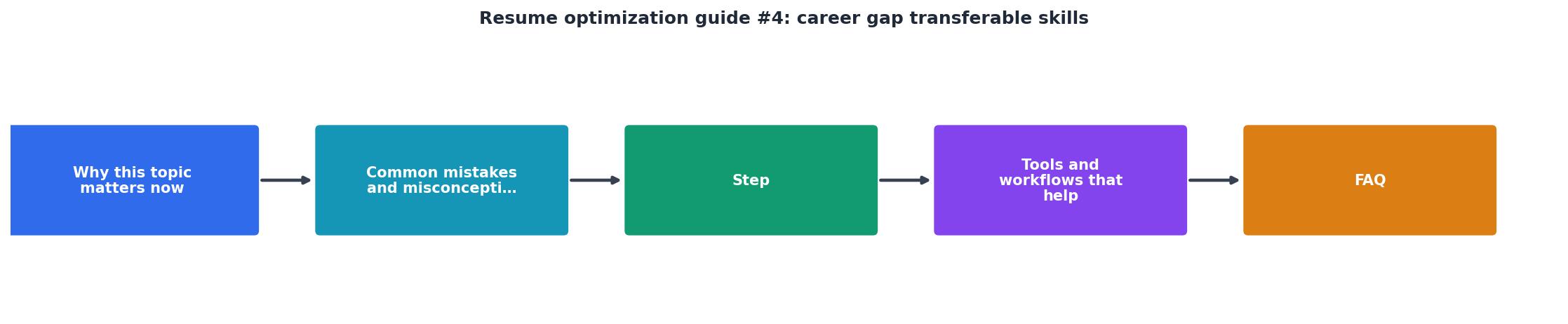
Follow these steps for each application:
- Audit your gap activities
- Extract keywords from the job posting
- Match your activities to those keywords
- Rewrite bullet points using the employer's exact language
- Verify ATS compatibility with a keyword checker
"Led project management for a community fundraiser serving 200+ attendees, coordinating stakeholder communication across 12 volunteers and 4 vendor partners."
That single bullet hits two keywords from the job posting and includes a measurable result.
"Pro tip: Use Resumly's free ATS Resume Checker to see if your skill keywords match the job posting.">, Transferable Skills on a Resume: Examples & Guide (2026)
Where to place gap skills on your resume

Placement matters as much as content. You have three options depending on your situation:
Option A: Chronological placement. List the gap period in your work experience section with a clear title like "Independent Consultant" or "Professional Development Sabbatical." Add 3-4 bullet points. This works best when the gap is short (under 18 months) and you have strong activities to show.
Option B: Functional/hybrid format. Group your skills into categories (Leadership, Technical, Communication) at the top of the resume, pulling from both your employment history and your gap period. This works well for longer gaps or career changers.
Option C: Dedicated skills section. Add a "Relevant Skills & Development" section near the top. List certifications earned during the gap, volunteer roles, and freelance projects. Pair this with a brief one-line mention of the gap in your timeline.
For most active job seekers sending 10+ applications per week, Option A combined with keyword-tailored bullet points delivers the best ATS results. Tools like Resume Hedgehog can help you match your gap skills to each specific job posting automatically, saving hours of manual rewriting.
Quantify everything you can
Numbers transform vague claims into credible achievements. During your gap, you almost certainly produced measurable outcomes:
- Managed a household budget of $X per month
- Coordinated care schedules for X family members across X providers
- Completed X certifications in Y months
- Raised $X for a nonprofit through event planning
- Built a freelance client base of X clients in X months
Career Gap Transferable Skills Action Plan
Your progress is saved automatically in your browser.
FAQ
Frequently Asked Questions
What transferable skills from your career gap are you struggling to translate into resume language? Share your situation and let's work through it together.
Additional Resources
- Transferable Skills on a Resume: Examples & Guide (2026) - Strong transferable skills examples include leadership, communication, project management, data analysis, problem solving, customer service, ...
- Career Change Resume Guide (2026): How to Rewrite ... - How to identify transferable skills, tables of common transferable skills by category, and how to position them on your resume.
- Transferable Skills Career Guide - These skills can be applied to different positions and industries. Click here for a list of transferable skills and how to write these experiences on a resume.

Get the 356 complete recruitment audit (free PDF)
Download the free PDF with 356 reasons hiring stalls, plus optional daily email tips. No credit card.
Get the free PDF 356 reasons · Free download