Resume optimization guide #6: free AI resume builder pitfalls
Free AI resume builders promise a polished, job-ready resume in minutes. The reality is different. Most free tools produce generic output stuffed with buzzwords, strip away the details that make your experience stand out, and leave you with a document that looks identical to thousands of other applicants. This guide breaks down the specific pitfalls, shows you how to spot them, and gives you a concrete plan to avoid wasting hours on a resume that hurts more than it helps.

Free AI resume builders promise a polished, job-ready resume in minutes. The reality is different. Most free tools produce generic output stuffed with buzzwords, strip away the details that make your experience stand out, and leave you with a document that looks identical to thousands of other applicants. This guide breaks down the specific pitfalls, shows you how to spot them, and gives you a concrete plan to avoid wasting hours on a resume that hurts more than it helps.
TL;DR:- Free AI resume builders often produce cookie-cutter resumes with inflated language that recruiters and ATS systems flag or ignore.
- The biggest pitfalls include generic bullet points, missing job-specific keywords, formatting that breaks in ATS parsers, and over-reliance on AI without human review.
- You can still use AI tools effectively by treating their output as a rough draft, manually tailoring keywords to each job posting, and verifying formatting before submitting.
Why free AI builders fail you
You applied to 40 jobs last month. Heard back from one. The resume you built with a free AI tool looked great on screen, but something went wrong between "Submit" and "We'll be in touch." That gap is where free AI resume builders do the most damage.
The core problem: free tools optimize for volume, not fit. They generate resumes fast, but they generate the same resume for every user who enters similar job titles. A marketing manager in SaaS gets nearly identical bullet points as a marketing manager in healthcare. The AI has no incentive to differentiate you because the product's goal is speed, not quality.
That number is not random. Applicant tracking systems filter out roughly three-quarters of incoming resumes before a recruiter ever sees them. When your free AI builder ignores the specific keywords in a job posting, your resume joins that pile.
A generic AI-generated resume typically matches around 30% of the keywords a specific job posting requires. A properly tailored resume hits 70-85%. That gap is the difference between an interview and silence.
The seven biggest pitfalls

1. Buzzword stuffing
Free AI tools love phrases like "results-driven professional" and "dynamic team player." These phrases say nothing. Recruiters skim past them. ATS systems do not score them because they are not job-specific keywords.
"Leveraged cross-functional synergies to architect AI-driven excellence at scale.">, The AI Resume Survival Guide (for 2025 and Beyond)
That quote reads like satire, but free AI builders produce sentences exactly like it. If your resume sounds like a corporate mission statement, it is not working.
2. One-size-fits-all output
Free builders ask for your job title and spit out pre-written bullets. They do not read the job description you are applying to. A "Project Manager" resume from these tools will mention Agile, Scrum, and stakeholder management regardless of whether the posting asks for construction project management or software delivery.
3. Formatting that breaks ATS parsing
Many free tools export resumes with:- Multi-column layouts that ATS reads as scrambled text
- Headers and footers containing contact info the parser skips entirely
- Tables that merge cells and confuse keyword extraction
- Custom fonts embedded as images, not text
4. Missing quantifiable achievements
AI defaults to responsibility descriptions: "Managed a team of engineers." A strong resume says: "Managed a team of 8 engineers, delivering 3 product releases ahead of schedule, reducing QA cycle time by 22%." Free tools rarely prompt you for numbers because that requires back-and-forth the free tier does not support.
5. Ignoring job-specific terminology
Every industry has its own vocabulary. A healthcare operations role wants "HIPAA compliance," "patient throughput," and "EMR systems." A free AI builder trained on general data might substitute "regulatory compliance" and "system management." Close, but not close enough for an ATS keyword match.
6. Data privacy concerns
Free means the product is you. Several popular free resume builders have been caught selling user data to recruiters, staffing agencies, and data brokers. Your contact information, work history, and salary expectations become someone else's lead list.
7. The "good enough" trap
The most dangerous pitfall is psychological. You see a clean PDF, feel relieved, and submit it everywhere without reviewing the content. The AI did the thinking for you, so you stop thinking. That is when generic resumes multiply across job boards, each one slightly wrong for the role it targets.
How to use AI without falling in

AI resume tools are not inherently bad. The problem is using them as a finished product instead of a starting point. Here is a step-by-step approach that keeps the speed benefit while eliminating the pitfalls.
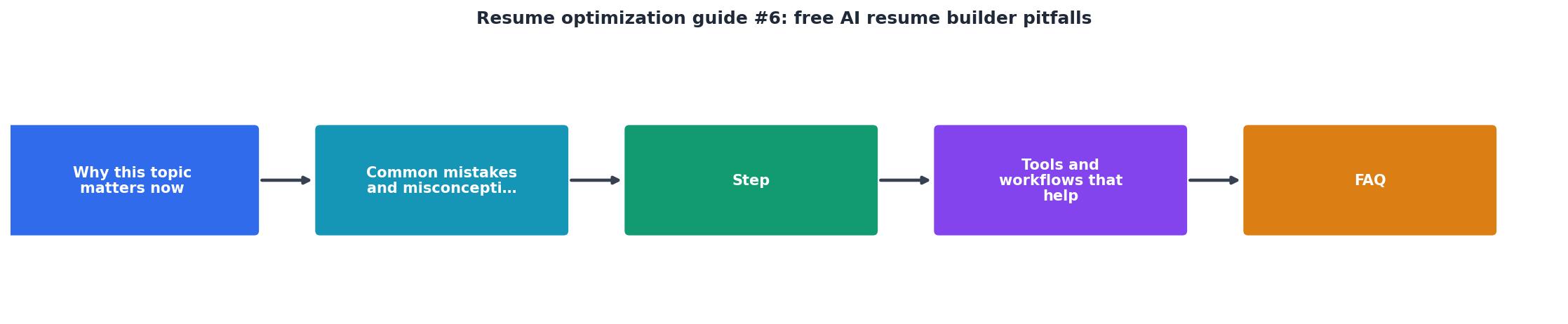
- Generate a draft with any AI tool. Get the structure and basic content on the page.
- Pull keywords directly from the job posting. List the hard skills, software, certifications, and industry terms mentioned.
- Replace generic phrases in the AI draft with those exact keywords, woven into real accomplishments from your experience.
- Add numbers to every bullet point where possible. Revenue, percentages, team sizes, timelines, cost savings.
- Strip formatting down to a single-column layout with standard fonts (Arial, Calibri, Times New Roman). No tables, no graphics, no headers/footers for critical info.
- Run a test parse. Copy-paste your resume into a plain text editor. If it reads coherently, ATS can parse it. If sections are jumbled, fix the layout.
- Get a second opinion. A human review catches what AI misses: tone, relevance, and whether the resume actually sounds like you.
What recruiters actually see

Recruiters spend an average of 6-7 seconds on an initial resume scan. In that window, they look for three things: relevant job title, recognizable company or context, and specific skills that match the role. A free AI resume that leads with "Highly motivated professional seeking challenging opportunities" wastes half that window on nothing.
Here is what the difference looks like in practice, comparing a free AI builder's output against a tailored version for a "Digital Marketing Manager" role at a mid-size e-commerce company:
| Free AI Builder Output | Tailored Resume |
|---|---|
| "Results-driven marketing professional" | "Digital Marketing Manager, 6 years in e-commerce" |
| "Managed social media campaigns" | "Scaled paid social ROAS from 2.1x to 4.8x across Meta and TikTok" |
| "Proficient in marketing tools" | "Google Analytics 4, Klaviyo, Shopify Plus, SEMrush" |
| "Strong communication skills" | "Led weekly cross-functional standups with product, design, and engineering (12 people)" |
| Generic PDF with two-column layout | Single-column, ATS-parseable, .docx format |
The tailored version names the exact tools from the job posting, includes numbers, and drops the filler. That is what gets past ATS and catches a recruiter's eye in 6 seconds.
The following card shows a typical scenario: how a single resume performs differently depending on whether it was generated generically or tailored to the specific posting.
50 Applications Sent
50 Applications Sent
The extra 7 minutes per application is not wasted time. It is the difference between a 2% and a 24% callback rate.
Free AI Resume Builder Pitfall Avoidance Checklist
Your progress is saved automatically in your browser.
FAQ
Frequently Asked Questions
What is the worst AI-generated resume line you have ever seen on your own resume or someone else's? Drop it in the comments.
Additional Resources
- The AI Resume Survival Guide (for 2025 and Beyond) - I wrote this guide to help reset the conversation around two key areas you do need to be able to describe your work—clearly, specifically, and ...
- How To Optimize Your Application for AI Resume Scanners - 1. Match your top skills to relevant keywords · 2. Choose a compatible file type · 3. Add contact details · 4. Write a resume summary · 5. List your ...
- AI Resume Writing: Benefits, Pitfalls & How to Optimize Your CV - Pitfalls of Using AI for Resume Writing · Lack of Personalization: While AI tools can generate resumes quickly, they may lack the personal touch ...

Get the 356 complete recruitment audit (free PDF)
Download the free PDF with 356 reasons hiring stalls, plus optional daily email tips. No credit card.
Get the free PDF 356 reasons · Free download