Resume optimization guide #7: CV format for UK roles
You have been applying to UK jobs with your standard resume and hearing nothing back. The problem is not your experience. UK employers expect a specific document called a CV, and it follows formatting rules that differ from the American resume in length, structure, and content. This guide breaks down exactly how to format a CV for UK roles so your application actually reaches a human.

You have been applying to UK jobs with your standard resume and hearing nothing back. The problem is not your experience. UK employers expect a specific document called a CV, and it follows formatting rules that differ from the American resume in length, structure, and content. This guide breaks down exactly how to format a CV for UK roles so your application actually reaches a human.
TL;DR:- A UK CV is typically two pages, uses a reverse chronological format, and never includes a photo, date of birth, or marital status.
- Start with a personal profile, follow with work experience, education, and skills.
- Tailor every CV to the specific job description, matching keywords the employer uses.
CV vs. resume: the UK difference
In the United States, "resume" means a one-page career summary. In the United Kingdom, the standard application document is called a CV (curriculum vitae). Despite sharing a Latin name with the lengthy academic CVs used in American academia, a UK CV is a concise, two-page document.
The confusion trips up thousands of applicants every year. You send a one-page American resume to a London-based recruiter, and it looks incomplete. You send a five-page academic CV, and it goes straight to the bin. Two pages is the sweet spot for most UK roles outside academia.
Key differences from a US resume:
- Length: Two full A4 pages, not one US Letter page
- Personal details: Include your phone number, email, and city. Never include a photo, age, gender, or nationality.
- Spelling: Use British English throughout (organisation, not organization; programme, not program)
- References: Write "References available upon request" or leave them off entirely
Common mistakes that sink UK applications

I have reviewed hundreds of CVs from international applicants targeting UK roles. The same mistakes appear over and over.
Including personal information that is illegal to request. UK equality law means employers cannot ask for your age, photo, marital status, or nationality. Including these details signals that you do not understand the UK job market. Worse, some recruiters will reject your CV to avoid any appearance of bias.
Using an objective statement instead of a personal profile. The "Objective: To obtain a challenging position..." format died in the UK around 2005. Replace it with a personal profile: three to four sentences summarizing who you are, what you bring, and what you are looking for.
Ignoring ATS formatting rules. UK employers use applicant tracking systems just like American ones. Fancy columns, text boxes, headers, and footers break ATS parsing. Stick to a single-column layout with standard section headings.
Listing duties instead of achievements. "Responsible for managing a team" tells a recruiter nothing. "Managed a team of 12, delivering a £2.4M project three weeks ahead of schedule" tells them everything.
The correct UK CV structure
"The traditional – or 'reverse chronological' – CV is the most commonly used format.">, CVs
Here is the section-by-section breakdown of a properly formatted UK CV. Follow this order unless you have a strong reason to deviate.
1. Contact details. Full name, phone number, email address, city (not full address), and optionally a LinkedIn URL. No photo. No date of birth.
2. Personal profile. Three to four sentences. State your profession, years of experience, core strengths, and what type of role you are targeting. Write in the third person or first person consistently.
3. Key skills. A short bulleted list of six to eight skills directly relevant to the target role. Pull these from the job description.
4. Work experience. Reverse chronological order. For each role: job title, company name, location, dates (month and year), then three to five bullet points focused on achievements.
5. Education. Degree title, institution, dates. For recent graduates, include relevant modules and dissertation topics. For experienced professionals, keep it brief.
6. Additional sections. Certifications, languages, volunteer work, or professional memberships. Only include what is relevant.
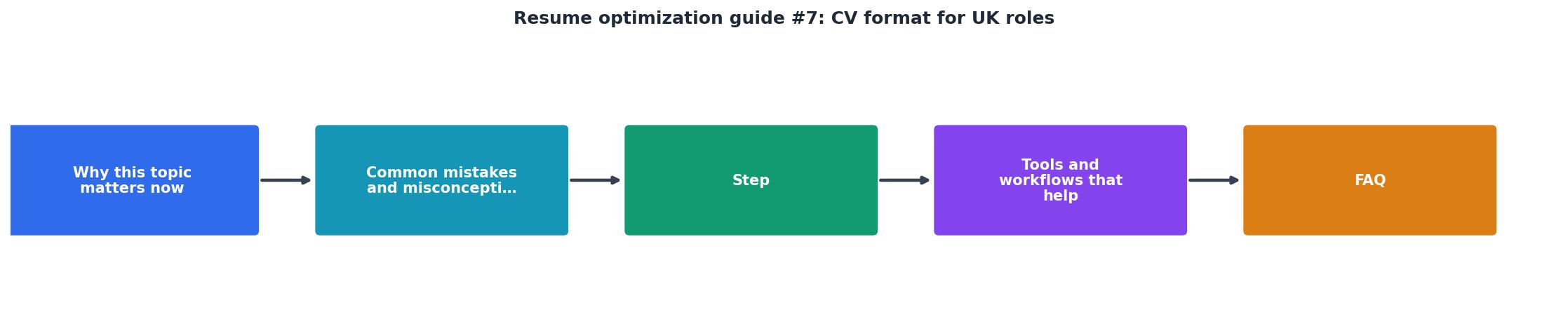
The diagram above shows the flow: Contact details, Personal profile, Key skills, Work experience, Education, Additional sections. Each section feeds into the next, building a complete picture for the recruiter.
Tailoring your CV for each role

Sending the same generic CV to every UK employer is the fastest way to get ignored. Each job posting contains specific keywords, required qualifications, and preferred skills. Your CV needs to reflect those.
Here is how to tailor effectively:
- Read the job description twice. Highlight every skill, qualification, and keyword.
- Match your personal profile. Rewrite it to echo the role's core requirements.
- Reorder your key skills. Put the most relevant ones first.
- Adjust your bullet points. Emphasize achievements that align with the job's priorities.
- Check for keyword matches. If the posting says "stakeholder management," use that exact phrase, not "working with clients."
Tools like Resume Hedgehog can speed this up significantly. Upload your CV, paste the UK job description, and get a tailored version that matches the employer's language and keywords.
UK-specific formatting details
Small formatting choices matter more than you think. UK recruiters have strong expectations.
Font: Use a clean, professional font. Arial, Calibri, or Garamond at 10-12pt. Avoid anything decorative.
Margins: 2cm on all sides is standard for A4 paper.
File format: PDF unless the employer specifically requests Word. PDFs preserve your formatting across devices.
Dates: Use the format "September 2023 - Present" or "Sep 2023 - Present." Do not use the American MM/DD/YYYY format.
Page breaks: Never split a single role across two pages. If a role's bullet points start on page one, they should finish on page one.
The following comparison shows what changes when you convert a US resume to a UK CV:
| US Resume | UK CV |
|---|---|
| One page preferred | Two A4 pages standard |
| "Resume" at top (optional) | No title needed |
| Objective statement | Personal profile |
| US Letter paper size | A4 paper size |
| American English spelling | British English spelling |
| May include GPA | Degree classification (First, 2:1, 2:2) |
| "References available" optional | "References available upon request" common |
Here is an example dashboard showing how a well-formatted UK CV typically scores across key areas when evaluated by recruiters and ATS systems:
UK CV Quality Scorecard (Example)
Your UK CV formatting checklist
UK CV Format Checklist
Your progress is saved automatically in your browser.
FAQ
Frequently Asked Questions
What part of the UK CV format do you find most different from what you are used to? Share your experience in the comments.
Additional Resources
- CVs - Oxford University Careers Service - A well written CV is easy to read and scan quickly; clear font of 10 pt or 11 pt; some blank spaces; not too narrow a margin · We would recommend writing your ...
- UK CV Format 2026: The Complete Guide for British Job ... - The standard UK CV in 2026 is a 2-page document written in British English. British CVs are formatted on A4 paper (210 × 297mm), not US Letter size. Use ...
- How to write a CV - When you write your CV, remember to: use a clear font like Arial, Times New Roman or Calibri in size 11 or bigger always use the same style throughout use ...
Get the 356 complete recruitment audit (free PDF)
Download the free PDF with 356 reasons hiring stalls, plus optional daily email tips. No credit card.
Get the free PDF 356 reasons · Free download