Resume optimization guide #8: internship resume template
Most internship applicants send the exact same resume to every posting and then wonder why they never hear back. The problem is not your lack of experience. The problem is that your resume does not speak the language of the specific internship you want. This guide gives you a concrete internship resume template, section by section, so you can tailor each application in minutes instead of hours and actually land interviews.

Most internship applicants send the exact same resume to every posting and then wonder why they never hear back. The problem is not your lack of experience. The problem is that your resume does not speak the language of the specific internship you want. This guide gives you a concrete internship resume template, section by section, so you can tailor each application in minutes instead of hours and actually land interviews.
Photo by Anna Shvets from Pexels
TL;DR:- An internship resume needs five sections: header, summary, education, experience (including projects), and skills.
- Every bullet point should start with an action verb and include a measurable result when possible.
- Tailoring keywords to each job description is the single highest-impact change you can make.
- Tools like Resume Hedgehog automate keyword matching so you spend minutes, not hours, per application.
Why internship resumes need their own template
A standard professional resume assumes years of full-time work history. You probably do not have that yet, and that is completely fine. What you do have are coursework, projects, volunteer work, part-time jobs, and campus activities that demonstrate real skills. The trick is structuring those assets so an Applicant Tracking System (ATS) and a recruiter both see value immediately.
That number is not a typo. Nearly every large employer filters resumes through software before a human ever reads them. If your formatting confuses the parser or your keywords do not match the job description, your resume disappears into a digital void.
"98% of Fortune 500 companies use an ATS to manage hiring at scale (Resume.io Resume Statistics Report, 2025), which is why formatting choices matter well before a hiring manager ever opens the file.">, ATS Resume Templates & Format Guide for 2026 · Resume.io
Common mistakes that sink internship resumes

Before building the template, here are the errors I see most often:
- Using a creative or multi-column layout. Two-column designs look nice on screen but ATS parsers frequently scramble the content. Stick to a single-column layout with clear section headings.
- Listing duties instead of accomplishments. "Responsible for social media" tells a recruiter nothing. "Grew Instagram engagement 40% over three months by scheduling daily Reels" tells a story.
- Ignoring the job description. Each internship posting contains the exact keywords the ATS screens for. If the posting says "data analysis" and your resume says "number crunching," you lose the match.
- Padding with irrelevant filler. A high school job at a grocery store can work if you frame it around transferable skills like customer service, inventory tracking, or team coordination. But listing every club you joined freshman year just to fill space dilutes your strongest points.
- Skipping a summary section. Recruiters spend roughly six seconds on an initial scan. A two-line summary at the top anchors their attention on who you are and what you bring.
Roughly seven out of ten internship resumes get filtered out before a human sees them, largely because of keyword mismatches and formatting issues. The template below addresses both problems directly.
The five-section internship template
Here is the structure that works. Each section has a specific job to do.
1. Header
Include your full name, phone number, professional email, LinkedIn URL, and optionally a portfolio or GitHub link. Skip your physical address. No recruiter needs your street name in 2026.
2. Professional summary
Two to three sentences. State your field of study, your target role, and one or two standout qualifications. Example:
"Junior computer science student at Georgia Tech with hands-on experience building full-stack web applications using React and Node.js. Seeking a summer 2026 software engineering internship to apply strong debugging skills and collaborative development experience from two open-source projects."
3. Education
For internship candidates, education goes above experience. Include your university name, degree and major, expected graduation date, and GPA (if 3.0 or above). Add relevant coursework only when it directly maps to the internship requirements.
4. Experience and projects
This is where most applicants struggle. Combine paid work, volunteer roles, class projects, and personal projects into one section. For each entry:
- Title and organization (or project name)
- Dates
- Two to four bullet points starting with action verbs: built, designed, analyzed, coordinated, reduced, increased
5. Skills
List hard skills first (programming languages, tools, certifications), then soft skills only if the job description explicitly mentions them. Match the exact phrasing from the posting. If they say "Microsoft Excel," do not write "spreadsheets."
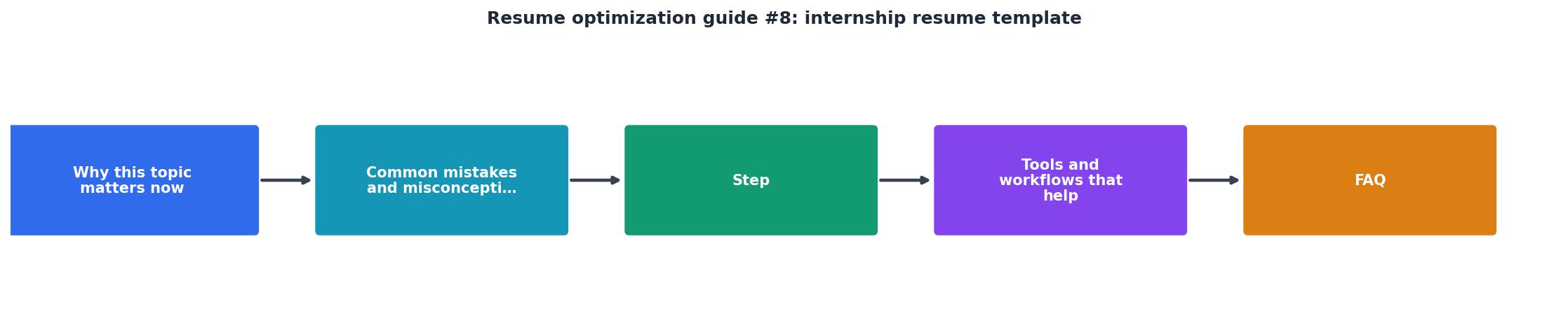
The flow is straightforward: Header, Summary, Education, Experience/Projects, Skills. Each section feeds the next, building a narrative from who you are to what you can do.
Tailoring the template to each posting

A template is a starting point, not a finished product. The real leverage comes from customizing it for every application. Here is the process:
- Copy the job description into a plain text file.
- Highlight repeated keywords like specific tools, methodologies, or soft skills.
- Map each keyword to something on your resume. If the posting mentions "Agile methodology" and you used Scrum in a class project, add that detail.
- Rewrite your summary to echo the posting's language. If they want a "detail-oriented marketing intern," open with that phrase.
- Reorder your bullet points so the most relevant experience appears first under each entry.
resume-google-swe-intern-2026.pdf). This prevents accidentally sending the wrong version and gives you a library to reference for similar roles later.Here is an example dashboard showing what a well-optimized internship resume looks like by the numbers:
Optimized Internship Resume Scorecard
Formatting rules that protect your resume
ATS compatibility comes down to a few non-negotiable formatting choices:
- File format: Submit as PDF unless the application specifically requests .docx. PDFs preserve layout across devices.
- Font: Use a standard font like Calibri, Arial, or Garamond at 10-12pt. Decorative fonts confuse parsers.
- Section headings: Use exact labels the ATS expects: "Education," "Experience," "Skills." Creative headings like "My Journey" get ignored.
- No tables, text boxes, or graphics inside the resume body. Headers and footers are also risky since many parsers skip them entirely.
- Consistent date format: "May 2025 - Aug 2025" works. Do not mix formats within the same document.
| ATS-Friendly Format | Risky Format |
|---|---|
| Single-column layout | Two or three columns |
| Standard section headings | Creative headings |
| PDF or .docx | .pages, .jpg, Google Docs link |
| 10-12pt standard font | Decorative or tiny fonts |
| Plain bullet points | Icons, graphics, text boxes |
Internship Resume Optimization Checklist
Your progress is saved automatically in your browser.
FAQ
Frequently Asked Questions
What section of your internship resume gives you the most trouble? Drop your question below and I will help you work through it.
Additional Resources
- ATS Resume Templates & Format Guide for 2026 - See the best ATS resume templates for 2026, learn how to optimize your resume for applicant tracking systems, and check real formatting examples.
- Resume Resources - University Career Center - Templates To get started, choose a template from below. Upload your resume then ask, “Optimize my resume for a job as a financial analyst.”
- How To Write an ATS Resume (With Template and Tips) - In this article, we explain what an ATS is, how to format an ATS-friendly resume and how to optimize resume content for ATS scans.
Get the 356 complete recruitment audit (free PDF)
Download the free PDF with 356 reasons hiring stalls, plus optional daily email tips. No credit card.
Get the free PDF 356 reasons · Free download