Resume Strategies for Moving from Finance to Education
You spent years analyzing spreadsheets, managing budgets, and presenting quarterly results to stakeholders. Now you want to stand in front of a classroom or design curriculum, and your resume still reads like a pitch deck for an investment committee. The gap between what you have done and what hiring managers in education expect to see is not as wide as it looks, but bridging it requires deliberate rewriting, not just swapping a job title.


You spent years analyzing spreadsheets, managing budgets, and presenting quarterly results to stakeholders. Now you want to stand in front of a classroom or design curriculum, and your resume still reads like a pitch deck for an investment committee. The gap between what you have done and what hiring managers in education expect to see is not as wide as it looks, but bridging it requires deliberate rewriting, not just swapping a job title.
Photo by Mikhail Nilov from Pexels
TL;DR:- Finance professionals already own transferable skills like data analysis, budgeting, project management, and stakeholder communication that education employers value.
- Reframe every bullet point using education-specific language: "trained junior analysts" becomes "facilitated professional development for a team of 8."
- Fill experience gaps with certifications, volunteer tutoring, and classroom observation hours, then let the right keywords carry your resume past ATS filters.
The real overlap between finance and education
Career changers often underestimate how much their daily finance work already mirrors what educators do. Teaching is not just lecturing. It involves planning, assessment, data-driven decision-making, and communicating complex ideas to people who are not experts.
"According to iHire's 2020 Talent Retention Report, 66 percent of survey respondents have recently considered changing careers.">, How to Write a Career Change Resume
That statistic is not surprising. What matters is that you are not alone, and schools are increasingly open to non-traditional candidates who bring real-world expertise into the classroom.
Here is a concrete list of finance skills that translate directly:
- Data analysis maps to student assessment and performance tracking.
- Budgeting and forecasting maps to grant writing, department budget management, and resource allocation.
- Client presentations map to lesson delivery and parent-teacher conferences.
- Compliance and regulation maps to understanding accreditation standards and state education requirements.
- Project management maps to curriculum development timelines and cross-departmental initiatives.
- Mentoring junior staff maps to student mentorship and peer coaching.
Translate skills into education language

The single biggest mistake finance-to-education career changers make is leaving their bullet points in finance jargon. A principal scanning your resume does not care about "EBITDA reconciliation." They care about whether you can explain a concept clearly, manage a room, and track progress over time.
Reframing technique: For each bullet point on your current resume, ask three questions:
- What skill did this task require?
- Who benefited from the outcome?
- How would an educator describe the same activity?
| Finance Version | Education Version |
|---|---|
| Created data-driven presentations that simplified complex financial concepts for non-specialist audiences | |
| Planned and allocated a $2.4M budget across multiple programs, ensuring full resource utilization | |
| Designed and delivered onboarding training for a cohort of 5, including hands-on workshops and assessment checkpoints | |
| Coordinated a 12-member cross-departmental team to meet regulatory standards within a 6-month timeline |
Education keywords that matter
Applicant tracking systems in school districts and universities filter resumes the same way corporate ATS software does. If the right terms are missing, a human never sees your application.
Here is a working list of education-specific keywords to weave into your resume where they honestly apply:
- Curriculum development
- Differentiated instruction
- Formative and summative assessment
- Classroom management
- Student engagement
- IEP (Individualized Education Program)
- STEM integration
- Project-based learning
- Professional development
- Learning outcomes
- Bloom's Taxonomy
- Standards alignment (Common Core, state standards)
- Data-driven instruction
- Collaborative learning
- Parent and community engagement
Closing the experience gap

No direct classroom experience? That is the objection you need to neutralize before a hiring manager even thinks it. Here is how:
Get certified strategically
Depending on your target role and state, consider:
- State teaching license through an alternative certification program (most states offer these for career changers).
- Praxis exams in your subject area (mathematics, business education, economics).
- TESOL/TEFL certification if you are interested in teaching English learners.
- Google Certified Educator for technology-integrated teaching roles.
- Project Management Professional (PMP) reframed as evidence of planning and execution skills.
Build classroom hours fast
- Volunteer as a guest speaker at a local high school's business or economics class.
- Tutor through organizations like SCORE, Junior Achievement, or a community college.
- Offer free financial literacy workshops at a library or community center.
- Shadow a teacher for a week and document what you observed.
Structure your education resume

The layout of a career-change resume differs from a standard chronological format. You want to lead with relevance, not recency.
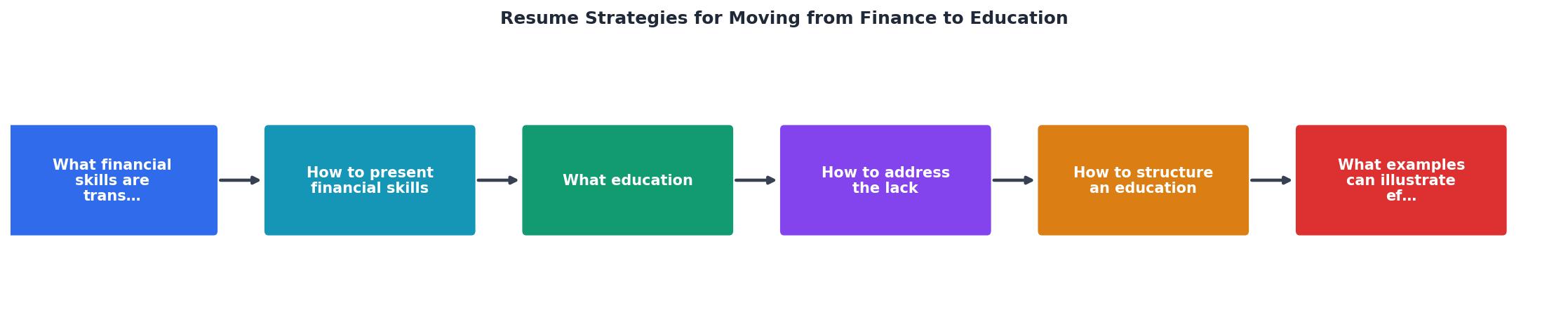
Follow these steps, matching the process in Figure 1:
- Identify transferable skills from your finance background.
- Research target role keywords and requirements.
- Reframe bullet points using education language.
- Add certifications and volunteer experience.
- Optimize for ATS with targeted keywords.
- Review and refine the final document.
Recommended resume sections (in order)
- Header with name, contact info, LinkedIn URL.
- Professional summary (3 to 4 lines) that names the target role and highlights your strongest transferable skills. Example: "Finance professional with 8 years of experience in data analysis, team training, and budget management, pursuing a secondary mathematics teaching position. Holds alternative teaching certification and 120+ hours of classroom volunteer experience."
- Relevant skills section with a two-column list of 8 to 12 keywords pulled from the job posting.
- Relevant experience that includes volunteer teaching, tutoring, and workshop facilitation listed before or alongside your finance roles.
- Professional experience with reframed bullet points.
- Education and certifications including any teaching credentials, Praxis scores, and relevant coursework.
The following interactive card shows how a typical finance professional's resume sections might map to an education-focused layout:
Finance Resume ➜ Education Resume
Sample bullet points that work
Concrete examples beat abstract advice. Here are bullet points a finance-to-education candidate could use, organized by the skill they demonstrate:
Data-Driven Instruction:- Analyzed performance data for a portfolio of 30+ accounts, identifying trends and recommending targeted interventions, directly applicable to tracking student progress across standardized assessments.
- Designed a 6-week internal training program on regulatory compliance, including learning objectives, session plans, practice exercises, and a final assessment with an 92% pass rate.
- Facilitated weekly team meetings with 15 cross-functional stakeholders, managing competing priorities and ensuring productive outcomes within a 60-minute timeframe.
- Volunteered 60 hours with Junior Achievement, delivering financial literacy lessons to 9th-grade students across 3 schools, receiving a 4.8/5.0 average feedback score.
- Allocated departmental resources across 4 concurrent projects totaling $1.8M, completing all deliverables on schedule and 3% under budget.
Finance-to-Education Resume Checklist
Your progress is saved automatically in your browser.
FAQ
Frequently Asked Questions
What part of your finance background are you finding hardest to translate into education language? Share your trickiest bullet point and let's figure it out together.
Additional Resources
- How to Write a Career Change Resume - Template - Wharton - 1. Craft a resume objective · 2. Include a skills summary · 3. Focus on the most relevant work experience · 4. Highlight your education (including certificates) · 5 ...
- Revamping Your Resume for a Career Change - Have a designated day and time to search for jobs that you may be interested in applying to. · You should customize your resume for each job you ...
- Resume Tips for Transitioning Educators - Reframe your skills: Replace classroom-specific terminology with business language, such as “team leadership” instead of “classroom management,” to make your ...

Get the 356 complete recruitment audit (free PDF)
Download the free PDF with 356 reasons hiring stalls, plus optional daily email tips. No credit card.
Get the free PDF 356 reasons · Free download