Checklist: ATS-friendly DevOps Engineer resume (2026)
You spent three years building CI/CD pipelines, automating infrastructure with Terraform, and keeping production clusters alive at 3 AM. Then you applied to 40 DevOps roles and heard back from exactly one. The problem is almost never your skills. It is your resume getting shredded by an Applicant Tracking System before a human ever reads it.

You spent three years building CI/CD pipelines, automating infrastructure with Terraform, and keeping production clusters alive at 3 AM. Then you applied to 40 DevOps roles and heard back from exactly one. The problem is almost never your skills. It is your resume getting shredded by an Applicant Tracking System before a human ever reads it. This checklist gives you every item to verify so your DevOps resume actually reaches the hiring manager's screen.
Photo by Jakub Zerdzicki from Pexels
TL;DR:- Use a single-column layout, standard section headings, and
.docxor.pdfformat so ATS parsers read every line. - Mirror exact keywords from the job posting: tool names (Kubernetes, Ansible, Jenkins), certifications (AWS SAA, CKA), and metrics (uptime %, deployment frequency).
- Quantify impact on every bullet: reduced deploy time by X%, cut incident MTTR from Y to Z minutes.
- Run your final draft through www.resumehedgehog.com to match it against the specific job description before you hit submit.
Why ATS compliance matters for DevOps
Three out of four resumes never reach a recruiter. ATS software scans for keyword matches, section structure, and file format before any human involvement. DevOps roles make this worse because job descriptions mix infrastructure terms, programming languages, cloud platforms, and methodology buzzwords into a single posting. Miss a handful of those terms and the system scores you below the threshold.
The good news: ATS rules are predictable. Fix the formatting, align the vocabulary, and quantify your results. That is the entire game.
Engineers who tailor their resumes to each posting report dramatically higher callback rates. The effort per application drops to minutes when you use the right workflow.
Common mistakes that kill DevOps resumes

Fancy templates with columns and icons. Two-column layouts confuse most ATS parsers. Columns get merged into garbled text. Icons for contact info (phone emoji, envelope emoji) are invisible to the parser, so your email vanishes.
Acronyms without spelled-out versions. You write "K8s" but the ATS searches for "Kubernetes." Include both: "Kubernetes (K8s)." Same for CI/CD, IaC, SRE, and every other abbreviation in your toolbox.
Generic bullet points. "Responsible for infrastructure" tells the system nothing. "Provisioned and managed 120+ EC2 instances across 3 AWS regions using Terraform and Ansible" tells it everything.
One resume for every application. DevOps job descriptions vary wildly. A posting focused on AWS ECS and GitHub Actions needs different keywords than one centered on Azure AKS and GitLab CI. Sending the same document to both wastes your time.
Step-by-step: build your ATS-ready resume
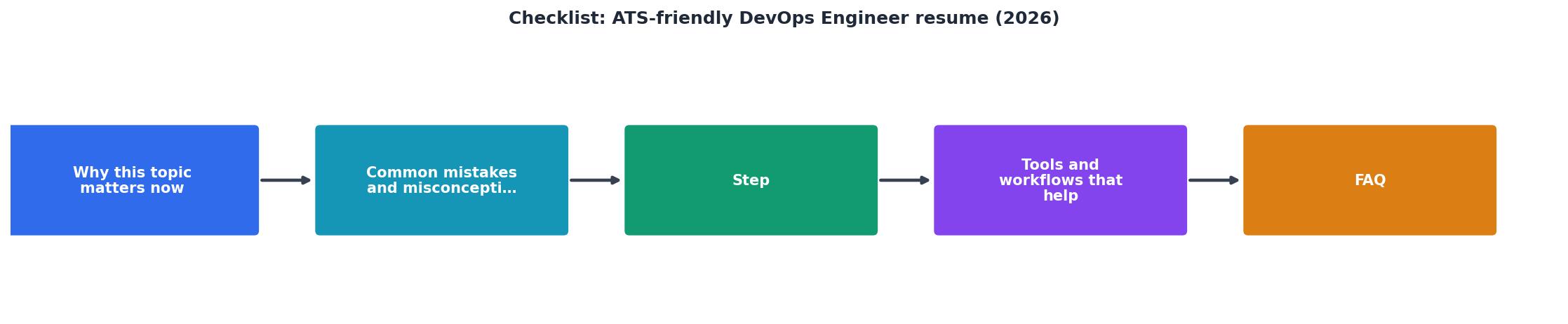
Follow these steps in order. Each one builds on the previous.
1. Pick the right format
Use a single-column layout in a clean .docx or ATS-parseable .pdf. Stick to standard fonts: Arial, Calibri, or Helvetica. No headers/footers for critical info because many parsers skip those regions.
2. Use standard section headings
ATS software looks for exact heading labels:
- Summary or Professional Summary
- Experience or Work Experience
- Skills or Technical Skills
- Education
- Certifications
3. Write a targeted summary
Two to three sentences. State your title, years of experience, core platforms, and one measurable achievement.
"Systems Administrator transitioning to DevOps with 3 years of Linux infrastructure management and Python scripting.">, Medium
This works because it names the role, quantifies experience, and includes searchable terms (Linux, Python).
4. Mirror the job posting's keywords
Open the job description. Highlight every tool, platform, methodology, and certification mentioned. Your resume must include each one you genuinely have experience with, using the exact phrasing from the posting.
Example keyword clusters for a typical 2026 DevOps posting:
- Cloud: AWS, GCP, Azure, multi-cloud
- Containers: Docker, Kubernetes, Helm, ECS, EKS
- IaC: Terraform, Pulumi, CloudFormation, Ansible
- CI/CD: Jenkins, GitHub Actions, GitLab CI, ArgoCD
- Monitoring: Prometheus, Grafana, Datadog, PagerDuty
- Scripting: Python, Bash, Go
5. Quantify every bullet
Swap vague descriptions for numbers:
Managed cloud infrastructure→ Managed 200+ AWS resources across 4 accounts, reducing monthly spend by 18% through right-sizing and Reserved Instance coverage.Improved deployment process→ Reduced deployment frequency from weekly to 12x daily using ArgoCD and Helm, cutting lead time from 5 days to 4 hours.Handled incidents→ Decreased MTTR from 45 minutes to 12 minutes by implementing automated runbooks in PagerDuty and Datadog.
6. Tailor for each application
This is where most people quit because it takes too long. A tool like www.resumehedgehog.com automates the matching: upload your base resume, paste the job description, and get an optimized version in minutes.
Tools and workflows that speed this up

| Manual Tailoring | AI-Assisted Tailoring |
|---|---|
| 30-60 min per application | 3-5 min per application |
| Easy to miss keywords | Automated keyword matching |
| Inconsistent formatting | Consistent ATS-safe output |
| Hard to A/B test versions | Quick iteration on variants |
A practical workflow for high-volume applications:
- Create a master resume with every role, project, tool, and metric you have.
- Save the job description as plain text.
- Run both through Resume Hedgehog to generate a tailored version.
- Review the output for accuracy. Remove anything you cannot defend in an interview.
- Export as
.pdfand submit.
DevOps-specific sections to include

Beyond the standard sections, DevOps resumes benefit from a few extras:
Technical Skills matrix. Group skills by category: Cloud Platforms, Containerization, CI/CD, IaC, Monitoring, Scripting. List specific tools under each. This gives the ATS multiple keyword hits in one scannable block.
Certifications section. AWS Solutions Architect, CKA (Certified Kubernetes Administrator), HashiCorp Terraform Associate, and Azure DevOps Engineer Expert are the four most requested certs in 2026 DevOps postings. List the full name, issuing body, and year obtained.
Projects section (optional). If you contributed to open-source infrastructure tools or built internal platforms, a short projects section adds keyword density and demonstrates initiative. Include the repo link if public.
Here is an example dashboard showing how a well-optimized DevOps resume scores against a typical job posting:
ATS Match Score: DevOps Engineer Posting
The complete checklist
Use this before every submission. Print it, bookmark it, or paste it into your job-search tracker.
ATS-Friendly DevOps Engineer Resume Checklist (2026)
Your progress is saved automatically in your browser.
FAQ
Frequently Asked Questions
.pdf unless the application portal specifically requests .docx. Most modern ATS platforms (Greenhouse, Lever, Workday, iCIMS) parse both formats reliably. Avoid .pages, .odt, or image-based PDFs created by scanning a printed document.What is the one item on this checklist you have been skipping? Drop it in the comments and let's figure out how to fix it.
Additional Resources
- DevOps Engineer Resume: Bullet Examples, ATS ... - DevOps Engineer Resume: Bullet Examples, ATS Keywords & Summary Templates (2026) ... What's the best resume format for DevOps Engineers?
- DevOps Engineer Resume Examples: Senior + Platform ... - Three filled-in DevOps resume examples (junior, senior, Platform Engineer) with DORA metrics, ATS keywords, the ATS keyword set that clears ...
- 15 DevOps Resume Examples for 2026 - Real examples and templates of DevOps resumes, updated for your 2026 job search. Download them for free, plus learn how to update your resume for 2026 ...

Get the 356 complete recruitment audit (free PDF)
Download the free PDF with 356 reasons hiring stalls, plus optional daily email tips. No credit card.
Get the free PDF 356 reasons · Free download