

Your resume works hard, but is it working for you? When you send the same document to every employer, you're competing on the wrong terms. The companies screening your application are looking for specific skills, experience, and keywords that match their open role. A generic resume doesn't speak that language. The result is silence, ghosting, and the growing suspicion that something is wrong with your application strategy. The fix is simpler than you think: tailor your resume to every job you apply for, and watch your interview rate climb.
TL;DR:- Generic resumes fail because they don't match job descriptions or pass ATS screening
- Tailor your resume to each specific job by analyzing the job description and extracting relevant keywords
- Customize your summary, skills, and achievements sections to emphasize role-specific accomplishments
- Use concrete metrics, specific terminology, and mirrored language from the job posting
- A tailored resume increases interview callback rates significantly compared to a one-size-fits-all approach
Why Generic Resumes Fail

A generic resume faces two gatekeepers: the Applicant Tracking System and the human recruiter. Neither favors one-size-fits-all approaches.
The ATS problem. Most large companies use ATS software to screen applications. The system searches for specific keywords from the job description. If your resume doesn't contain the terms the job is screening for, it gets filtered out before a human ever reads it. You might have the right experience, but if you describe it using different language than the job posting, the ATS misses it. This is why sending the same resume to a marketing coordinator role and a marketing manager role often fails, even though both are marketing jobs. The keywords and requirements are different.
The recruiter problem. Even if your resume passes the ATS, recruiters skim applications in seconds. They look for alignment between what the job asks for and what you've done. When your resume is generic, they see a history of tasks you've performed, not a strategic fit for their specific opening. You become another candidate in a pile, not the person who can solve their exact problem.
The structural issue. Generic resumes often lead with a one-size-fits-all summary or objective. "Seeking a challenging role in [industry] where I can contribute my skills" says nothing about why you're a fit for this particular job. It's a placeholder, not a value proposition. The same goes for a generic skills section that lists every capability you have. Recruiters need to see the skills that matter for this role, prioritized and obvious.
"𝗖𝗵𝗲𝗰𝗸 𝗬𝗼𝘂𝗿 𝗙𝗼𝗿𝗺𝗮𝘁Format is about 5% of the resume equation." >, Resume Troubleshooting: Is Your Resume the Problem?
How to Tailor Resumes to Specific Jobs
Tailoring doesn't mean rewriting your entire resume from scratch for each application. It means strategically adjusting what you emphasize, reordering sections, and using the language the job posting uses. Here's the process.
Step 1: Analyze the job description. Read it carefully, twice. Identify the core responsibilities, required skills, and preferred qualifications. Look for repeated terms and phrases. If "data analysis" appears three times in the job description, that's a signal. The company cares about data analysis. Make sure your resume shows you can do it.
Step 2: Extract keywords and skills. Create a list of the top 10-15 skills and terms from the job posting. Include both hard skills (Python, Salesforce, project management) and soft skills (communication, collaboration). These are your tailoring targets. Your resume should reflect as many of these as honestly apply to your background.
Step 3: Reorder and prioritize. Move your most relevant experience to the top of your resume or call it out explicitly. If you have five years of sales experience and the job emphasizes customer retention, lead with the retention-focused projects, not the first job you ever had. Make the recruiter see the match immediately.
Step 4: Adjust your professional summary. Instead of a generic objective, write a 2-3 sentence summary that connects your experience to the job's core need. Example: Instead of "Experienced marketing professional seeking a growth role," try "Marketing manager with 5 years driving customer acquisition and retention for SaaS platforms, seeking to apply go-to-market expertise in a scaled B2B environment."
Step 5: Mirror the language. If the job posting says "develop marketing campaigns," use those exact words. If it says "create" instead, use "create." The ATS is looking for matches, and synonyms don't always register. If the job lists "CRM platforms" as required and you know Salesforce, say "Salesforce and other CRM platforms" rather than forcing a different phrasing.
The Role of Keywords in Resume Success
Keywords are the bridge between what you've done and what the employer is looking for. They're not filler; they're how your resume gets found and how it gets read.
An ATS keyword is a term the system is programmed to search for. When a recruiter sets up the ATS, they specify which skills, titles, and qualifications to screen for. If you don't include those exact terms, the system doesn't flag your resume as relevant, even if you're overqualified. The solution is to include the keywords from the job posting in your resume, in context, where they naturally fit.
The challenge: don't keyword-stuff. Padding your resume with irrelevant terms or repeating words unnaturally sets off alarms for both the ATS (many systems penalize keyword density) and human readers (it looks desperate and dishonest). Instead, include keywords where they're genuine. If the job requires Excel and you use Excel, say it. If it mentions "cross-functional collaboration" and you've led cross-functional teams, use that phrase.
Concrete keyword strategy:- Copy the job title into your professional summary if it matches your background.
- Include specific tools and technologies mentioned in the job (Jira, Tableau, HubSpot, etc.) in your skills section and where you've used them.
- Use the exact phrasing from "required qualifications" when describing your experience. If they want "proven track record of X," and you've delivered X, phrase it that way.
- Look for industry-specific terminology and incorporate it. A healthcare job might emphasize "patient outcomes" or "clinical workflows." Match that language.
- Check competitor job postings for the same role type. If multiple postings mention the same keywords, those are signals that the industry values them.
How to Customize Summaries and Skills Sections
Your professional summary and skills section are real estate. In a 5-10 second skim, a recruiter reads these first. Make them count.

Rewriting your summary. A generic summary is usually a sentence about what you're looking for. A tailored summary is a sentence about what you can do for this employer. It should answer: "What relevant experience do I bring?" and "Why should you pay attention?"
Generic version: "Results-driven professional with marketing experience seeking a new challenge."
Tailored version (for a B2B SaaS marketing role): "B2B marketing manager with 6 years driving customer acquisition and retention for enterprise SaaS platforms. Proficient in HubSpot, content marketing, and demand generation. Seeking to expand my expertise in product-led growth strategies."
The tailored version is specific, shows you understand the space, and immediately signals that you're not just a generalist. Notice it includes keywords from a typical B2B SaaS job posting: customer acquisition, demand generation, product-led growth.
Reorganizing your skills section. Most resumes list skills alphabetically or by category. Instead, order your skills by relevance to the job. If the job emphasizes data analysis, Python, and SQL, put those first. Move less relevant skills down or remove them entirely. You have limited space; use it strategically.
Example reorganization:- Generic: "Skills: Adobe Creative Suite, JavaScript, Python, Excel, Customer Service, Social Media, Project Management"
- Tailored for a data analyst role: "Skills: Python, SQL, Excel (advanced), Tableau, Data Analysis, Statistical Modeling, PowerBI"
Examples of Successful Resume Transformations
Let's walk through a real scenario. You're a mid-career professional with 4 years in marketing operations, and you're applying for a "Growth Manager" role at a tech startup.
The job posting emphasizes:- Growth strategy and experimentation
- Analytical mindset (A/B testing, metrics-driven)
- CRM platform management (HubSpot)
- Campaign coordination with cross-functional teams
Tailored version:
"Growth Operations Manager with 4 years driving customer acquisition and retention through data-driven experiments. Designed and executed 50+ A/B tests using HubSpot, increasing email campaign CTR by 23% and trial-to-customer conversion by 18%. Cross-functional leader managing coordination between marketing, sales, and product teams to align on growth priorities. Expert in funnel analysis, campaign performance metrics, and CRM optimization."
- The role title that matches the job ("Growth" is emphasized)
- Specific keywords: data-driven experiments, A/B tests, HubSpot, funnel analysis, CRM optimization
- Concrete metrics: 50+ tests, 23% CTR increase, 18% conversion increase
- Evidence of collaboration and strategy, not just task management
Key takeaway: A tailored resume isn't about dishonesty; it's about emphasis. Highlight the parts of your background that matter for this specific job, use the language the employer uses, and show metrics that prove impact. The same person sends different resumes to different jobs, not because the experience changes, but because the story you highlight changes.
Tailoring Checklist Overview
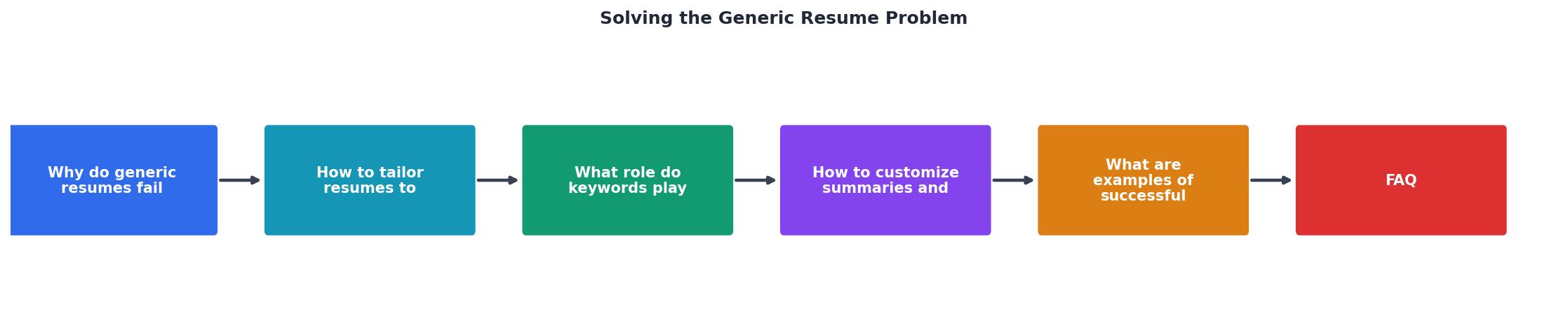
The dashboard above shows the five-step tailoring flow in order. Each step builds on the previous one, and together they transform a generic resume into a targeted, compelling document that speaks directly to the employer's needs.
Practical Artifact: Resume Tailoring Checklist
Use this checklist before submitting each application. Print it, bookmark it, or screenshot it. Don't send a resume without checking these boxes.
Resume Tailoring Before Submission
Your progress is saved automatically in your browser.
FAQ
Frequently Asked Questions
The difference between sending generic resumes and tailored ones is the difference between hoping someone notices you and making sure they do. Every detail matters in a crowded job market. Your experience is real; your tailored resume is just making sure the right people see it.
Additional Resources
- How To Include Problem-Solving Skills on Your Resume - Learn what problem-solving skills are, why employers value them, and how to list these skills on your resume.
- Is Your Resume the Problem? | Erin Lewber posted on the ... - Hint 1: It isn't your resume. Step away from the resume. Hint 2: It probably has to do with your interview prep/presentation. Check Your ...
- Resume Resources - University Career Center - Copy/paste a job description and ask “Summarize the most important keywords and skills from this job description”; “I am about to apply for a job as an account ...
Can't find a job? We'll check your resume for free
Upload or paste your resume on our home page. Get a quality score and clear fixes in minutes. No signup required to start.
Check my resume free Free AI score · No signup to start