Supporting a Thin Resume with a Strong Cover Letter
A thin resume doesn't mean you lack potential. It means you haven't had the time or opportunities yet to fill it with years of professional experience. The gap between what's on your resume and what an employer needs to see is where a strong cover letter becomes your secret weapon. Your cover letter is your chance to tell the story your resume can't fit on one page, to show enthusiasm that no bullet point can capture, and to connect your limited experience directly to what the company actually n

A thin resume doesn't mean you lack potential. It means you haven't had the time or opportunities yet to fill it with years of professional experience. The gap between what's on your resume and what an employer needs to see is where a strong cover letter becomes your secret weapon. Your cover letter is your chance to tell the story your resume can't fit on one page, to show enthusiasm that no bullet point can capture, and to connect your limited experience directly to what the company actually needs.
- Highlight personal projects, coursework, and volunteer work to add substance beyond formal employment
- Show genuine enthusiasm and willingness to learn to offset limited direct experience
- Research the company deeply and align your narrative with their values and culture
- Use your cover letter to address gaps and reframe what might look like a liability
- Frame each experience, no matter how small, as proof you can do the job
Why a resume might be considered thin
A thin resume typically means limited professional work history. You might be a recent graduate with one internship under your belt, someone making a career change without direct experience in the target field, or someone returning to work after time away. A thin resume isn't a character flaw; it's a timing issue. The real problem is that recruiters spend six seconds scanning a resume, and if they don't see immediate relevance, they move on.
The gap between your resume and the job requirements creates anxiety. You're competing against people with three, five, or ten years in the field. But here's what works in your favor: employers know not everyone can have ten years of experience. What they actually screen for early on is whether you're coachable, capable of learning, and genuinely interested in the work. A cover letter lets you prove all three.
Highlighting personal projects and coursework
Personal projects and coursework are legitimate experience. They're not filler; they're proof of initiative and competence. The key is presenting them in a way that shows professional relevance, not just academic obligation.

When you mention a personal project in your cover letter, be specific about what problem you solved and why it matters. Don't just say you "built a website." Say: "I built a real-time expense tracker using React and Firebase for my roommates because I wanted to eliminate the monthly money conflicts. It now handles over 200 monthly transactions." That second version shows you identified a problem, chose appropriate technology, and delivered a working solution.
Coursework becomes relevant when you connect it to the job. If you took a data structures course and the job requires algorithmic thinking, mention it. Better yet, mention a specific project: "In my Systems Design course, I architected a distributed cache system that improved query performance by 40% compared to a naive approach." This proves you understand concepts that matter in the actual role.
Graduate projects, capstones, and thesis work are gold. These are sustained efforts that required planning, iteration, and problem-solving. Frame them not as academic exercises but as real work. "My capstone project involved designing and implementing a mobile app for local nonprofits to track volunteer hours. I partnered with three real organizations, deployed the app, and it's now used by over fifty volunteers monthly."
Emphasizing enthusiasm and willingness to learn
Thin-resume candidates often worry they'll be seen as unprepared or incapable. The counter-narrative is to position yourself as hungry and eager to grow. This requires a different tone in your cover letter than someone with ten years of experience would use.
Enthusiasm in a cover letter must be genuine and specific. Don't write, "I'm excited about this opportunity." Employers hear that a hundred times a day. Instead, write: "I've been following your product updates for six months, and when I saw you launched the API for third-party integrations last quarter, I spent a weekend building a Slack plugin to test it. It's not production-ready, but I learned how your architecture works and I'm impressed by the design decisions. I want to be part of a team that ships thoughtfully like that."
That's enthusiasm because it's backed by action. You didn't just say you were interested; you proved it.
Willingness to learn is equally effective. Frame yourself as someone who asks good questions, seeks feedback, and iterates. In your cover letter, you might write: "I don't have three years of experience in customer success, but I have a track record of quickly mastering complex tools. During my internship, I picked up our entire CRM stack in two weeks and became the go-to person for troubleshooting by month two. I'm the person who reads the documentation, asks targeted questions, and then helps others understand it."
This addresses the concern head-on. You're saying: yes, I'm junior, but I learn fast and I'll be an asset to the team, not a burden.
Aligning with company values
Research the company to help you determine your approach. This isn't generic research. You're looking for signals about what they actually care about, not just what their marketing says.

Start with their careers page, blog, and recent news. Read the job description with an eye toward what problem they're solving. If they mention "we value builders who move fast," that's a signal. If they say "we're committed to accessibility," that's a value. If their recent blog posts focus on remote-first culture, that tells you something.
Then find where you align. This isn't making things up. If you genuinely care about accessible design, mention a project where you thought about accessibility. If the company values transparency and community, mention your experience in open-source or volunteer work. If they're obsessed with speed and iteration, talk about how you shipped a project quickly and incorporated feedback.
"Research the company to help you determine your approach.">, How to write an effective cover letter (with samples)
A cover letter aligned with company values reads differently than a generic one. Instead of "I'm interested in working at Acme Inc.," you write: "Acme's approach to shipping small, validated features resonates with me. In my capstone project, I iterated weekly with real users and cut our initial feature set in half because we learned most of it wasn't needed. That discipline, shipping less to learn more, is how I want to work."
Key takeaway: A thin resume paired with a cover letter that demonstrates genuine enthusiasm, specific examples of self-directed learning, and clear alignment with company values can compete effectively against more experienced candidates who submit generic applications.
Leveraging volunteer experiences
Volunteer work carries weight in a cover letter because it shows you choose to do things that don't directly pay you. That's a effective signal about your values and motivation.
If you've volunteered, don't bury it. Put it front and center in your cover letter with the same specificity you'd use for paid work. Don't write, "I volunteered at a local nonprofit." Write: "For the past eight months, I've volunteered as a data analyst for a local food bank. I built a spreadsheet system that tracks donation sources, inventory, and distribution patterns. This project led to a 12% reduction in food waste and helped them identify gaps in their supply chain. I did this entirely through learning on my own, Excel functions, basic data visualization, and eventually Python scripts, because the organization couldn't afford to hire someone for this work."
That's not just volunteering; that's demonstrating initiative, problem-solving, and the ability to learn independently. An employer reading that knows you'll find solutions when faced with ambiguity.
Community involvement counts too. If you've organized events, mentored people, contributed to open-source projects, or participated actively in professional groups, these belong in your cover letter. They show you're already part of communities and ecosystems, not just passively looking for a paycheck.
Examples of strong cover letters for thin resumes
Here's the structure that works: open with a specific observation about the company or role, connect one or two of your experiences directly to their needs, acknowledge what you don't have while showing what you do bring, and close by making clear what you'll do next.
Example 1 (Recent Graduate, Product Role):
"When I saw DataViz Inc. was hiring a product analyst, I immediately remembered your 2024 product launch blog post about how you integrated user feedback into your redesign. That's exactly how I approached my capstone project, I shipped an MVP, gathered feedback from fifty beta users, and cut our second iteration scope in half because users told us what actually mattered. I've never worked in product at a company before, but I've worked in a user-centered way, and I'm ready to learn your tools and processes. I've already spent two hours working through your API documentation and I'm excited to dig deeper."
Example 2 (Career Changer, Marketing Role):
"I'm switching into marketing from education, and I know that looks like a leap. But I've spent five years understanding how people learn and what messaging actually changes behavior, that's marketing. To prove I'm serious about this transition, I spent the last three months learning your industry. I've completed HubSpot's certification, I've built a small content site that's ranking for three keywords, and I understand your product's buyer journey better than someone who's just skimmed your website. I don't have marketing experience on my resume, but I've built the foundation and I'm ready to bring my unique lens as a career-changer."
Example 3 (Early Career, Engineering Role):
"I'm relatively early in my engineering career, one year as an intern, one year contracting, but I've already solved problems that senior engineers on my team said I'd eventually learn. The codebase was slow, so I profiled it, identified bottlenecks, and shipped optimizations that cut response time by 30%. No one asked me to do that; I just wanted to understand how systems actually work. For this role at TechCorp, I've read three of your engineering blog posts and I see you value deep technical understanding and ownership. That's exactly who I am, and I want to grow as an engineer surrounded by people who think that way."
The difference between a generic cover letter and one tailored to your specific experience and the company's values is enormous. These examples show how to take limited experience and frame it as relevant, valuable, and worth investing in.
The process in action
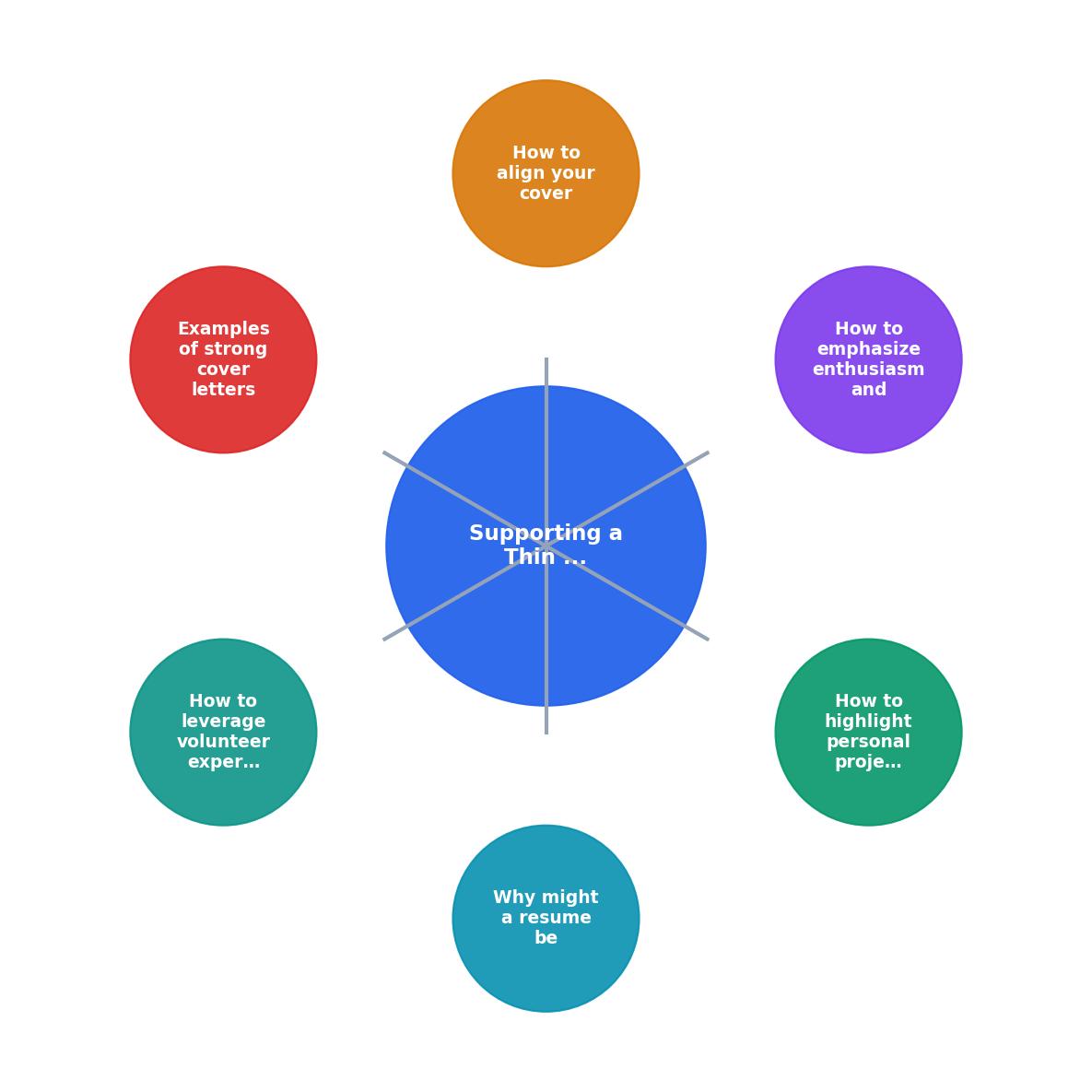
The workflow is straightforward: read the job description and identify what they actually need, research the company to understand their culture and values, audit your experiences to find genuine connections, write a cover letter that bridges the gap between what's on your resume and what they're looking for, and use specific examples rather than generalizations.
Each step matters. If you skip the research phase, your cover letter will feel generic. If you don't identify specific connections between your experience and their needs, you'll sound like you're applying to every company. If you don't back up your claims with concrete examples, they'll doubt whether you actually have the skills you're claiming.
Crafting a Strong Cover Letter for Your Thin Resume
Your progress is saved automatically in your browser.
FAQ
Frequently Asked Questions
Additional Resources
- How to write an effective cover letter (with samples) - An effective cover letter is directed towards a specific position or company, and describes examples from your experience that highlight your skills related to ...
- Cover Letter Resources - University Career Center - Keep it short and sweet, do not exceed one page. Be persuasive and show enthusiasm. Emphasize both your hard and soft Internship Coordinator, Human Resources ...
- How to Write a Cover Letter (With Examples and Tips) - Format your cover letter like a business letter and include relevant achievements and skills that show the value you bring to the organization.
Can't find a job? We'll check your resume for free
Upload or paste your resume on our home page. Get a quality score and clear fixes in minutes. No signup required to start.
Check my resume free Free AI score · No signup to start