Tailoring a Resume for Remote Software Development Jobs
You have sent dozens of applications for remote developer roles and heard nothing back. The problem is rarely your coding ability. Most remote software development job postings attract hundreds of applicants, and a generic resume gets filtered out before a human ever reads it. The fix is straightforward: rebuild your resume around the specific signals that remote hiring managers and their ATS systems are scanning for.

You have sent dozens of applications for remote developer roles and heard nothing back. The problem is rarely your coding ability. Most remote software development job postings attract hundreds of applicants, and a generic resume gets filtered out before a human ever reads it. The fix is straightforward: rebuild your resume around the specific signals that remote hiring managers and their ATS systems are scanning for.
Photo by Vitaly Gariev from Pexels
TL;DR:- Highlight remote-specific skills like async communication, self-directed time management, and distributed collaboration tools directly on your resume.
- Mirror exact keywords from each job posting to pass ATS filters.
- Quantify remote work outcomes (sprint velocity, uptime, response times) instead of listing responsibilities.
- Structure your resume with a remote-focused summary, a dedicated tools section, and achievement-driven bullet points.
Why remote dev roles need a different resume
A remote software development position is not just an office job done from home. The hiring manager evaluates a completely different skill set alongside your technical chops. They want proof you can ship code without someone looking over your shoulder, communicate clearly across time zones, and stay productive without the structure of an office.
That statistic means three out of four resumes never reach a recruiter. For remote roles, the filtering is even more aggressive because companies add remote-specific keywords to their screening criteria. If your resume does not contain those terms, it disappears.
The core difference comes down to trust. An on-site employer can observe your work habits. A remote employer has to trust your resume, your references, and the signals you put on paper. Your resume needs to build that trust explicitly.
Key skills for remote dev roles

Remote software development demands a blend of technical and operational skills that on-site roles often take for granted. Here are the categories that matter most:
- Asynchronous communication - Writing clear Slack messages, pull request descriptions, and technical documentation that teammates in different time zones can act on without a follow-up call.
- Distributed version control workflows - Experience with Git branching strategies (GitFlow, trunk-based development) and code review processes on GitHub, GitLab, or Bitbucket.
- Self-directed time management - Using tools like Toggl, Clockify, or simple Pomodoro techniques to stay productive without external accountability.
- Remote collaboration platforms - Daily use of Jira, Linear, Notion, Confluence, Slack, and Zoom for standups, sprint planning, and retrospectives.
- CI/CD pipeline management - Setting up and maintaining automated build, test, and deployment pipelines with GitHub Actions, CircleCI, or Jenkins.
- Independent debugging and problem-solving - Resolving blockers without tapping a colleague on the shoulder. This means strong Google-fu, reading source code, and knowing when to escalate.
Highlight remote work experience

The biggest mistake on remote-targeted resumes is burying remote experience inside generic job descriptions. Call it out explicitly. Here is how to restructure your experience section:
Add "(Remote)" after each relevant job title. This is the simplest change with the highest impact. "Senior Backend Developer (Remote) | Acme Corp | 2023-2025" immediately tells the ATS and the recruiter that you have done this before.
Quantify outcomes, not tasks. Compare these two bullet points:
Participated in daily standups and code reviews.- Delivered 12 features across 6 two-week sprints in a fully distributed team spanning 4 time zones, maintaining a 94% on-time delivery rate.
"After: Successfully handled 50+ daily customer inquiries through phone and email while working in a fully remote, fast-paced environment, maintaining a 95% customer satisfaction rating.">, How to Tailor Your Resume for Remote Jobs
Show communication artifacts. Mention that you wrote technical RFCs, maintained a team wiki in Confluence, or authored onboarding documentation for new remote hires. These are concrete proof of async communication skills.
Keywords that pass ATS filters
Every remote software development job posting contains a specific vocabulary. Your resume needs to reflect it. Here is a practical process:
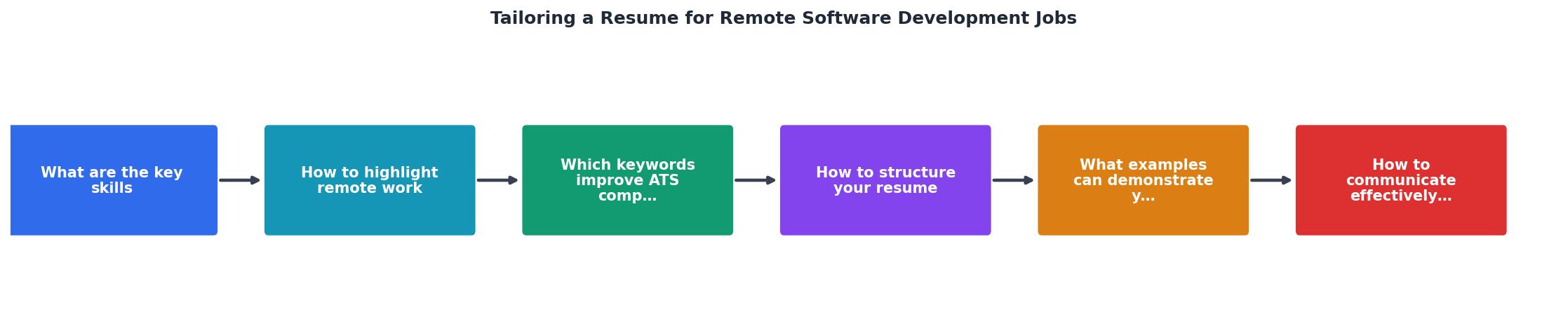
Follow these steps for each application:
- Copy the job posting into a plain text editor.
- Highlight repeated terms - words that appear two or more times are almost certainly ATS keywords.
- Categorize them into technical skills (Python, React, AWS), soft skills (self-starter, collaborative), and tools (Jira, Slack, Docker).
- Map each keyword to a bullet point on your resume where you can demonstrate that skill with a real example.
- Insert missing keywords naturally into your summary or skills section if you genuinely have the experience.
remote, distributed team, async, self-motivated, cross-functional, agile, scrum, CI/CD, code review, pair programming, documentation, and specific language/framework names from the posting.
A tool like Resume Hedgehog can automate this keyword matching. Upload your resume, paste the job description, and it identifies gaps between your resume and the posting's requirements in seconds.
Structure your resume for impact

Layout matters more than most developers think. Here is a structure that works for remote software development applications:
1. Remote-focused professional summary (3-4 lines)
Open with years of experience, primary tech stack, and explicit remote experience. Example: "Full-stack developer with 6 years of experience building SaaS products in fully remote, distributed teams. Proficient in TypeScript, React, Node.js, and AWS. Track record of shipping features independently while maintaining clear async communication across time zones."
2. Technical skills section (grouped)
Organize into rows: Languages, Frameworks, Cloud/DevOps, Collaboration Tools, Methodologies. This makes ATS parsing reliable and gives recruiters a quick scan.
3. Experience section with "(Remote)" labels
Each role gets the remote tag, company name, dates, and 3-5 quantified bullet points. Lead each bullet with an action verb: Architected, Deployed, Reduced, Automated, Mentored.
4. Projects or open source contributions
Remote employers love seeing GitHub profiles and open source work. It proves you can collaborate asynchronously with strangers across the globe. Link to 1-2 relevant repositories.
5. Education and certifications
Keep this brief. AWS certifications, Kubernetes certifications, or relevant CS degrees go here.
| Generic Resume | Remote-Tailored Resume |
|---|---|
| No remote mention in title | "(Remote)" after every remote role |
| Lists responsibilities | Quantifies outcomes with numbers |
| Generic skills list | Tools grouped by category |
| No collaboration evidence | Mentions async docs, RFCs, wikis |
| Same resume for every job | Keywords matched to each posting |
Prove you work independently
Remote hiring managers have one fear: hiring someone who disappears after onboarding. Your resume needs to counter that fear with evidence.
Side projects and open source contributions show initiative without supervision. If you maintain a package on npm with 500+ weekly downloads, that is stronger proof of self-motivation than any adjective.
Freelance or contract work demonstrates you managed your own schedule, communicated with clients directly, and delivered without a manager checking in daily.
Certifications completed independently (AWS Solutions Architect, Google Cloud Professional, Hashicorp Terraform Associate) prove you can learn complex material on your own.
Metrics from previous remote roles close the deal. "Reduced API response time by 40% through independent performance audit" tells the story without you having to claim you are a self-starter.
Here is an example dashboard showing how a well-tailored remote resume compares to a generic one across key hiring signals:
Resume Effectiveness: Generic vs. Remote-Tailored
Communicate effectively on paper
Virtual communication skills are not something you list in a skills section and move on. You demonstrate them through the resume itself.
- Write concise bullet points. If your resume is wordy and unclear, the recruiter assumes your Slack messages will be too.
- Use structured formatting. Clean headings, consistent date formats, and logical grouping signal that you can write organized documentation.
- Include links. A link to your GitHub, a technical blog, or a portfolio site shows you communicate publicly and asynchronously.
- Mention specific communication practices. "Led weekly async standups via Loom video updates for a 12-person distributed team" is concrete evidence.
Remote Dev Resume Tailoring Checklist
Your progress is saved automatically in your browser.
FAQ
Frequently Asked Questions
Additional Resources
- How to Tailor Your Resume for Remote Jobs - 1. List your past remote experience · 2. Include remote-related keywords · 3. Describe how you succeeded in a remote setting · 4. Showcase ...
- How to Tailor Your Resume for Software Engineer Jobs ... - The general tailoring system applies here: you build a small number of archetype resumes, then spend about ten minutes per application.
- Tailor Your Resume to Any Job With AI - Tailor your resume to any job in seconds. Just paste the job ad, and our AI will rewrite your CV using your real information to match the job description.

Get the 356 complete recruitment audit (free PDF)
Download the free PDF with 356 reasons hiring stalls, plus optional daily email tips. No credit card.
Get the free PDF 356 reasons · Free download