

You've spent years in the classroom, but your real passion is designing learning experiences, not just delivering them. The problem: your resume still reads like a teacher's resume, and hiring managers for instructional design roles can't see past the classroom to the skills you actually have. A targeted resume reframe gets you noticed by the right recruiters and past the ATS screening that filters out education backgrounds applying to corporate training roles.
TL;DR:- Reframe classroom experience as instructional design work (curriculum development, assessment design, learner analysis).
- Use instructional design terminology: ADDIE, learning objectives, learner personas, content modules, assessment strategies.
- Highlight tech skills (LMS platforms, authoring tools, video production) that transfer directly to corporate training roles.
- Include measurable outcomes: completion rates, engagement metrics, performance improvements, not just "taught 120 students."
This template shows you how to translate your teaching experience into instructional design language, reorganize your resume for corporate training roles, and include the specific skills and metrics that matter in this field.
Why This Transition Matters Now
Corporate training and learning & development (L&D) teams are expanding faster than ever. Companies need people who understand how adults learn, can design online courses, and can bridge the gap between subject matter experts and learners. Teachers bring exactly this expertise, but only if your resume shows it.

The shift from education to corporate is not a lateral move; it's a repackaging of the same core competencies. A teacher who designs a unit on photosynthesis has done the same work as an ID designing a module on product compliance, breaking down complex information, sequencing it for learner readiness, building assessments that check understanding, and iterating based on data. The language changes, but the work is the same.
"Most schools could benefit from tools that best support one type of lesson or learner.">, Instructional Design Resume; 8 Tips To Stand
This is exactly why corporate L&D roles exist. Companies need to support different learning styles, different skill levels, and different delivery formats. Your classroom experience shows you've done this, you just need to say so in the right vocabulary.
Common Mistakes Teachers Make on ID Resumes
Before you reframe, know what kills your candidacy.
Mistake 1: Keeping the teacher title and job description.
If your job title is "High School English Teacher" and your bullet points are about grading and attendance, you've already signaled to the ATS and the recruiter that you're applying from education, not from relevant experience. Reframe or rename the role so the resume leads with the work, not the institution.
Mistake 2: Using education-specific metrics.
"Taught 120 students per year" means nothing to an instructional designer. "Designed and delivered 8 course modules reaching 120 learners, achieving 87% assessment pass rate on first attempt" means you understand design, delivery, and outcomes.
Mistake 3: Forgetting to list tech skills.
If you've used Google Classroom, Schoology, Zoom, Canva, or iMovie, that's tech. If you've edited videos, coded a simple quiz in Quizizz, or built a shared folder structure, that counts. Instructional designers use LMS platforms, authoring tools, and media creation software. Show what you've used, even if it's educational software.
Mistake 4: Not highlighting design and analysis work.
Teachers do design work every day, curriculum mapping, learning objective setting, assessment building, differentiation. Most teacher resumes bury this under generic "planning" language. Pull it forward.
Mistake 5: Ignoring data and outcomes.
Corporate training lives and dies by metrics: completion rates, pass rates, time-to-competency, engagement scores. School teachers don't always talk this way, but your data exists. Reframe student achievement data as learning outcomes data.
Step-by-Step Resume Reframing
Step 1: Retitle Your Role
Don't call yourself a "High School Teacher" or "Elementary Teacher." Use a functional title that highlights design and development work.
Old:
High School English Teacher
New:
Instructional Designer & Learning Experience Developer
K–12 Education | Curriculum Development | Learning Assessment
Why it works: The new title uses ID terminology, immediately signals your core function, and uses keywords that LMS systems and recruiters scan for. The subtitle qualifies your domain without pigeonholing you as education-only.
Step 2: Audit and Translate Your Experience
List every meaningful thing you've done in your teaching role, then translate it into ID language.

| Teaching Work | Instructional Design Translation |
|---|---|
| Created unit plans | Designed multi-module curriculum; mapped learning objectives to assessments |
| Adapted lessons for different learners | Conducted learner analysis; created differentiated learning paths; developed content for multiple proficiency levels |
| Built rubrics and tests | Designed formative and summative assessments; established pass/fail criteria; analyzed results to iterate content |
| Recorded video lessons | Produced and edited instructional video content; optimized for online delivery and learner engagement |
| Used Google Classroom or similar | Managed learning management system; administered courses; tracked learner progress and completion rates |
| Gave feedback to students | Provided formative feedback; analyzed performance data; recommended interventions based on assessment results |
| Collaborated with colleagues | Worked cross-functionally with subject matter experts; gathered feedback to refine course design |
Step 3: Build Your Bullet Points with Metrics
This is where career changers often fail. Your bullets should show:- What you designed (the scope/scale of the learning experience)
- How you designed it (your process/methodology)
- What happened (the outcome/result)
Taught AP US History to 120 students annually
Strong bullet:
Designed and delivered 12-unit AP US History curriculum aligned to College Board standards; sequenced content and assessments to scaffold historical thinking skills; achieved 78% 5-score pass rate (vs. 60% national average)
Another strong example:
Conducted learner analysis across 3 grade levels to identify reading comprehension gaps; developed 6-module remedial curriculum using differentiated content; tracking showed 34% improvement in mid-level reader passage comprehension within 8 weeks
Tech-forward example:
Built interactive Schoology course shell for blended learning model; created 40+ instructional videos (5–12 min each); designed 15 auto-graded quizzes using learning objective mapping; managed 300+ learners across 4 sections; achieved 91% course completion rate and 87% average on summative assessment
Skills Section: The ID Toolkit
Create a Skills section that shows you speak the language and have the tools.
Core Instructional Design Skills
- Learning objectives development
- Curriculum design and mapping
- Learner analysis and persona creation
- Assessment design (formative and summative)
- Instructional sequencing and scaffolding
- Differentiation and accessibility
- Learning outcomes measurement
Platforms and Tools
- LMS: Google Classroom, Schoology, Canvas, Blackboard (list what you actually used)
- Authoring: Articulate Storyline, Adobe Captivate, or web-based tools (if applicable)
- Video production: Adobe Premiere, iMovie, CapCut, Camtasia
- Design: Canva, Figma (if you've used it), Microsoft Office
- Data/analytics: Google Sheets, Excel, learning analytics dashboards
- Collaboration: Asana, Monday.com, Notion (if you've project-managed course builds)
Soft Skills (ID-flavored)
- Stakeholder communication
- Cross-functional collaboration
- Feedback integration and iteration
- Problem-solving through design
- Change management (e.g., rolling out new curricula)
- Critical thinking and analysis
Education Section: Highlight Relevant Credentials
If you have teaching credentials, certifications, or degrees, frame them for ID roles.
Standard:
Bachelor of Arts in Education, State University, 2015
State Teaching License (Social Studies, 6–12)
ID-framed:
Bachelor of Arts in Education (Curriculum Development focus), State University, 2015
IDOL (Instructional Design Online Learning) Certification, 2024
State Teaching License (Social Studies, 6–12)
Notice the addition of relevant coursework or certs. If you haven't taken an ID course yet, consider a quick online credential (many cost under $500 and take 4–12 weeks). This is your hedge while you're transitioning.
Experience Section: Structure for Scannability
Use a tight structure that leads with achievement, not tasks.

Job Title | Organization | Dates
Context line (1–2 sentences showing scope): What you owned, what the environment was, what the constraint was.
Then 4–6 bullet points covering:- 1 design/strategy bullet (what you planned)
- 2–3 execution/delivery bullets (what you built and delivered)
- 1–2 outcomes/metrics bullets (what changed because of your work)
- Optional: 1 tool/tech bullet if it's a standout
Instructional Designer & Curriculum Developer | Central High School | Aug 2018–Present
Designed and delivered K–12 English Language Arts curriculum for 600+ learners across 4 grade levels. Owned end-to-end course development, from learner analysis through summative assessment design. Implemented blended learning model combining in-person and asynchronous modules.
- Designed 18 unit curricula aligned to Common Core standards; mapped learning objectives to formative and summative assessments; created rubrics with specific proficiency levels
- Conducted learner persona research across demographic groups (ESL, gifted, remedial); developed 3 differentiated learning paths for each unit; tracked completion and pass rates by path
- Produced 35 instructional videos (total 8 hours) for async delivery; edited in Adobe Premiere; optimized for YouTube and LMS embedding; achieved 89% average view completion rate
- Mentored 4 new teachers on instructional design best practices; conducted 12 professional development sessions on assessment design and rubric development
- Managed Schoology LMS for 600+ learners; maintained course shells; configured 40+ auto-graded assessments; analyzed learning analytics to identify at-risk learners; designed intervention modules resulting in 12% improvement in pass rates YoY
Custom Visual: Interactive Resume Audit Card
Before you finalize your resume, use this interactive checklist to confirm your resume speaks the ID language and includes the data that matters.
Resume Audit Checklist
Key Resume Sections at a Glance
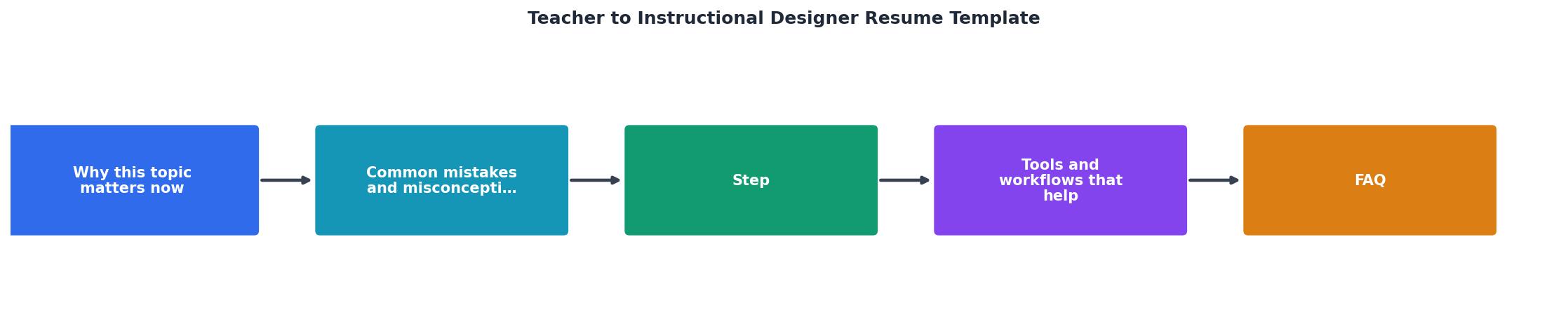
This process diagram shows the core anatomy of your reframed ID resume.
Building Your Action Plan
Now that you understand the reframe, here's the specific workflow to rebuild your resume.
Teacher to Instructional Designer Resume Rebuild
Your progress is saved automatically in your browser.
Overcoming the "Lack of Direct Experience" Objection
You'll hear this: "You don't have corporate training experience." Here's how to answer it in your resume and cover letter.
Your classroom is your training lab. You've:- Analyzed learner needs and designed interventions (learning analysis)
- Built assessments aligned to objectives (instructional design)
- Iterated content based on performance data (continuous improvement)
- Collaborated with stakeholders (SMEs, parents, admin)
- Managed timelines and budgets (school budgets, curriculum rollouts)
In your cover letter, frame it this way: "My 7 years designing curriculum and managing learner outcomes in K–12 have taught me the core discipline of instructional design: analyzing learner need, designing targeted interventions, and measuring impact. I'm excited to apply this methodology to corporate training environments where the learner population and content domain are different, but the design process is the same."
That statement shows confidence and self-awareness, exactly what hiring managers want from career changers.
Frequently Asked Questions
Next Steps
Your reframed resume is your ticket into the interview. But the resume alone won't get you hired, it gets you the conversation. Once you have it, practice talking about your transition story. Hiring managers will ask why you left teaching and why instructional design. Have a 60-second answer ready: what drew you to ID, what specific moment made you realize the move, and why you're confident you'll succeed in a corporate environment.
Then tailor your resume to each job posting using tools like Resume Hedgehog to spot the keywords that matter. Corporate training roles care about specific platforms, methodologies, and outcomes, make sure your resume reflects what the job is actually asking for.
The teachers who successfully transition to instructional design aren't the ones with the most perfect resumes, they're the ones who clearly translate their experience, show measurable outcomes, and speak the language of the new field. Your reframe is the beginning of that translation.
Additional Resources
- Instructional Design Resume; 8 Tips To Stand-Out - Learn what you can do to begin building your Instructional Design resume and set you up for success with your career transtion from teaching.
- Instructional Designer Resume: Examples, Keywords, and ... - Below you'll find a fillable template, a keyword table organized by category, before and after bullet examples (including teacher-to-ID ...
- Adapting Resumes from Teaching to Instructional Design - Principles and examples for adapting resumes from teaching to instructional design so hiring managers clearly see the relevant skills.
Can't find a job? We'll check your resume for free
Upload or paste your resume on our home page. Get a quality score and clear fixes in minutes. No signup required to start.
Check my resume free Free AI score · No signup to start